ART WIKI32.963 en sala
MapaColecciónArtistasMuseosExposicionesRevista
Acceder

ART WIKI

Dónde cuelga la obra maestra y cuándo le dejan pasar.

Colecciones: Galería Nacional de Arte, Galería Nacional de Dinamarca, Galería Nacional de Retratos, Galería Tretiakov, Harvard Art Museums, Instituto de Arte de Chicago, Instituto de Artes de Mineápolis, MoMA, Museo de Arte de Cleveland, Museo de Victoria y Alberto, Museo del Hermitage, Museo del Louvre, Museo Estatal Ruso, Museo Hirshhorn y Jardín de Esculturas, Museo J. Paul Getty, Museo Metropolitano de Arte, Museo Pushkin, Museo Smithsoniano de Arte Americano, Museo Whitney de Arte Estadounidense, National Museum of Asian Art, Rijksmuseum, Villa Getty, Catálogo Estatal del Fondo Museístico de Rusia (274 museos), Europeana (19 museos), Wikidata (6 museos), Paris Musées (12 museos) y Joconde, la base de museos del Ministerio de Cultura de Francia (495 museos). Las imágenes pertenecen a sus titulares de derechos.

Secciones

  • Mapa
  • Búsqueda
  • Colección
  • Obras maestras
  • Expuestas ahora
  • Artistas

Más

  • Museos y galerías
  • Exposiciones
  • Revista
  • De dónde salen los datos
  • Privacidad y cookies
InicioMapaCatálogo
  1. Colección/
  2. Harvard Art Museums/
  3. Squirrels and Grapevine
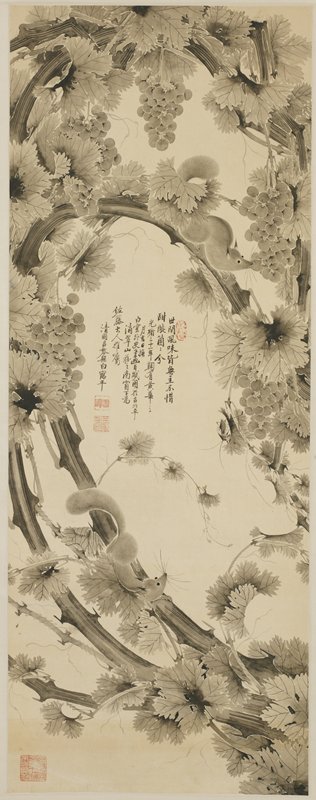
Squirrels and Grapevine, Bai Haonian, dated to 1906
BBai HaonianChina

Squirrels and Grapevine

dated to 1906 · Painting

Sobre el cuadro

Painted in ink on paper, this hanging scroll represents an upside-down, U-shaped, old grapevine with two squirrels sporting amongst the fruiting branches. The grapevine comprises four intertwined, leafy stalks that enter the composition in the lower left corner, diagonally traverse the composition, rise along the right edge, make a U-turn at the top, and then extend down the left edge. Numerous bunches of ripe grapes hang from the vines. In the upper left corner of the painting one squirrel nibbles on a grape, while another squirrel in the lower right corner looks up toward the first. Neatly framed all around by the grapevine, the artist's inscription and signature appear at the very center of the composition.

Harvard Art Museums

Ficha

Número de inventario
2009.83

Más obras de Bai Haonian

Todas las obras

En la misma sala · Gallery 2600, floor 2, East Asian Art, Harvard Art Museums

Página del museo

¿Se puede contemplar?

Sí, recibe visitas

Harvard Art Museums

Cambridge, Estados Unidos

Sala2600, floor 2, East Asian Art

Expuesta al público. Quién lo avala figura más abajo.

Comprobado
hace 3 días
En este estado desde
27 sept 2026
Fuente
El museo
En el mapaPágina del museo

En el catálogo

PinturaTintaPintura chinaModernismoSiglo XXChina

Fuentes

  • Harvard Art Museums
  • Imagen: Harvard Art Museums — © President and Fellows of Harvard College
Squirrels and Grapevine, Bai Haonian, 1905

Squirrels and Grapevine

1905 · No expuesta · Instituto de Artes de Mineápolis

Paper God: Kitchen God and Two Wives, with Two Officers and "Three Stars" (Gods of Happiness, Emoluments, and Longevity), at an Altar Table, and with a Calendar for the Year Minguo 21 (1932), 1932

Paper God: Kitchen God and Two Wives, with Two Officers and "Three Stars" (Gods of Happiness, Emoluments, and Longevity), at an Altar Table, and with a Calendar for the Year Minguo 21 (1932), 1932

This Morning's Autumn (left), Watanabe Kōkan 渡辺公観, 1918 (Taishō 7)

Watanabe Kōkan 渡辺公観

This Morning's Autumn (left), 1918 (Taishō 7)

This Morning's Autumn (right), Watanabe Kōkan 渡辺公観, 1918 (Taishō 7)

Watanabe Kōkan 渡辺公観

This Morning's Autumn (right), 1918 (Taishō 7)

Momoyogusa (Flowers of a Hundred Worlds), vol. 1, Kamisaka Sekka 神坂雪佳, 1909 (vol. 1) - 1910 (vols. 2 and 3)

Kamisaka Sekka

Momoyogusa (Flowers of a Hundred Worlds), vol. 1, 1909 (vol. 1) - 1910 (vols. 2 and 3)

Momoyogusa (Flowers of a Hundred Worlds), vol. 3, Kamisaka Sekka 神坂雪佳, 1909 (vol. 1) - 1910 (vols. 2 and 3)

Kamisaka Sekka

Momoyogusa (Flowers of a Hundred Worlds), vol. 3, 1909 (vol. 1) - 1910 (vols. 2 and 3)

Momoyogusa (Flowers of a Hundred Worlds), vol. 2, Kamisaka Sekka 神坂雪佳, 1909 (vol. 1) - 1910 (vols. 2 and 3)

Kamisaka Sekka

Momoyogusa (Flowers of a Hundred Worlds), vol. 2, 1909 (vol. 1) - 1910 (vols. 2 and 3)

Autumn Sunset Along the River, Fang Shishu 方士庶, dated to 1727

Fang Shishu

Autumn Sunset Along the River, dated to 1727

Seasonal Genre Scenes (Fūzoku zukan): Summer Scenes Along the Sumida River, Attributed to Hishikawa Moronobu 菱川師宣, Edo period, circa 1684-1688 (Jōkyō era)

Attributed to Hishikawa Moronobu 菱川師宣

Seasonal Genre Scenes (Fūzoku zukan): Summer Scenes Along the Sumida River, Edo period, circa 1684-1688 (Jōkyō era)