ART WIKI32.963 en sala
MapaColecciónArtistasMuseosExposicionesRevista
Acceder

ART WIKI

Dónde cuelga la obra maestra y cuándo le dejan pasar.

Colecciones: Galería Nacional de Arte, Galería Nacional de Dinamarca, Galería Nacional de Retratos, Galería Tretiakov, Harvard Art Museums, Instituto de Arte de Chicago, Instituto de Artes de Mineápolis, MoMA, Museo de Arte de Cleveland, Museo de Victoria y Alberto, Museo del Hermitage, Museo del Louvre, Museo Estatal Ruso, Museo Hirshhorn y Jardín de Esculturas, Museo J. Paul Getty, Museo Metropolitano de Arte, Museo Pushkin, Museo Smithsoniano de Arte Americano, Museo Whitney de Arte Estadounidense, National Museum of Asian Art, Rijksmuseum, Villa Getty, Catálogo Estatal del Fondo Museístico de Rusia (274 museos), Europeana (19 museos), Wikidata (6 museos), Paris Musées (12 museos) y Joconde, la base de museos del Ministerio de Cultura de Francia (495 museos). Las imágenes pertenecen a sus titulares de derechos.

Secciones

  • Mapa
  • Búsqueda
  • Colección
  • Obras maestras
  • Expuestas ahora
  • Artistas

Más

  • Museos y galerías
  • Exposiciones
  • Revista
  • De dónde salen los datos
  • Privacidad y cookies
InicioMapaCatálogo
  1. Colección/
  2. Rijksmuseum/
  3. Schizonema comoides
Schizonema comoides, Anna Atkins, c. 1843 - c. 1853
Anna Atkins, retratoAnna AtkinsReino Unido, 1799–1871

Schizonema comoides

c. 1843 - c. 1853 · page

¿Se puede contemplar?

Se desconoce: el museo guarda silencio

Rijksmuseum

Amsterdam, Países Bajos

Se sabe quién es el propietario. Si hoy está expuesta, el museo no lo dice, y a adivinar no nos enseñaron.

Fuente
Los datos de colección del propio museo
En el mapaPágina del museo

Ficha

c. 1843 - c. 1853
17991871
Número de inventario
RP-F-2016-133-276

Lo que muestra

Algae, seaweed

En el catálogo

FotografíaRomanticismoRealismoSiglo XIX

Fuentes

  • Rijksmuseum: los datos abiertos del museo · obtenido hace 8 días
  • Imagen: Rijksmuseum — public domain

Mientras tanto, en la vida de Anna Atkins

La vida entera
  1. by 1841

    A camera and lessons from Fox Talbot

    Anna's father and husband were friends of William Henry Fox Talbot, and she learned about “photogenic drawing” and the calotype from Talbot himself; she is known to have had a camera by 1841. She is sometimes called the first woman photographer, but no camera photographs by her survive, so the rival claim of Constance Fox Talbot may never be settled.

  2. 1842–1843

    Takes up Herschel's cyanotype

    The family friend Sir John Herschel invented the cyanotype in 1842 (1839 by other accounts), and within a year Atkins applied it to algae, contact-printing dried specimens laid directly on the cyanotype paper.

  3. October 1843

    Publishes “Photographs of British Algae: Cyanotype Impressions”

    The first instalment, self-published in a small run with handwritten text, was meant to illustrate William Harvey's “A Manual of British Algae” (1841) and is considered the first book illustrated with photographs. Talbot's “The Pencil of Nature”, the first commercially published photographically illustrated book, began to appear eight months later, in June 1844.

  4. 1843–1853

    Three volumes of “British Algae”

    Over ten years Atkins produced three volumes, presenting them to the British Museum through J. E. Gray. Seventeen copies are known (other accounts say twelve were made in all); the Royal Society's copy, with 389 plates, is thought to be the only one as she intended it.

  5. 1853

    Publishes a memoir of her father

    “Memoir of J. G. Children”, a memoir of her father John George Children including unpublished poetry by him and by his father, came out in London from John Bowyer Nichols and Sons.
Más obras de Anna Atkins

Todas las obras
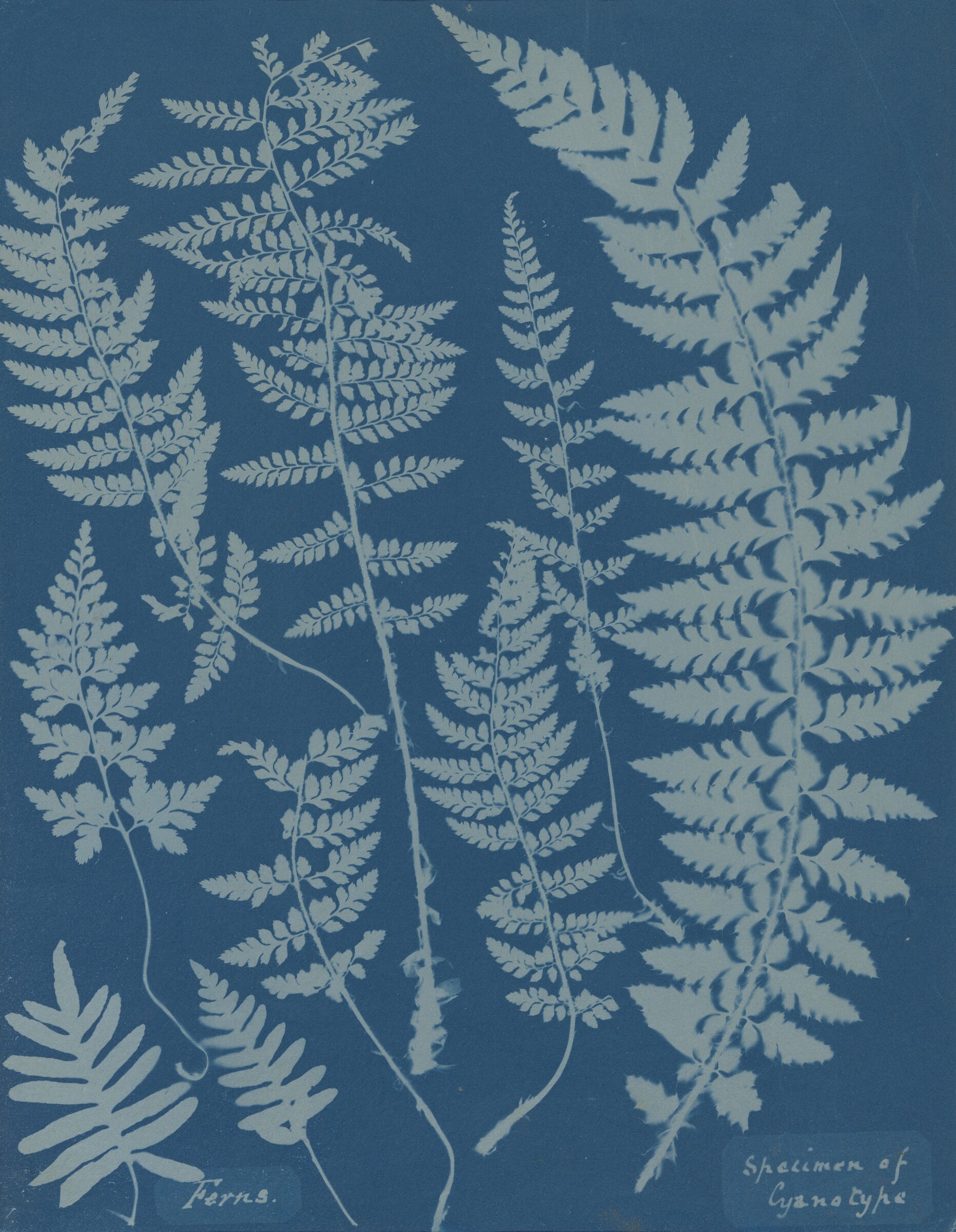
Ferns. Specimen of Cyanotype, Anna Atkins, 1840s

Ferns. Specimen of Cyanotype

1840s · No expuesta · Galería Nacional de Arte

Callithamnion versicolor, Anna Atkins, c. 1843 - c. 1853

Callithamnion versicolor

c. 1843 - c. 1853 · Rijksmuseum

Conferva rivularis, Anna Atkins, c. 1843 - c. 1853

Conferva rivularis

c. 1843 - c. 1853 · Rijksmuseum

Griffithsia Devoniensis, Anna Atkins, c. 1843 - c. 1853

Griffithsia Devoniensis

c. 1843 - c. 1853 · Rijksmuseum

Hydrodictyon utriculatum, Anna Atkins, c. 1843 - c. 1853

Hydrodictyon utriculatum

c. 1843 - c. 1853 · Rijksmuseum

Polysiphonia fucoides, Anna Atkins, c. 1843 - c. 1853

Polysiphonia fucoides

c. 1843 - c. 1853 · Rijksmuseum

Trentepohlia pulchella / Trentepohlia pulchella. var. β, Anna Atkins, c. 1843 - c. 1853

Trentepohlia pulchella / Trentepohlia pulchella. var. β

c. 1843 - c. 1853 · Rijksmuseum

Conferva diffusa, Anna Atkins, c. 1843 - c. 1853

Conferva diffusa

c. 1843 - c. 1853 · Rijksmuseum

Bajo el mismo techo: Rijksmuseum

Página del museo
Self-portrait, Vincent van Gogh, 1887

Vincent van Gogh

Self-portrait, 1887

La Corniche near Monaco, Claude Monet, 1884

Claude Monet

La Corniche bij Monaco, 1884

De Nachtwacht, Rembrandt van Rijn, 1642

Rembrandt van Rijn

La ronda de noche, 1642

Portrait of a Woman, Probably Maria Trip (1619-1683), Rembrandt van Rijn, 1639

Rembrandt van Rijn

Retrato de Maria Trip, 1639

Still Life with Peacocks, Rembrandt van Rijn, c. 1639

Rembrandt van Rijn

Still Life with Peacocks, c. 1639

Landscape with a Stone Bridge, Rembrandt van Rijn, c. 1638

Rembrandt van Rijn

El puente de piedra, c. 1638

Man in Oriental Dress, Rembrandt van Rijn, 1635

Rembrandt van Rijn

Man in Oriental Dress, 1635

Portrait of Haesje Jacobsdr van Cleyburg, Rembrandt van Rijn, 1634

Rembrandt van Rijn

Portrait of Haesje Jacobsdr van Cleyburg, 1634