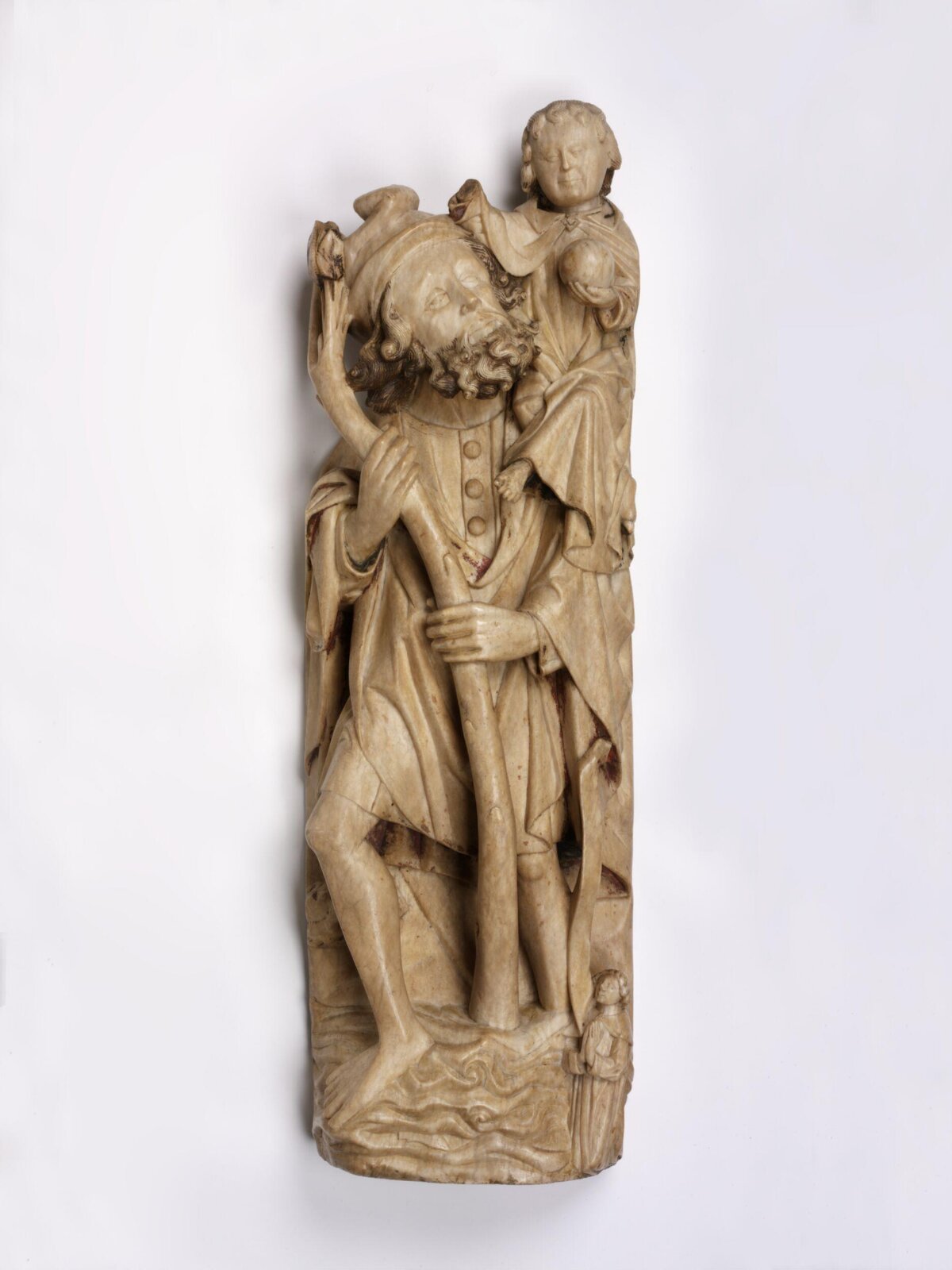
Saint Christopher
¿Se puede contemplar?
Sí, recibe visitas

Museo de Victoria y Alberto
SalaMedieval & Renaissance, Room 10Londres, Reino Unido
Expuesta al público. Quién lo avala figura más abajo.
- Comprobado
- hace 7 días
- En este estado desde
- 25 sept 2026
- Fuente
- Los datos de colección del propio museo
About the sculpture
This monumental figure of St Christopher would have been designed as a single devotional image, rather than forming part of an alabaster altarpiece. Images of St Christopher were highly popular in the Middle Ages, largely because of the inclusion of his story in the Golden Legend, the dissemination of the subject through woodcuts throughout Europe and the role of the saint as the protector of travellers, and against untimely death. Large-scale images of the saint often appear in English parish churches, usually in wall-paintings opposite the entrance.
Read on
This particular figure has, at his feet, a diminutive kneeling figure of a monk, which is likely to represent the donor. The scroll unwinding above him would originally have shown his prayer to the saint. The inclusion of this donor figure would support the theory that the sculpture was an individual commission, rather than bought off the shelf, as was usual for alabaster sculptures.
The plinth now associated with the figure, with its carved tracery and blank shield, is also of interest, although it was not an original part of the object. It can be related to French and particularly Spanish bases of 14th- and 15th-century date, and was probably added to the figure shortly before its sale in 1921.
The alabaster was donated to the V&A by friends of Cecil Duncan Jones (1883-1918) in his memory after his untimely death, following a lengthy period of internment during World War I, firstly in Ruhleben, and then in Holland.
Museo de Victoria y Alberto
Ficha
- Número de inventario
- A.18-1921
What it shows
Fuentes
- Museo de Victoria y Alberto: the museum's own open data · obtenido hace 7 días
- Imagen: Museo de Victoria y Alberto — © Victoria and Albert Museum, London