 Camille Jacob PissarroFrancia, 1830–1903
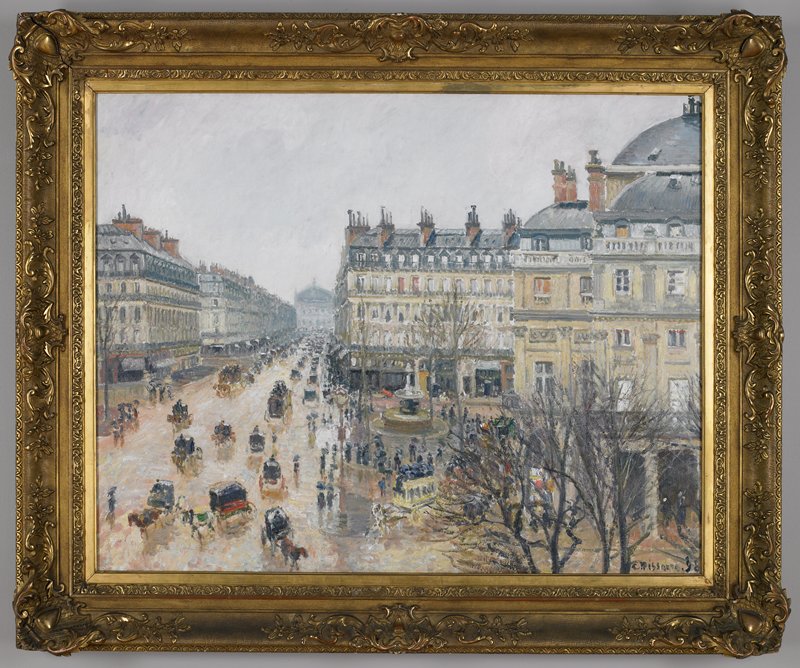
Rue a Macon
¿Puedo verla?
No, robada y en búsqueda
¿Dónde está «Rue a Macon» hoy? No, robada y en búsqueda. Comprobado 29 de septiembre de 2026.
Consta en el Registro Nacional de Arte Robado del FBI, con el n.º 00804.
- Comprobado
- · Según informes
- En este estado desde
- Fuente
- Un registro de arte robado
Ficha
En el catálogo
Fuentes
- El registro de arte robado del FBI
- Imagen: FBI National Stolen Art File
En la vida de Camille Jacob Pissarro
La vida entera10 de julio de 1830
Born
c. 1851
Meeting Fritz Melbye: the choice of a vocation
Pissarro's life changed sharply at twenty-one when he met the Danish artist Fritz Melbye, who saw his talent, persuaded him to paint full-time and became his teacher and close friend.
1855
Move to Paris: Anton Melbye and Corot
In 1855 Pissarro decided to go to Paris; Fritz Melbye stayed in Venezuela but gave him letters of recommendation to his brother Anton, who welcomed him warmly, made him an assistant in his own studio and introduced him to Camille Corot.
1870
A move to England because of the Franco-Prussian War
When the Franco-Prussian War began, Pissarro, who held only Danish nationality and could not join the French army, moved his family to Norwood, then a small town on the edge of London; his style of painting was not understood in England.
1870–1871
Meeting Paul Durand-Ruel in London
In London Pissarro met the Paris art dealer Paul Durand-Ruel, who helped him sell his paintings for most of his life.
1873
Founding the Société Anonyme of artists
Pissarro told the group he wanted an alternative to the Salon and helped found the Société Anonyme des Artistes, Peintres, Sculpteurs et Graveurs, of fifteen artists; he wrote its first charter and became the pivotal figure holding it together, and the forty-three-year-old with his prematurely grey beard was regarded as a wise elder and father figure.