Fernand LégerFrancia, 1881–1955
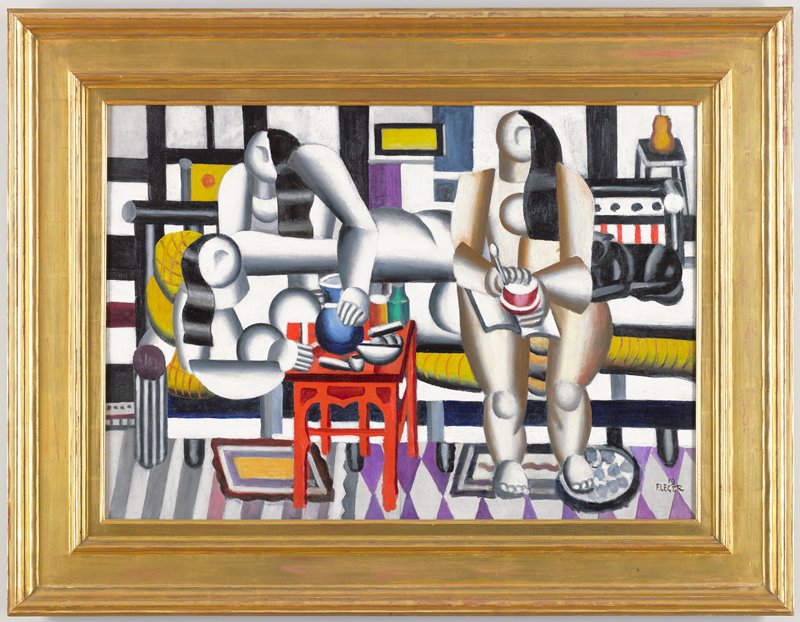
Reclining Woman
¿Puedo verla?
Sí, expuesta ahora
¿Dónde está «Reclining Woman» hoy? Instituto de Arte de Chicago, Sala 393, Chicago. Sí, expuesta ahora. Comprobado 12 de octubre de 2026.

Chicago, Estados Unidos
Cerrado· abre el jue a las 11:00
Expuesta al público.
- Comprobado
- En este estado desde
- Fuente
- El museo
Sobre el cuadro
Fernand Léger first saw the work of the Cubists Georges Braque and Pablo Picasso at the Paris gallery of Daniel-Henry Kahnweiler. Around 1909 Léger began to experiment with geometric shapes, complementary colors, and strong outlines, although his paintings remained largely nonrepresentational until after World War I. His involvement in the war had a profound impact on his work. In the years following, he introduced volumetric forms that resembled pistons and pipes into his compositions, joining others in the Parisian vanguard in charting a more sober, conservative course that placed renewed emphasis on objective observation.
Leer más
Substituting hard metallic tubes for pliant flesh and flat patterned disks for soft and dense pillows, the artist updated the classical figure of the odalisque (a female slave or concubine often pictured in the history of art as a reclining nude) with his particular blend of Cubism and machine aesthetics. Reclining Woman demonstrates Léger’s interest in producing “everyday poetic images”: paintings in which the manufactured object is the “principal personage,” shown as precisely as possible to reveal an absolute sculptural value rather than sentimental associations. This work exemplifies the Purist style, a kind of industrial classicism that focused on utilitarian objects. Léger hoped that through such paintings, art would become accessible to the whole of modern society rather than to just a privileged few.
Instituto de Arte de ChicagoCC BY 4.0
Ficha
- Número de inventario
- 1999.369
Lo que muestra
En el catálogo
Fuentes
- Instituto de Arte de Chicago
- Imagen: Instituto de Arte de Chicago — © the artist or rights holder
En la vida de Fernand Léger
La vida entera1920
Friendship with Le Corbusier, “The Mechanic” and “The Great Lunch”
In 1920, at the founding of the journal “L'Esprit nouveau”, Léger befriends Le Corbusier, who remains a lifelong friend. In the same year he paints the canvases “The Mechanic” and “The Great Lunch”, and from this year he exhibits at the Indépendants for many years.
1921
Meeting van Doesburg and Mondrian
In 1921 Léger meets van Doesburg and Mondrian.
1921
Gance's “La Roue” and Malraux's “Lunes en papier”
In 1921, together with Blaise Cendrars, Léger works on Abel Gance's film “La Roue” and illustrates André Malraux's book “Lunes en papier”. He is so drawn to cinema that he considers for a time giving up painting for filmmaking.
1922–1924
Stage and screen: the Swedish Ballet and “L'Inhumaine”
In 1922 Léger designs sets, costumes and the curtain for “Skating Rink” (music by Milhaud) for Rolf de Maré's Swedish Ballet, and in 1923 for the ballet “La Création du monde” (Milhaud, libretto by Cendrars). In 1923–24 he designs the laboratory set for Marcel L'Herbier's film “L'Inhumaine”.
1924
Through Italy with Rosenberg: Ravenna
In 1924 Léger travels through Italy with Rosenberg and is enraptured by Ravenna. In the same year he gives a lecture at the Sorbonne.
1924
A free academy with Ozenfant, and the pupil Nadia Khodossevitch
In 1924 Léger, with Amédée Ozenfant, Marie Laurencin and Alexandra Exter, sets up the Académie Moderne, a free school where he teaches. Among its students from 1924 is Nadia Khodossevitch, a cousin of the poet, later Léger's assistant and wife; other accounts place the opening of a “Modern Academy” with Ozenfant in 1929.