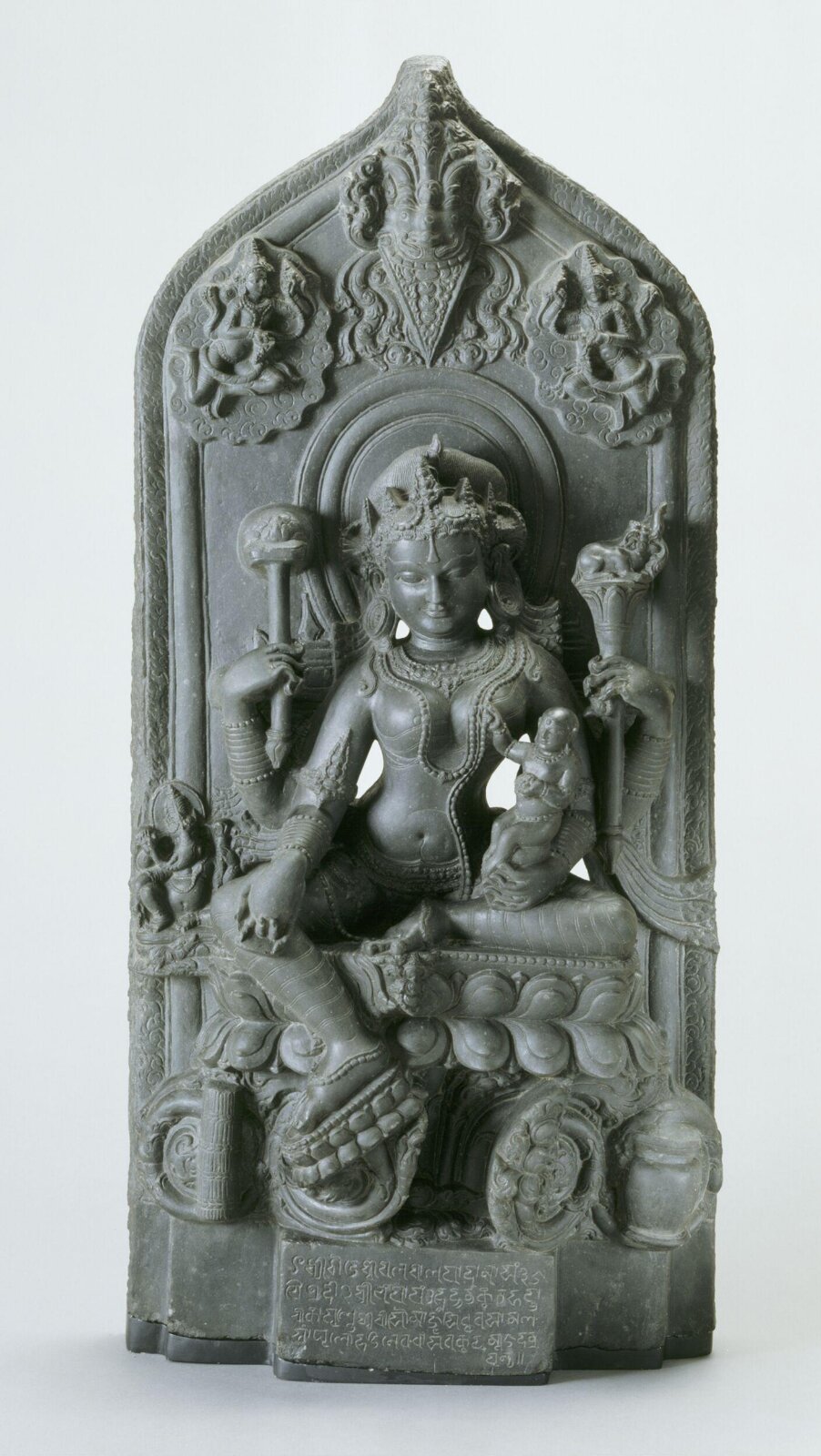
Purneshvari
¿Se puede contemplar?
Sí, recibe visitas

Museo de Victoria y Alberto
SalaBuddhism, Room 18, The Robert H. N. Ho Family Foundation Galleries of Buddhist ArtLondres, Reino Unido
Expuesta al público. Quién lo avala figura más abajo.
- Comprobado
- hace 7 días
- En este estado desde
- 25 sept 2026
- Fuente
- Los datos de colección del propio museo
About the sculpture
The Mother Goddess was popularly worshipped under a variety of local names throughout India. During the Pala period (ca.760-1142 A.D.) in eastern India, Purneshvari was venerated by both Buddhists and Hindus.
This rare and beautiful sculpture was found in 1877 during an excavation of a tank at Jaynagar, Monghyr District, Bihar. Here the four-armed goddess is seen seated on a double-lotus throne with one pendant foot resting on a lotus stem. She is beautifully formed, richly bejewelled and smiles benignly, as she supports an infant on her lap. Her upper hands hold rods, one with an elephant emblem, the other a fly-whisk.
Read on
Above her, a pair of celestial garland-bearers hover in the clouds, and a wondrous kirttimukha(face of glory) presides over all of them from above. Purneshvari is flanked by the Hindu elephant-headed god Ganesha. However, the inscription suggests a possible Buddhist affiliation. It offers merit to the siddhas (community of tantric masters) and sramanas (ascetic monks), as well as to the relatives of the donor, named as Utakva.
The inscription also names the goddess and the ‘illustrious (city of) Campa', as the place of its installation. It dates the sculpture to the 35th year regnal year of a king called Palapala, who was entitled ‘Lord of Gauda’ (Gaudesvara). This king may have been the last of the Pala rulers, as these regions subsequently succumbed to Muslim invaders between 1199 and 1201.
Museo de Victoria y Alberto
Ficha
- Número de inventario
- IS.71-1880
What it shows
En el catálogo
Fuentes
- Museo de Victoria y Alberto: the museum's own open data · obtenido hace 7 días
- Imagen: Museo de Victoria y Alberto — © Victoria and Albert Museum, London