 John Everett MillaisReino Unido, 1829–1896
Paz concluida
Peace Concluded
¿Se puede contemplar?
Sí, recibe visitas

Instituto de Artes de Mineápolis
SalaG357Minneapolis, Estados Unidos
Expuesta al público. Quién lo avala figura más abajo.
- Comprobado
- En este estado desde
- Fuente
- Los datos de colección del propio museo
About the painting
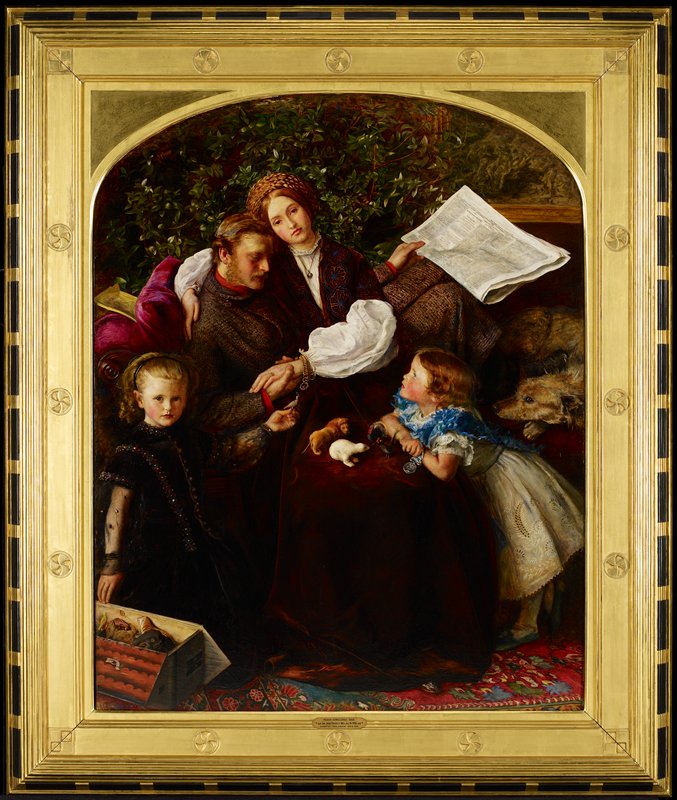
Paz concluida, 1856 es una pintura de 1856 de John Everett Millais que representa a un oficial británico herido leyendo el informe del periódico The Times sobre el final de la Guerra de Crimea. Se exhibió en la Real Academia de Arte (Royal Academy) en 1856 con críticas mixtas, pero el crítico John Ruskin la respaldó firmemente. La figura central de la pintura es un retrato de la esposa de Millais, Effie Gray, quien anteriormente había estado casada con Ruskin. Actualmente se exhibe en el Instituto de Artes de Mineápolis.
In the museum's words
At first glance this appears to be a family portrait complete with realistic details of middle-class English decor. In fact, it is a staged scene of domestic harmony, celebrating the end of the Crimean War. The father, a wounded officer, holds a copy of the Times announcing the war's end. One daughter clasps his combat medal. On the mother's lap, four animals from the toy Noah's Ark represent the four belligerents: Britain (lion), Russia (bear), the Ottoman Empire (turkey), and France (rooster). The girl at the left holds a dove with an olive branch in its beak, a symbol of peace. Millais belonged to a group of English painters called the Pre-Raphaelite Brotherhood. Their work emphasized close observation of nature and the depiction of contemporary events.
Instituto de Artes de Mineápolis
Ficha
- Número de inventario
- 69.48
En el catálogo
Fuentes
- Instituto de Artes de Mineápolis: the museum's own open data · obtenido hace 7 días
- Imagen: Instituto de Artes de Mineápolis — public domain
Mientras tanto, en la vida de John Everett Millais
La vida entera3 de julio de 1855
Married: Effie Gray
1855–1857
After his marriage he changes manner: faster and dearer
Marriage changed Millais: to support his growing family he began to paint more quickly and in greater quantity and to sell his pictures dearly, moving away from Pre-Raphaelite principles. Effie became a powerful promoter of his work, and together they secured commissions and widened their circle; he gained great popularity and a fortune (up to £30,000 a year), while William Morris and other critics accused him of selling out.
30 de mayo de 1856
Son born: Sir Everett Millais, 2nd Baronet
1857
Ruskin calls “Sir Isumbras” a catastrophe
Ruskin called Sir Isumbras (1857), in which Millais had departed sharply from Pre-Raphaelite technique, not even a failure but a catastrophe.
19 de septiembre de 1857
Son born: George Gray Millais
28 de noviembre de 1858
Daughter born: Effie Gray Millais