 TitianItalia, 1490–1576
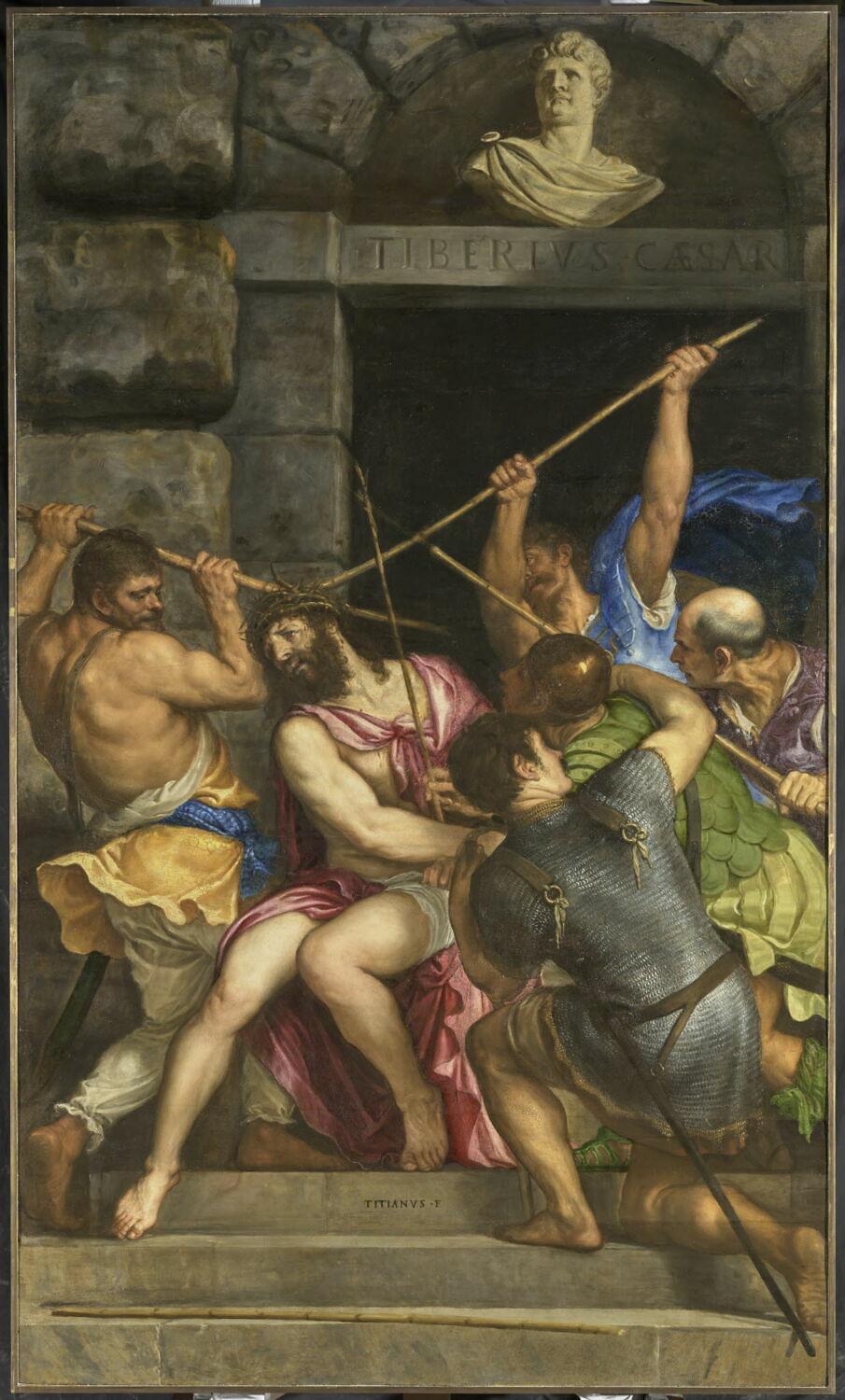
La coronación de espinas
Le Couronnement d'épines
¿Se puede contemplar?
Sí, recibe visitas

Expuesta al público. Quién lo avala figura más abajo.
- Comprobado
- En este estado desde
- Fuente
- El museo
Sobre el cuadro
La coronación de espinas es un cuadro de Tiziano (como indica la inscripción Titianus F. en uno de los escalones). Realizado entre 1542 y 1544, es un cuadro clave del periodo comprendido entre sus trabajos para las cortes italianas de Ferrara, Mantua y Urbino, y las obras para los Farnesio de Roma, adonde Tiziano se trasladó en 1545.
Fue pintado por encargo de la Hermandad de la Iglesia de Santa Maria delle Grazie, en Milán, para adornar el altar de la capilla de la Santa Corona. Expoliado durante la invasión napoleónica y llevado a Museo del Louvre de París (entonces llamado Museo Napoleón), permanece a día de hoy en dicha institución pues no se incluyó entre las obras a restituir tras el Congreso de Viena, debido a que no fue reclamado por Austria, país del que dependía Milán entonces.
Ficha
- Número de inventario
- INV 748
En el catálogo
Fuentes
- Museo del Louvre
- Imagen: Museo del Louvre — © 2019 GrandPalaisRmn (musée du Louvre) / Adrien Didierjean
Mientras tanto, en la vida de Titian
La vida entera1525
Marries Cecilia, the mother of his sons
Cecilia, a barber's daughter from Pieve di Cadore, had been Titian's housekeeper and for some five years his mistress, and had already borne him two sons, Pomponio and Orazio. In 1525, when she fell seriously ill, Titian married her to legitimise the children; Cecilia recovered, and the marriage was a happy one.
1527
Aretino, Sansovino and the “triumvirate”
In March 1527 the satirist Pietro Aretino arrived in Venice: he became friends with Titian and with Jacopo Sansovino, and the three were popularly known as “the triumvirate”, becoming the centre of the city's artistic establishment. Aretino enlisted both in pursuing the patronage of Federico II Gonzaga, and by the autumn of 1527 the Marquis of Mantua had received from Titian a portrait of Aretino (lost); important commissions and an introduction to Emperor Charles V followed.
1529
First meeting with Emperor Charles V in Parma
Thanks to the patronage of Federico Gonzaga, Duke of Mantua, in 1529 at Parma Titian obtained an audience with Emperor Charles V, who promised him his patronage.
1533
Bologna: Count Palatine and Knight of the Golden Spur
In 1533, after painting a portrait of Emperor Charles V in Bologna, Titian was made a Count Palatine and Knight of the Golden Spur; his children were reportedly also made nobles of the Empire. He was court painter to Charles V from 1533 and received from him a heavy gold chain.
1545–1546
A triumphant trip to Rome
In 1545–1546 Titian made a triumphant trip to Rome, painting portraits of Pope Paul III and meeting Michelangelo. Returning to Venice, he found that the most lucrative commissions were going to other, younger artists.
1547–1548
Augsburg: the “Equestrian Portrait of Charles V”
In 1547 Titian was summoned from Venice to Augsburg to paint portraits of Charles V and other dignitaries; at the Diet in early 1548 he completed six paintings, among them the “Equestrian Portrait of Charles V”. He also made the emperor aware that he had not received a single payment of his stipend, and on 10 July 1548 Charles V granted him a second annual pension of 100 scudi.