Fernand LégerFrancia, 1881–1955
La racine noire
¿Puedo verla?
Se desconoce
¿Dónde está «La racine noire» hoy? Colección: Rijksmuseum, Amsterdam. Se desconoce.

Amsterdam, Países Bajos
Se conoce el propietario; no se sabe si hoy está expuesta.
- Fuente
- El museo
Sobre la obra
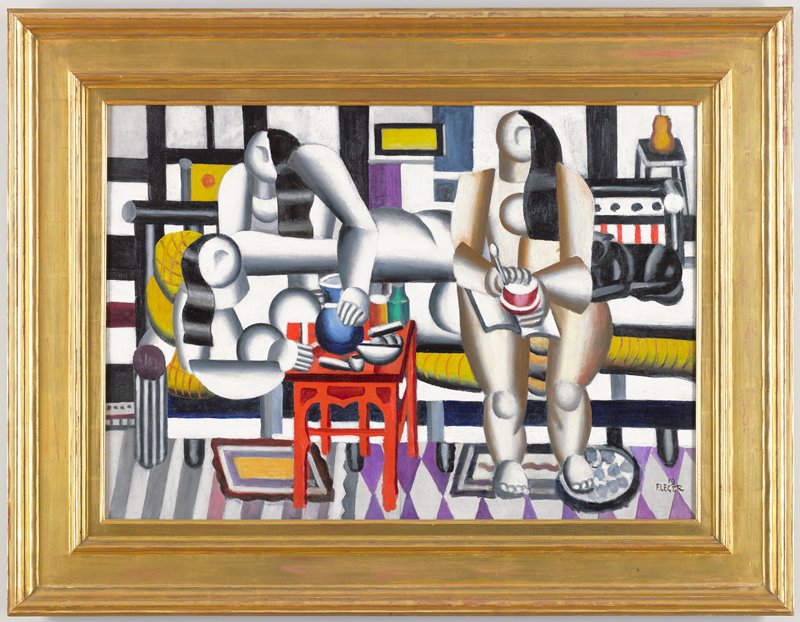
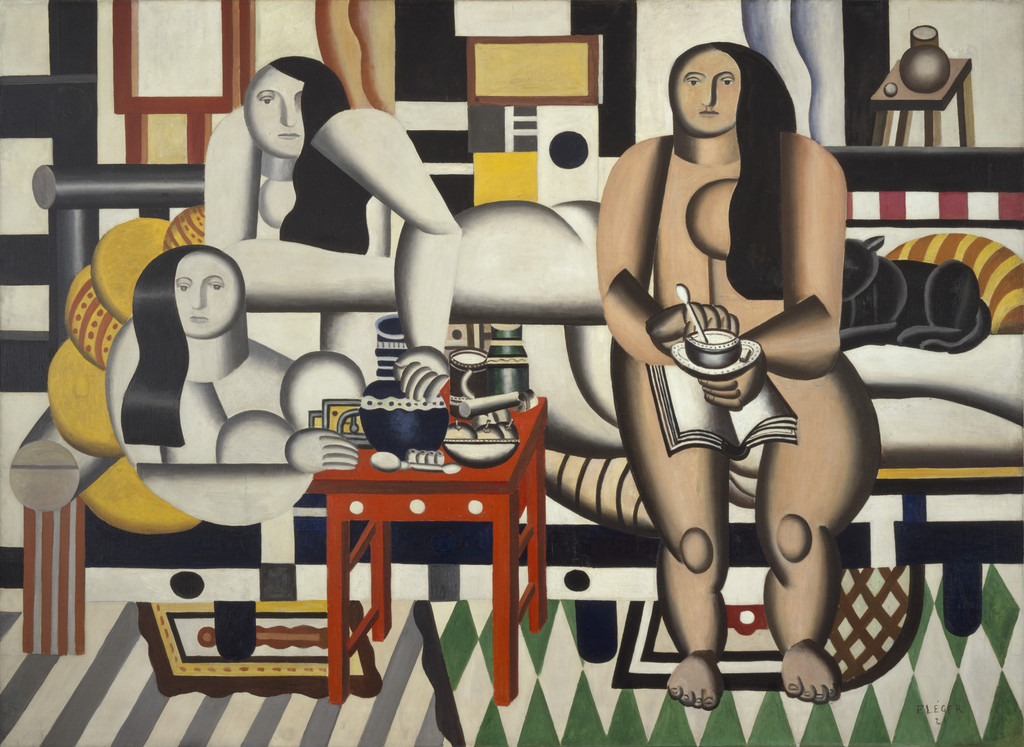
Bruna admired the work of the French avant-garde artist Léger, because he had separated the planes of colour from the lines and let them move independently over the picture plane. As Bruna put it: ‘this way you can look twice’
Rijksmuseum
Ficha
- Número de inventario
- RP-P-1949-535
En el catálogo
Fuentes
- Rijksmuseum
- Imagen: Rijksmuseum — public domain
En la vida de Fernand Léger
La vida entera1948
The Congress of Intellectuals in Wrocław
In 1948 Léger travels to Poland for the World Congress of Intellectuals in Defence of Peace in Wrocław. In the same year he designs sets for Prokofiev's ballet “Le Pas d'acier” staged by Serge Lifar and, with his students, decorates the premises for the International Women's Congress in Paris.
1949
A retrospective at the National Museum of Modern Art
In 1949 a retrospective exhibition of Léger's work is held at the National Museum of Modern Art in Paris.
1949
First ceramics at Biot with Roland Brice
In 1949, together with Roland Brice, Léger makes his first ceramic works at Biot; in 1950 he sets up a ceramics workshop there.
1949
The album “Cirque” for Tériade
In 1949 Léger writes the text and makes the drawings for the album “Cirque”, published by Tériade; he also illustrates Rimbaud's “Illuminations” and designs sets and costumes for Milhaud's opera “Bolivar”.
1949
The essay “How I Conceive the Human Figure”
In 1945 Léger wrote that the object in modern painting must become the main character and overthrow the subject, and that if the human form in turn becomes an object it can considerably liberate possibilities for the modern artist. In his 1949 essay “How I Conceive the Human Figure” he elaborates: the figure is to be seen as a plastic value, not a sentimental one — which is why it has remained willfully inexpressive.
1950
The death of his wife Jeanne
In 1950 Léger's first wife, Jeanne-Augustine Lohy, whom he had married in 1919, dies.