 Viktor Vasnetsov1848–1926
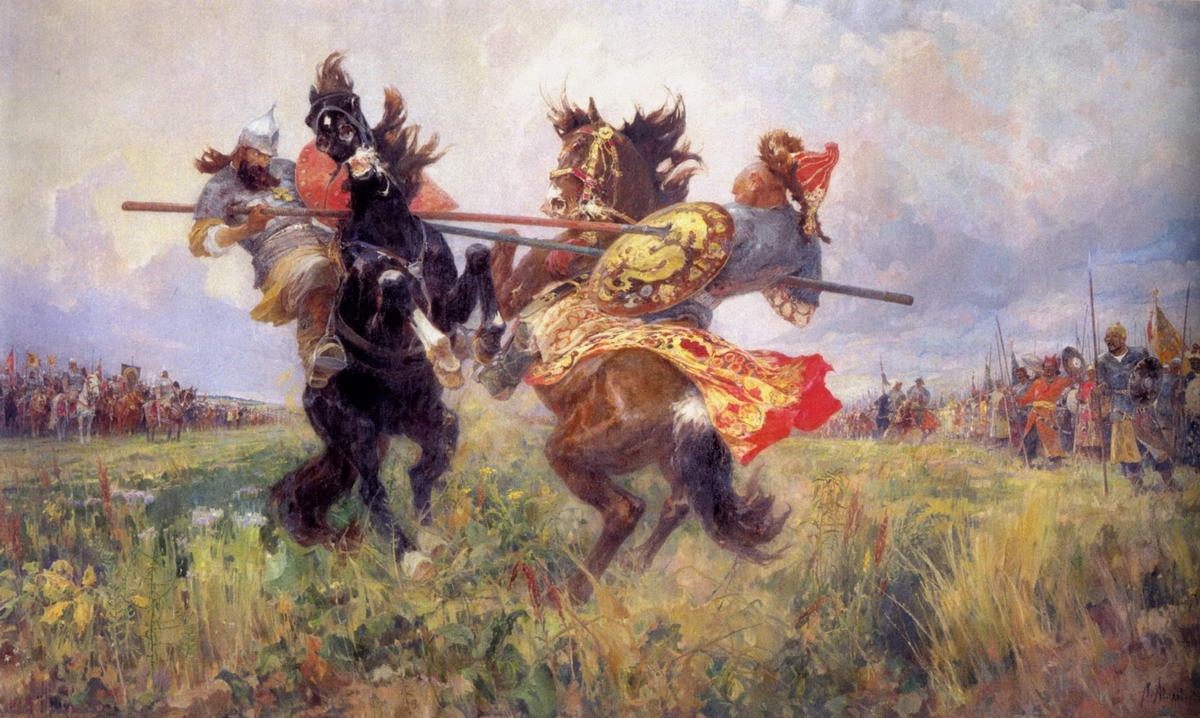
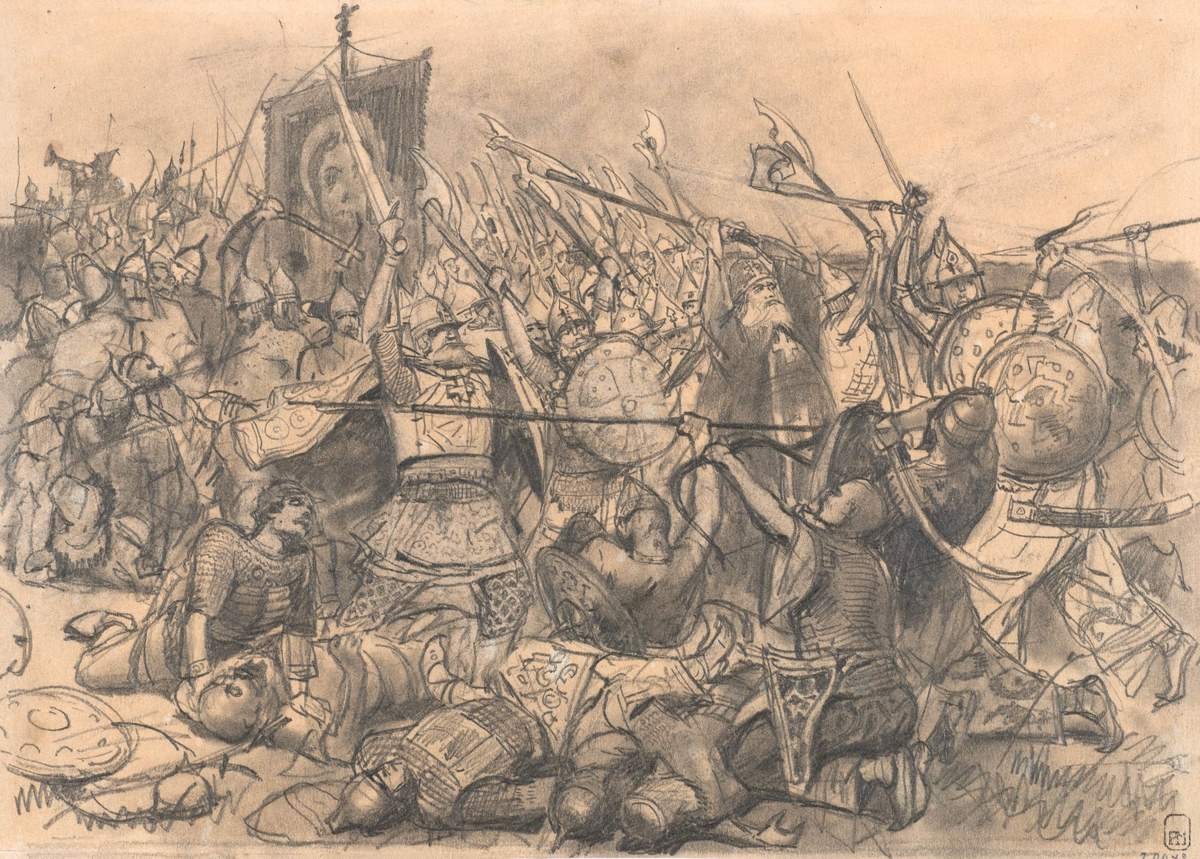
Куликовская битва
¿Puedo verla?
Se desconoce
¿Dónde está «Куликовская битва» hoy? Colección: Museo Estatal Ruso, San Petersburgo. Se desconoce.

San Petersburgo, Rusia
Se conoce el propietario; no se sabe si hoy está expuesta.
- En este estado desde
- Fuente
- El museo
Sobre la obra
En palabras del museo — en ruso
8 сентября 1380. Куликовская битва
Ранним утром на Куликовом поле между Доном и Непрядвой началась битва, в которой русские войска наголову разгромили полчища монгольского хана Мамая. Согласно летописным источникам, началась она с поединка богатырей. Русский монах Пересвет сражался с ордынцем Челубеем. Удар копий богатырей был настолько силен, что оба они погибли на месте. После этого в бой вступили войска. Князь Дмитрий, несмотря на свой статус, одел на себя доспехи простого воина и встал во главе Большого полка. За эту победу, ставшую прологом к обретению полной независимости от Орды, князь Дмитрий получил прозвание Донской. В 1988 году канонизирован Русской Православной Церковью в лике благоверного. Картины военной жизни в отечественном искусстве XVI–XX веков. СПб, 2022. С. 16-17.
Museo Estatal Ruso
Ficha
- Número de inventario
- Р-13349
Lo que muestra
En el catálogo
Fuentes
- Museo Estatal Ruso
- Imagen: Museo Estatal Ruso — © State Russian Museum
En la vida de Viktor Vasnetsov
La vida entera1867–1868 · Formación
Risovalnaya shkola Imperatorskogo obshchestva pooshchreniya khudozhestv
1868
Admitted to the Academy of Arts
In August 1868, at the second attempt, he was admitted to the Imperial Academy of Arts; the attempt a year earlier had not worked out.
1870
He meets Pavel Chistyakov
Pavel Chistyakov, back from Rome, saw Vasnetsov’s drawing “A Prince’s Icon-painting Workshop” at an Academy exhibition, asked to be introduced to its author and soon made him a regular pupil; Vasnetsov remembered his teacher as “an enemy of the formula” who could show each pupil the road to his own development.
summer 1871
He meets his future wife, Alexandra Ryazantseva
In the summer of 1871, home in Vyatka on academic leave, he met Alexandra Ryazantseva in the local library — a merchant’s daughter who would become one of the first women from Vyatka with a higher medical education; he was struck by “her eyes — stern and extraordinarily kind”.
1873–1875
He leaves the Academy before graduating
In 1873, a year before the end of the course, he almost stopped attending the Academy and went only to Chistyakov’s studio: Chistyakov told him he had already got from the Academy all it could give, and Kramskoi advised the same; on 4 (16) February 1875 he was formally discharged, receiving a certificate that listed two small silver medals and one large one.
1878
He moves to Moscow, the city of his life’s work
In 1878, his resolve strengthened by Mamontov’s letter, he moved to Moscow, the city to which most of his creative life would be tied: he settled in a small flat in 3rd Ushakovsky Lane near Ostozhenka, walked the city for hours admiring the Kremlin and St Basil’s, and until 1885 the family changed rented flats in Moscow six times.