 Alphonse MuchaRepública Checa, 1860–1939
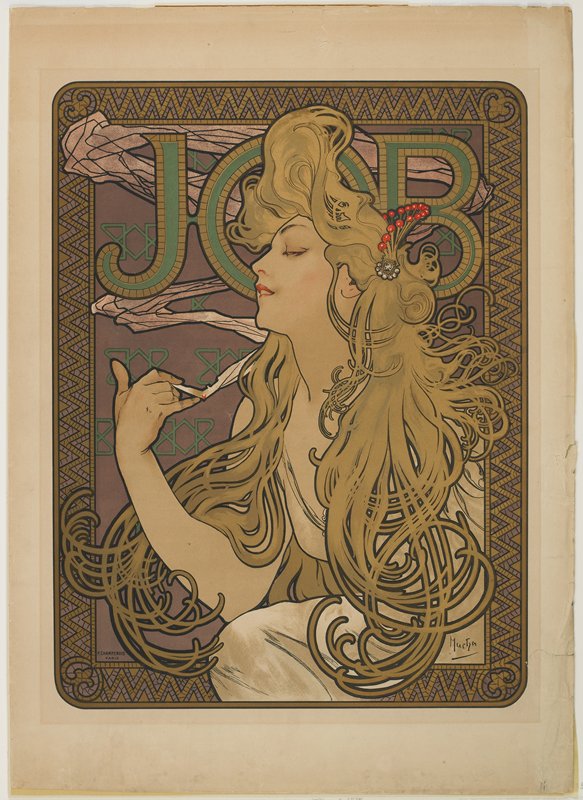
Job
¿Puedo verla?
No expuesta por ahora
¿Dónde está «Job» hoy? Colección: Instituto de Artes de Mineápolis, Minneapolis. No expuesta por ahora. Comprobado 23 de noviembre de 2026.

Minneapolis, Estados Unidos
Pertenece a la colección, pero ahora mismo no está expuesta.
- Comprobado
- En este estado desde
- Fuente
- El museo
Sobre la obra
Proponents of the Art Nouveau movement of the late 1800s sought escape from the limitations of past traditions, and they achieved it by creating a new style. By applying this style to all forms of creativity, they hoped to eliminate the separation between art and craft. Alphonse Mucha did just that by treating the poster, humbly temporary and commercial, like a canvas.
The Job cigarette paper being advertised also represents literal escape. Despite Mucha's use of an idealized female in this poster, respectable women of the nineteenth century did not smoke. This pleasure belonged to men, who could use it as an excuse to retreat into smoking rooms and the company of male friends.
Instituto de Artes de Mineápolis
Ficha
- Número de inventario
- P.91.1.8
En el catálogo
Fuentes
- Instituto de Artes de Mineápolis
- Imagen: Instituto de Artes de Mineápolis — © Minneapolis Institute of Art
En la vida de Alphonse Mucha
La vida enteraautumn 1894
Friendship with August Strindberg
In late autumn 1894 he became friends with the playwright August Strindberg, with whom he shared interests in philosophy and mysticism.
1894
First official recognition at the 1894 Salon
Four of his illustrations for Seignobos’s book, including one depicting the death of Frederick Barbarossa, were chosen for display at the 1894 Paris Salon of Artists; he received a medal of honour, his first official recognition.
26 December 1894
Sarah Bernhardt orders the poster for “Gismonda”
Bernhardt telephoned Maurice de Brunhoff of the publishing firm Lemercier, ordering a poster for the continued run of Sardou’s “Gismonda” by 1 January 1895; because of the holidays none of the regular Lemercier artists was available, and Mucha, who happened to be at the firm correcting proofs, took the job.
1 January 1895
The “Gismonda” poster appears on the streets of Paris
The poster, a little over two metres high, with Bernhardt as a Byzantine noblewoman under a rainbow-shaped arch almost like a halo, appeared on the streets of Paris on 1 January 1895 and caused an immediate sensation; Bernhardt ordered four thousand copies in 1895 and 1896 and gave Mucha a six-year contract.
after 1 January 1895
A contract with the printer Champenois and a new studio
Bernhardt switched to a different printer, F. Champenois, who, like Mucha, was put under a six-year contract to work for her and gave Mucha a generous monthly salary in exchange for the rights to publish all his works. With the extra income Mucha moved to a three-bedroom apartment with a large studio in a historic house at 6 Rue du Val-de-Grâce.
1897
Retrospective at the Salon des Cent: 448 works
Léon Deschamps, the editor of La Plume, invited him to show at the Salon des Cent in 1896, and in 1897 the same gallery gave him a major retrospective of 448 works; the magazine La Plume devoted a special issue to him, and the exhibition travelled to Vienna, Prague, Munich, Brussels, London and New York, giving him an international reputation.