.jpg?width=96) Vincent van GoghPaíses Bajos, 1853–1890
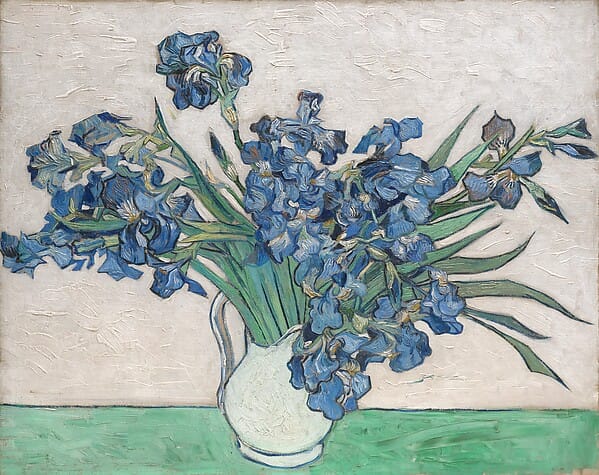
Vincent van GoghPaíses Bajos, 1853–1890Lirios
Irises
¿Se puede contemplar?
Sí, recibe visitas
Expuesta al público. Quién lo avala figura más abajo.
- Comprobado
- En este estado desde
- Fuente
- Los datos de colección del propio museo
About the painting
In May 1889, after episodes of self-mutilation and hospitalization, Vincent van Gogh chose to enter an asylum in Saint-Rémy, France. There, in the last year before his death, he created almost 130 paintings. Within the first week, he began *Irises*, working from nature in the asylum's garden. The cropped composition, divided into broad areas of vivid color with monumental irises overflowing its borders, was probably influenced by the decorative patterning of Japanese woodblock prints. There are no known drawings for this painting; Van Gogh himself considered it a study. His brother Theo quickly recognized its quality and submitted it to the *Salon des Indépendants* in September 1889, writing Vincent of the exhibition: "[It] strikes the eye from afar. It is a beautiful study full of air and life." Each one of Van Gogh's irises is unique.
Read on
He carefully studied their movements and shapes to create a variety of curved silhouettes bounded by wavy, twisting, and curling lines. The painting's first owner, French art critic Octave Mirbeau, one of Van Gogh's earliest supporters, wrote: "How well he has understood the exquisite nature of flowers!"
Museo J. Paul Getty
Ficha
- Número de inventario
- 90.PA.20
En el catálogo
Fuentes
- Museo J. Paul Getty: the museum's own open data · obtenido hace 6 horas
- Imagen: Museo J. Paul Getty — Open Content
Mientras tanto, en la vida de Vincent van Gogh
La vida enteraFebruary 1888
To Arles, dreaming of a “Studio of the South”
The public still neither accepted nor bought his paintings, and in February 1888 Van Gogh left for Arles in the south of France to found a “Studio of the South”, a brotherhood of like-minded artists in which he gave Gauguin the leading role. Theo backed the plan with money.
23 October 1888
Gauguin arrives in Arles
After much pleading Gauguin arrived in Arles, and in November the two painted together: Gauguin portrayed Van Gogh in “The Painter of Sunflowers”, and their first joint outing was to the Alyscamps. At Gauguin's suggestion Vincent painted from memory, producing “Memory of the Garden at Etten”.
23 December 1888
The severed ear
After an altercation on the evening of 23 December, Van Gogh, seemingly hearing voices, severed his left ear, wholly or in part, with a razor and delivered it, wrapped in paper, to a woman at a brothel. Next morning a policeman found him unconscious; in hospital he was diagnosed with “acute mania with generalised delirium”.
May 1889
Voluntarily into the Saint-Paul asylum
Van Gogh left Arles and voluntarily entered the Saint-Paul-de-Mausole asylum, a former monastery in Saint-Rémy-de-Provence, accompanied by the Protestant clergyman Frédéric Salles. Of his two cells with barred windows one became a studio, and the clinic and its garden became the main subjects of his paintings.
27 July 1890
A fatal wound: a revolver shot
Out painting, Van Gogh shot himself in the chest with a revolver he had bought to scare off birds while working outdoors; the bullet passed below his heart, and he made his own way back to his room at the inn. Theo arrived the next day and stayed with him to the end; according to Theo, Vincent's last words were: “The sadness will last forever.”
29 de julio de 1890
Died