ART WIKI32.963 en sala
MapaColecciónArtistasMuseosExposicionesRevista
Acceder

ART WIKI

Dónde cuelga la obra maestra y cuándo le dejan pasar.

Colecciones: Galería Nacional de Arte, Galería Nacional de Dinamarca, Galería Nacional de Retratos, Galería Tretiakov, Harvard Art Museums, Instituto de Arte de Chicago, Instituto de Artes de Mineápolis, MoMA, Museo de Arte de Cleveland, Museo de Victoria y Alberto, Museo del Hermitage, Museo del Louvre, Museo Estatal Ruso, Museo Hirshhorn y Jardín de Esculturas, Museo J. Paul Getty, Museo Metropolitano de Arte, Museo Pushkin, Museo Smithsoniano de Arte Americano, Museo Whitney de Arte Estadounidense, National Museum of Asian Art, Rijksmuseum, Villa Getty, Catálogo Estatal del Fondo Museístico de Rusia (274 museos), Europeana (19 museos), Wikidata (6 museos), Paris Musées (12 museos) y Joconde, la base de museos del Ministerio de Cultura de Francia (495 museos). Las imágenes pertenecen a sus titulares de derechos.

Secciones

  • Mapa
  • Búsqueda
  • Colección
  • Obras maestras
  • Expuestas ahora
  • Artistas

Más

  • Museos y galerías
  • Exposiciones
  • Revista
  • De dónde salen los datos
  • Privacidad y cookies
InicioMapaCatálogo
  1. Colección/
  2. Instituto de Arte de Chicago/
  3. Human Figure with Two Birds
Human Figure with Two Birds, Max Ernst, 1925/29
Max Ernst, retratoMax ErnstFrancia, 1891–1976

Human Figure with Two Birds

1925/29 · Painting

Sobre el cuadro

Like Constantin Brâncusi, Max Ernst was fascinated with birds, and among his earliest works incorporating this motif are some two dozen small, unconventional pictures made around 1925. One of these works was incorporated as a picture within a picture in Human Figure with Two Birds, a painting that set the stage for an extraordinary series of works that Ernst began in 1930, which featured a large, fantastic bird figure that the artist identified as Loplop. In these works, Loplop, the artist’s "private phantom attached to my person," generally holds up a picture for presentation. Here the rudimentary figure outlined in white is an early manifestation of Loplop, Ernst’s playful, surreal concept of self-portraiture by proxy.

Instituto de Arte de Chicago · CC BY 4.0

Ficha

1925/29 · a los 34 años
18911976
Número de inventario
1989.386

Mientras tanto, en la vida de Max Ernst

La vida entera
  1. 1923

    The Salon des Indépendants: a warm welcome from the Cubists

    In 1923 Ernst exhibited at the Salon des Indépendants: the critics ignored his work, but the Cubists Georges Braque, Juan Gris and Louis Marcoussis responded warmly. La belle jardinière, shown there, was bought the next year by the Düsseldorf exhibition centre and later removed at the Nazis’ demand; in 1937 Ernst saw it in a photograph of the “degenerate art” exhibition, and it was most likely destroyed.

  2. 1924

    To Saigon after the Éluards

    In March 1924 Paul Éluard abruptly left for Monaco and then for Vietnam. To raise the fare Ernst sold paintings to the gallery owner Johanna Ey; he met Éluard and Gala in Singapore and Saigon, but Gala stayed with Paul. Ernst went on exploring South-East Asia for several more months.

  3. 1926

    “Histoire naturelle”: a portfolio of frottages

    At Jeanne Bucher’s press Ernst published Histoire naturelle, a portfolio of drawings in the frottage technique, with an introduction by Hans Arp.

  4. 1926

    The first large show at Galerie van Leer

    In 1926 the Paris gallery van Leer held Ernst’s first large exhibition; in place of a preface the catalogue printed poems by Paul Éluard, Benjamin Péret and Robert Desnos.

  5. 1926

    Diaghilev’s ballet and Breton’s scandal

    In 1926 Ernst and Joan Miró designed Romeo and Juliet for Sergei Diaghilev’s company; Breton, indignant at the work with the Ballets Russes, made a scandal at the premiere, and in La Révolution surréaliste he and Aragon accused Ernst and Miró of belittling the idea of surrealism. The next issue, however, carried two of Ernst’s works with an apologia by Éluard.
Más obras de Max Ernst

Todas las obras

En la misma sala · Research Center Franke Reading Room, Instituto de Arte de Chicago

Página del museo
  • 1927

    Married: Marie-Berthe Aurenche

  • ¿Se puede contemplar?

    Sí, recibe visitas

    Instituto de Arte de Chicago

    Chicago, Estados Unidos

    SalaResearch Center Franke Reading Room

    Expuesta al público. Quién lo avala figura más abajo.

    Comprobado
    hace 3 días
    En este estado desde
    19 ago 2026
    Fuente
    El museo
    En el mapaPágina del museo

    En el catálogo

    PinturaÓleoPintura francesaPintura alemanaPintura estadounidenseModernismoSiglo XXEstados Unidos

    Fuentes

    • Instituto de Arte de Chicago
    • Imagen: Instituto de Arte de Chicago — © the artist or rights holder
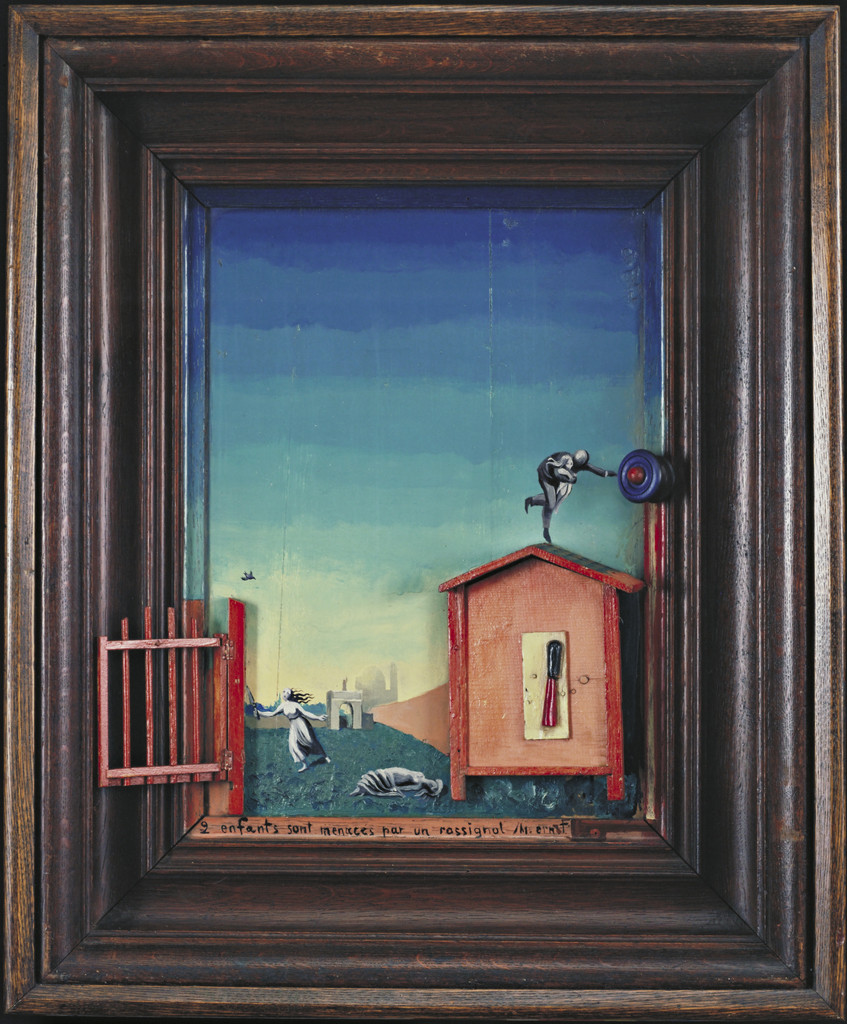
    Two Children Are Threatened by a Nightingale (Deux Enfants sont menacés par un rossignol), Max Ernst, 1924

    Two Children Are Threatened by a Nightingale (Deux Enfants sont menacés par un rossignol)

    1924 · MoMA

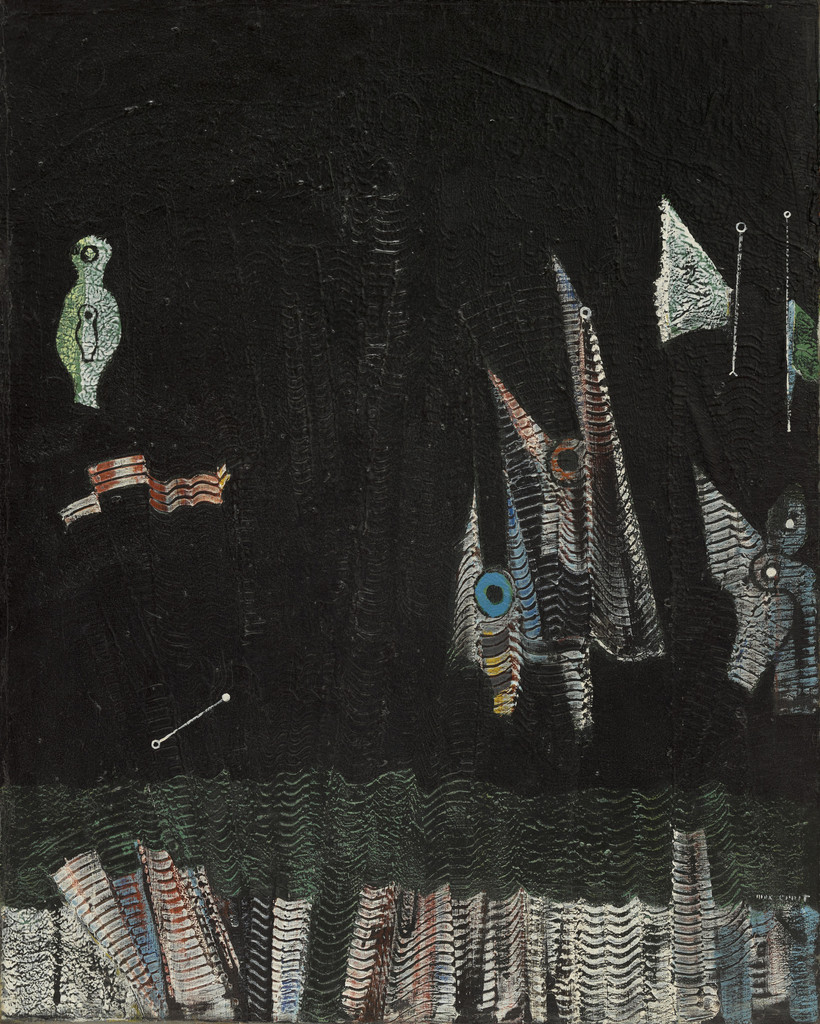
    Birds above the Forest (Oiseaux au-dessus de la forêt), Max Ernst, 1929

    Birds above the Forest (Oiseaux au-dessus de la forêt)

    1929 · MoMA

    Bird-Head (Oiseau-tête), Max Ernst, 1934-35

    Bird-Head (Oiseau-tête)

    1934-35 · MoMA

    A Moment of Calm, Max Ernst, 1939

    A Moment of Calm

    1939 · Galería Nacional de Arte

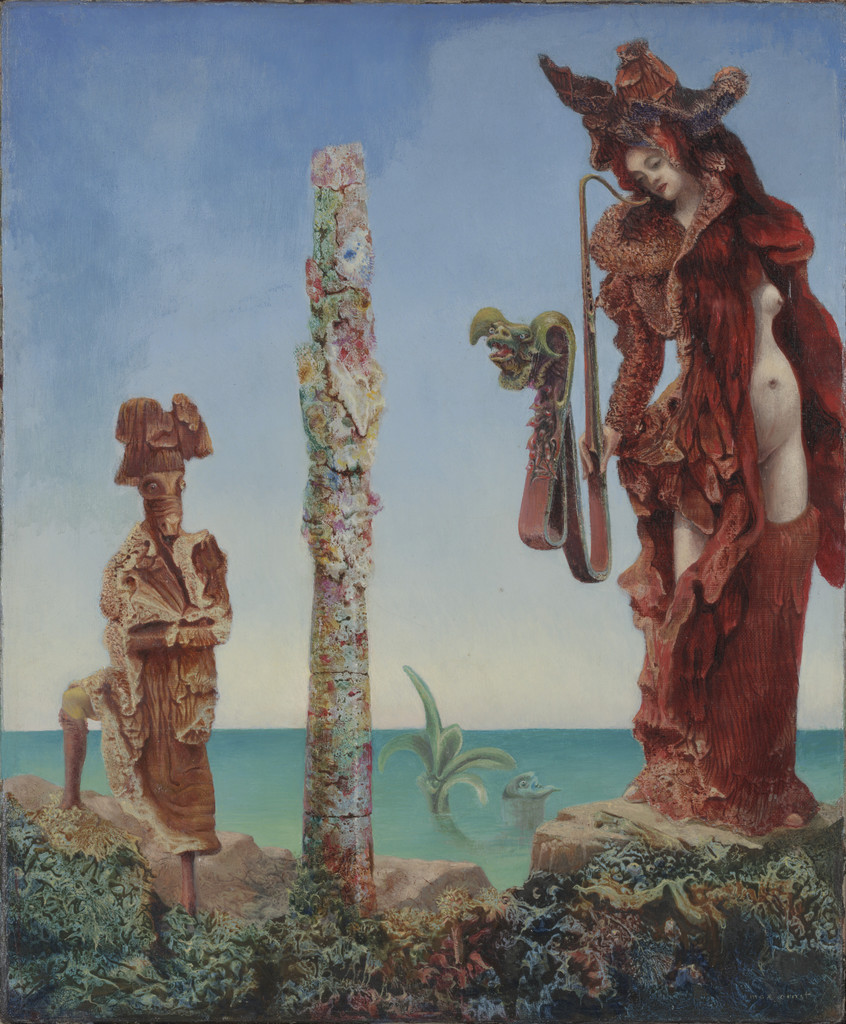
    Napoleon in the Wilderness, Max Ernst, 1941

    Napoleon in the Wilderness

    1941 · MoMA

    Forest and Sun, Max Ernst, 1927

    Forest and Sun

    1927 · Instituto de Arte de Chicago

    Self-Constructed Little Machine, Max Ernst, 1919/20

    Self-Constructed Little Machine

    1919/20 · Instituto de Arte de Chicago

    The Massacre of the Innocents, Max Ernst, 1920

    The Massacre of the Innocents

    1920 · Instituto de Arte de Chicago

    Veranda Post (Òpó Ògògá), Olowe of Ise, 1910-14

    Olowe of Ise

    Veranda Post (Òpó Ògògá), 1910-14

    Passing Through the Opposite of What It Approaches, Chapter 25 (Portrait of Anne Rorimer), R. H.  Quaytman, 2012

    R. H. Quaytman

    Passing Through the Opposite of What It Approaches, Chapter 25 (Portrait of Anne Rorimer), 2012

    The Maple Tree with Pine, Sylvia Plimack Mangold, 2005

    Sylvia Plimack Mangold

    The Maple Tree with Pine, 2005

    Correct Me If I'm Wrong, Amy Sillman, 1999

    Amy Sillman

    Correct Me If I'm Wrong, 1999

    Blue Note, Judith Godwin, 1982

    Judith Godwin

    Blue Note, 1982

    Cloudy Night, a Picture That Can Be Hung Upside Down, Roger Brown, 1978

    Roger Brown

    Cloudy Night, a Picture That Can Be Hung Upside Down, 1978

    Eucalol, Ellen Lanyon, 1977

    Ellen Lanyon

    Eucalol, 1977

    Clay Lake, Morning Sundown, Irving Petlin, 1975

    Irving Petlin

    Clay Lake, Morning Sundown, 1975