ART WIKI32.963 en sala
MapaColecciónArtistasMuseosExposicionesRevista
Acceder

ART WIKI

Dónde cuelga la obra maestra y cuándo le dejan pasar.

Colecciones: Galería Nacional de Arte, Galería Nacional de Dinamarca, Galería Nacional de Retratos, Galería Tretiakov, Harvard Art Museums, Instituto de Arte de Chicago, Instituto de Artes de Mineápolis, MoMA, Museo de Arte de Cleveland, Museo de Victoria y Alberto, Museo del Hermitage, Museo del Louvre, Museo Estatal Ruso, Museo Hirshhorn y Jardín de Esculturas, Museo J. Paul Getty, Museo Metropolitano de Arte, Museo Pushkin, Museo Smithsoniano de Arte Americano, Museo Whitney de Arte Estadounidense, National Museum of Asian Art, Rijksmuseum, Villa Getty, Catálogo Estatal del Fondo Museístico de Rusia (274 museos), Europeana (19 museos), Wikidata (6 museos), Paris Musées (12 museos) y Joconde, la base de museos del Ministerio de Cultura de Francia (495 museos). Las imágenes pertenecen a sus titulares de derechos.

Secciones

  • Mapa
  • Búsqueda
  • Colección
  • Obras maestras
  • Expuestas ahora
  • Artistas

Más

  • Museos y galerías
  • Exposiciones
  • Revista
  • De dónde salen los datos
  • Privacidad y cookies
InicioMapaCatálogo
  1. Colección/
  2. Eaton Place
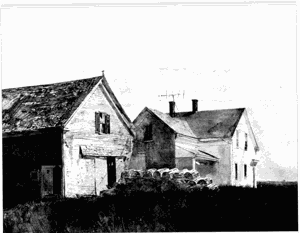
Eaton Place, Andrew Wyeth, 1964
Andrew Wyeth, retratoAndrew WyethEstados Unidos, 1917–2009

Eaton Place

1964 · Painting; Watercolor on paper · 28 x 40 in

¿Se puede contemplar?

No: fue robada y se la busca

Listed in the FBI's National Stolen Art File under no. 00187.

Comprobado
hace 9 días· Según informes
En este estado desde
30 sept 2026
Fuente
Un registro de arte robado
Todas las obras robadas y perdidas

Ficha

1964 · a los 47 años
19172009

En el catálogo

PinturaPintura estadounidenseArte de posguerraSiglo XX

Fuentes

  • El registro de arte robado del FBI
  • Imagen: FBI National Stolen Art File

Mientras tanto, en la vida de Andrew Wyeth

La vida entera
  1. 1950–1970s

    The Kuerner farm, his subject for 30 years

    His Chadds Ford neighbours Anna and Karl Kuerner and their farm were among Wyeth's chief subjects for nearly 30 years: “I didn't think it a picturesque place. It just excited me, purely abstractly and purely emotionally.” In “Brown Swiss” (1957), named after Karl's cows, there are no cows — only their tracks in the grass.

  2. 1960s

    Turning to portraiture

    In the 1960s Wyeth began to paint portraits: his friend Tom Clark (“Garret Room”, 1962), his neighbour Adam Johnson (“Adam”, 1963), his sister Carolyn (“Up in the Studio”, 1965).

  3. 1963 · Distinción

    Presidential Medal of Freedom

  4. 1965

    In Life magazine he calls himself an abstractionist

    In a 1965 Life magazine article Wyeth said that although he was thought of as a realist, he thought of himself as an abstractionist: “My people, my objects breathe in a different way: there's another core — an excitement that's definitely abstract.”
Más obras de Andrew Wyeth

Todas las obras
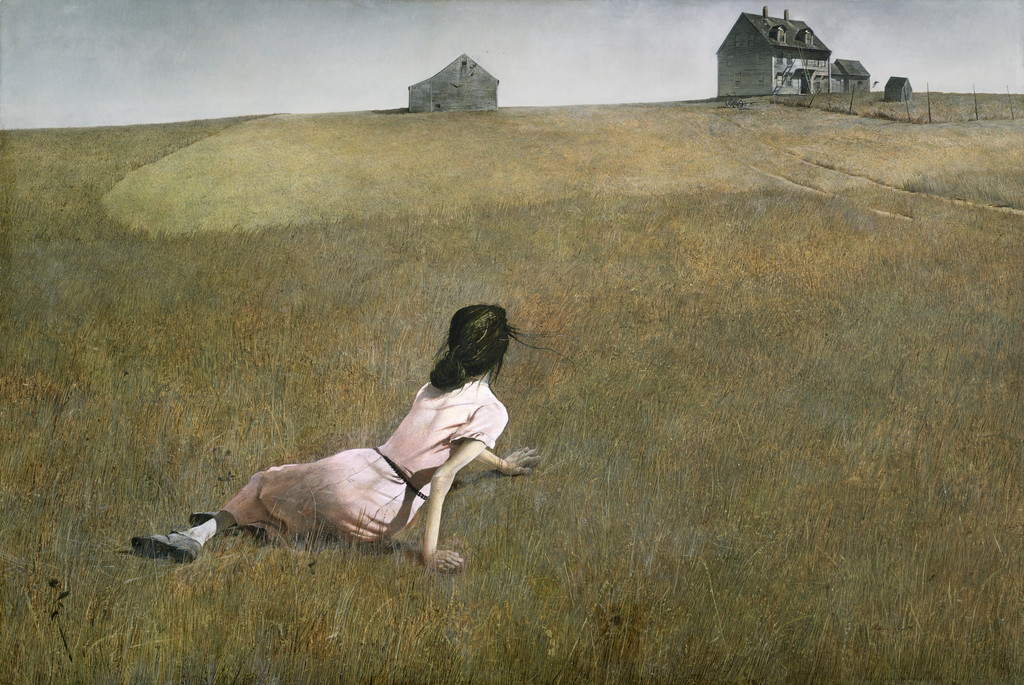
Christina's World, Andrew Wyeth, 1948

Christina's World

1948 · MoMA

Wind from the Sea, Andrew Wyeth, 1947

Wind from the Sea

1947 · Galería Nacional de Arte

The Door Step, Andrew Wyeth, 1940s

The Door Step

1940s · No expuesta · Galería Nacional de Arte

Christmas Card, Andrew Wyeth

Christmas Card

No expuesta · Galería Nacional de Arte

Christmas Card, Andrew Wyeth

Christmas Card

No expuesta · Galería Nacional de Arte

Lobsterman's Ledge, Andrew Wyeth, 1939

Lobsterman's Ledge

1939 · No expuesta · Galería Nacional de Arte

The Oak, Andrew Wyeth, 1940-1945

The Oak

1940-1945 · No expuesta · Galería Nacional de Arte

Brandywine Valley, Andrew Wyeth, 1940

Brandywine Valley

1940 · No expuesta · Galería Nacional de Arte