Knud BaadeNoruega
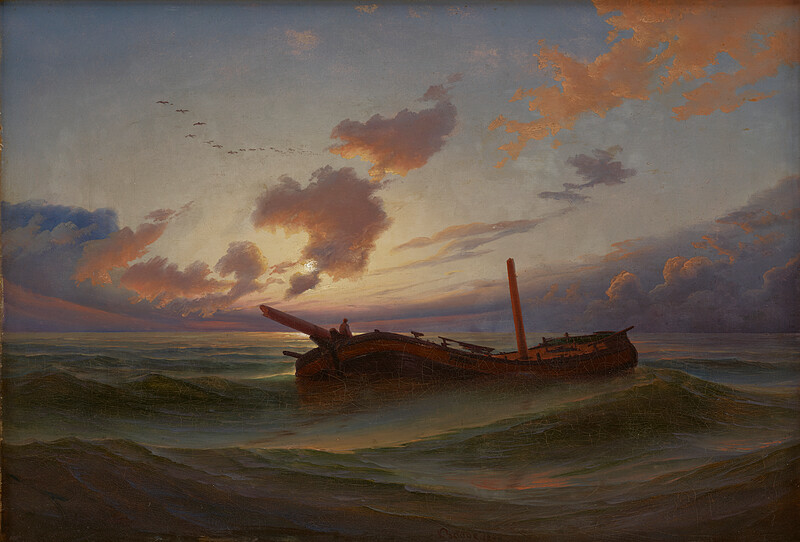
Dresden i solnedgång
¿Se puede contemplar?
Se desconoce

Museo Nacional de Suecia
Estocolmo, Suecia
Se conoce el propietario; no se sabe si hoy está expuesta.
- En este estado desde
- Fuente
- El museo
Sobre el cuadro
New acquisitions, June 2016: Three examples of Dresden Romanticism Nationalmuseum has acquired three works by painters of the Dresden Romantic school: Fantasy of the Alps by Carl Gustav Carus, Oak and Birch by Carl Julius von Leypold and Dresden at Sunset by Knud Baade. Along with the works by Johan Christian Dahl already in the museum’s collection, the new acquisitions constitute a comprehensive presentation of a significant period in the art history of northern Europe. For several decades starting around the turn of the 19th century, Dresden was a major centre of the Romantic movement in literature, philosophy and art. The ideas behind this intense period of artistic creativity rippled across much of Europe. A key figure of the period was Caspar David Friedrich, who advocated a fundamental renewal of the landscape painting genre.
Seguir leyendo
Previous timeless and faraway landscapes from around 1800 harkened back to Claude Lorrain’s 17th-century Arcadian scenes. Caspar David Friedrich broke with this long-held ideal by painting more realistic motifs. He depicted nature with great precision and allowed the locations of his paintings to appear as if they were the audience’s own surroundings. However, his intent was to connect onlookers through the image with something else, perhaps best described as the freedom to let their own imagination take over. A relationship between artist, painting and audience that, according to some, constitutes the very essence of Romanticism as expressed by the poet Novalis in the famous lines, “The world must be romanticized.
Only in that way will one rediscover its original senses. […] I romanticize something when I give the commonplace a higher meaning, the known the dignity of the unknown, and the finite the appearance of the infinite.” Incorporating lifelike elements, Caspar David Friedrich composed his landscapes so as to turn scenery into food for the imagination rather than mere terrain, so as to remind audiences of the extraordinary that is inherent in the familiar. All three of Nationalmuseum’s new acquisitions illustrate this principle. Carl Gustav Carus’ (1789–1869) Fantasy of the Alps is a transfixing scene with the dominant, dramatically positioned eagles in the foreground. Longing was a concept central to Romantic art and literature, and was often represented by the horizon or by distant mountains that awaken dreams of what lies beyond.
The eagles in effect make this painting a Romantic manifesto, as if to prove the point that there are no limits to how far the inner eye can see. A doctor by profession, Carus was a member of Dresden’s intellectual elite and was close friends with Goethe, Caspar David Friedrich and Johan Christian Dahl. Carl Julius von Leypold (1806–1874) studied under both Johan Christian Dahl and Caspar David Friedrich. Of all Friedrich’s pupils, he was the one who came closest to his teacher in terms of technique – so much so that several of his paintings were long mistaken for works by Friedrich and have only fairly recently been identified as Leypold’s work. Nationalmuseum’s newly acquired painting is a study of an oak and a birch tree on a hillside. Judging by the date on the work, 18 April 1832, it was painted in a single day, and the fresh style suggests that Leypold painted it on location.
However, it is also conceivable that he did not find a scene that looked exactly like this, but rather sought out the trees individually after deciding what he was going to paint. Although meticulously realistic in its depiction of nature, there is something about the painting that is hard to pin down, something that feeds the audience’s imagination. The intricately stylized branches of the trees call to mind the ornamentation of Gothic cathedrals, and the hillside is balanced in such a way that it is hard not to imagine what might lie beyond. The third painting is not much bigger than a postcard, but epic in nature. It is dated 1838. Knud Baade (1808–1879) travelled from Norway to Dres
Museo Nacional de Suecia
Ficha
En el catálogo
Fuentes
- Museo Nacional de Suecia
- Imagen: Museo Nacional de Suecia — Public Domain Mark 1.0
![Preparatory Study for After the Storm [recto] Study of a Shipwreck [verso], Knud Baade, 1841](https://img.artsmia.org/web_objects_cache/150000/600/90/150693/mia_8037990_800.jpg)
