Joaquín SorollaEspaña, 1863–1923
Dos figuras masculinas
¿Puedo verla?
Se desconoce
¿Dónde está «Dos figuras masculinas» hoy? Colección: Museo Sorolla, Madrid. Se desconoce.

Madrid, España
Se conoce el propietario; no se sabe si hoy está expuesta.
- En este estado desde
- Fuente
- El museo
Sobre la obra
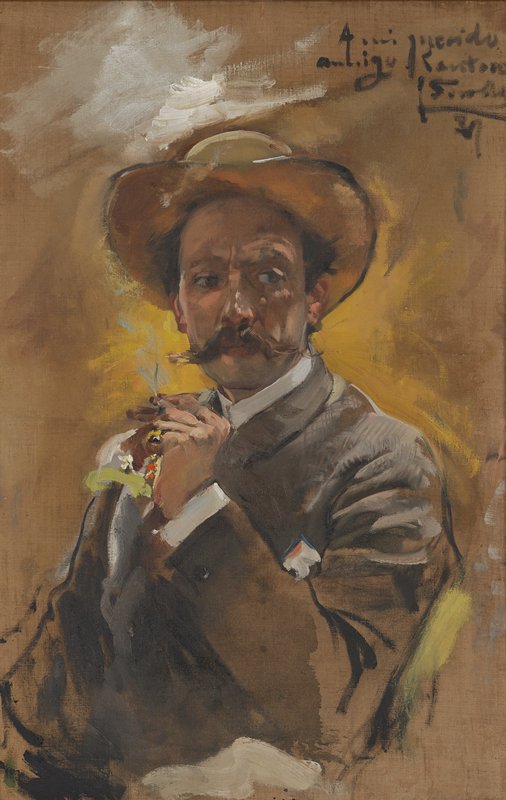
Anverso: El herrero Figura masculina de cuerpo entero, de pie, casi de frente a nosotros. Está inclinado hacia su izquierda, apoyándose en lo que parece una barca. Lleva mandil de su oficio. Reverso: Dos figuras masculinas En primer plano, figura masculina de espaldas, ligeramente girada. Lleva fajín a la cintura, gorra a la cabeza y está fumando en pipa. Tiene las manos en los bolsillos, y frente a él hay una estructura que no identificamos. A la izquierda, esbozo de otra figura, muy esquemático.
Museo Sorolla
Ficha
Lo que muestra
En el catálogo
Fuentes
- Museo Sorolla
- Imagen: Museo Sorolla — In Copyright
En la vida de Joaquín Sorolla
La vida entera1888
Returns to Valencia to marry Clotilde
Sorolla returned to Valencia to marry Clotilde García del Castillo; by 1895 they had three children — María, Joaquín and Elena.
13 de abril de 1889
Daughter born: María Sorolla García
1890
Moves to Madrid: large canvases for the salons
The family moved to Madrid. For the next decade Sorolla concentrated on large canvases of orientalist, mythological, historical and social subjects for salons and international exhibitions in Madrid, Paris, Venice, Munich, Berlin and Chicago.
8 de noviembre de 1892
Son born: Joaquín Sorolla García
12 de junio de 1895
Daughter born: Elena Sorolla García
1897
“A Research”: the Prize of Honour in Madrid
Two paintings linking art and science, “Portrait of Dr. Simarro at the Microscope” and “A Research”, won Sorolla the Prize of Honour at the National Exhibition of Fine Arts. He showed his friend Simarro in the laboratory, catching the contrast between the reddish-yellow light of a gas burner and the weak mauvish light from the window.