 Roy LichtensteinEstados Unidos, 1923–1997
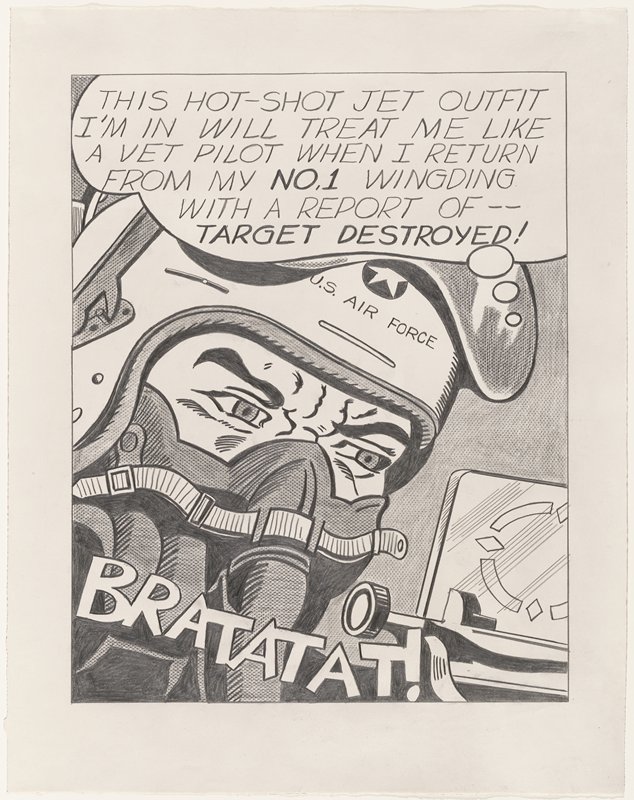
Bratatat!
¿Se puede contemplar?
Por ahora no recibe

Instituto de Artes de Mineápolis
Minneapolis, Estados Unidos
Pertenece a la colección, pero ahora mismo no está expuesta.
- Comprobado
- anteayer
- En este estado desde
- 25 sept 2026
- Fuente
- Los datos de colección del propio museo
Sobre la obra
Comic books were important sources for Roy Lichtenstein’s early Pop experiments, especially the genre’s distinctive pictorial conventions. The artist began Bratatat! by making a small freehand drawing based on a single comic strip panel. He then redrew the composition, much enlarged, with the aid of an opaque projector. He intentionally mimicked commercial printing, using flat areas of tone, strong contrasts, precise outlines, and stylized shading. He also rubbed the paper on perforated metal sheets to simulate the Benday dot pattern common to cheap photomechanical reproduction. For Lichtenstein, the process of manipulating and altering the source image while retaining the quirky conventions of comics was critical to the work’s ultimate meaning as fine art.
Instituto de Artes de Mineápolis
Ficha
- Número de inventario
- 64.75
En el catálogo
Fuentes
- Instituto de Artes de Mineápolis: the museum's own open data · obtenido hace 6 días
- Imagen: Instituto de Artes de Mineápolis — © Estate of Roy Lichtenstein
Mientras tanto, en la vida de Roy Lichtenstein
La vida entera1960
Rutgers and the influence of Allan Kaprow
In 1960 Lichtenstein began teaching at Rutgers University, where he was heavily influenced by Allan Kaprow, who also taught there. The environment reignited his interest in proto-Pop imagery.
1961
The turn to Pop Art: a challenge from his son
In 1961 Lichtenstein began his first Pop paintings, using cartoon images and techniques derived from commercial printing; the first work to use hard-edged figures and Ben-Day dots on a large scale was “Look Mickey”. The push came from his son, who, as the artist told it, pointed to a Mickey Mouse comic book and doubted that his father could paint as well.
1961
Leo Castelli begins showing his work
In 1961 Leo Castelli began displaying Lichtenstein’s work at his gallery in New York.
1962
The Castelli show sells out before it opens
Lichtenstein’s first one-man show at the Castelli gallery took place in 1962: the entire collection was bought by influential collectors before it even opened. The Leo Castelli Gallery has represented him exclusively since then.
1963–1964
Leaves Rutgers and returns to New York
In September 1963 Lichtenstein took a leave of absence from Douglass College at Rutgers; in 1964 he moved back to New York to be at the centre of the art scene and resigned from Rutgers to concentrate on his painting.
1964
The first American to exhibit at the Tate Gallery
Lichtenstein became the first American to exhibit at the Tate Gallery in London, in the show “’54–’64: Painting and Sculpture of a Decade”.


![Untitled [pyramid], Roy Lichtenstein, c. 1970](https://whitneymedia.org/assets/artwork/61776/2019_234_14_cropped.jpg)
![Untitled [pyramid], Roy Lichtenstein, c. 1970](https://whitneymedia.org/assets/artwork/61778/2019_234_16_cropped.jpg)
![Untitled [pyramid], Roy Lichtenstein, c. 1970](https://whitneymedia.org/assets/artwork/61777/2019_234_15_cropped.jpg)
![Untitled [pyramid], Roy Lichtenstein, c. 1970](https://whitneymedia.org/assets/artwork/61763/2019_234_1_cropped.jpg)