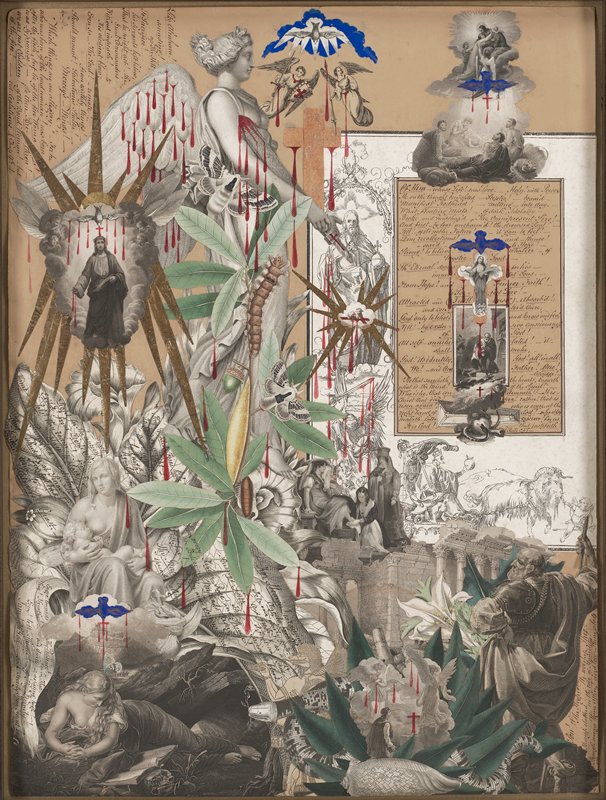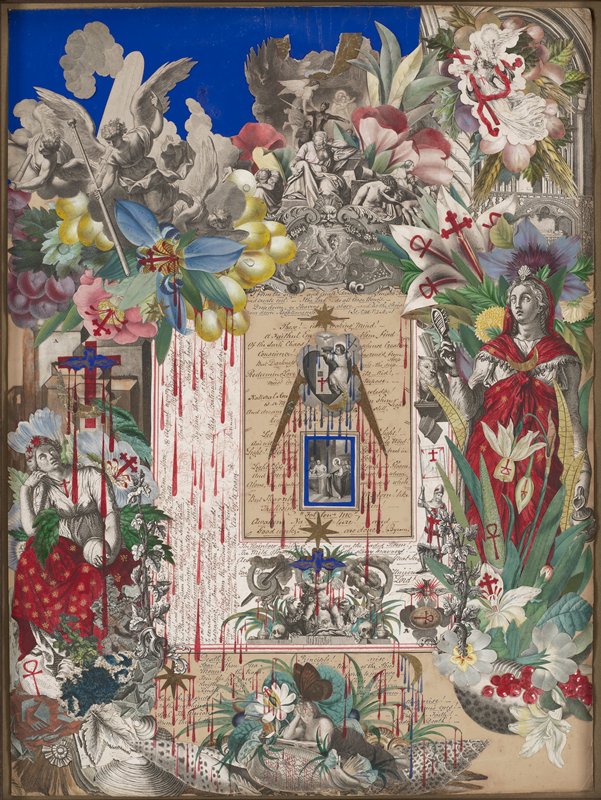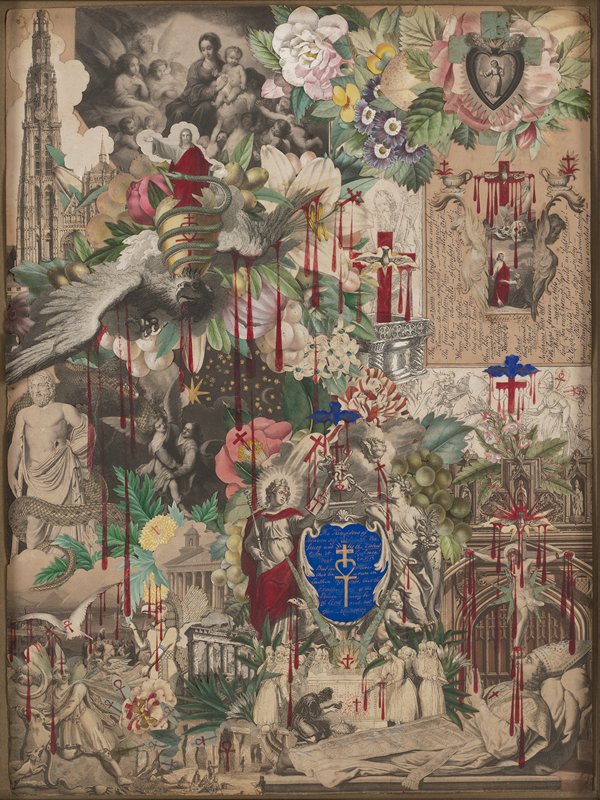
Blood Collage
¿Puedo verla?
No expuesta por ahora
¿Dónde está «Blood Collage» hoy? Colección: Instituto de Artes de Mineápolis, Minneapolis. No expuesta por ahora. Comprobado 29 de septiembre de 2026.

Minneapolis, Estados Unidos
Pertenece a la colección, pero ahora mismo no está expuesta.
- Comprobado
- En este estado desde
- Fuente
- El museo
Sobre la obra
John Bingley Garland was a prosperous English merchant, politician, public servant, and collage artist. He lived in Newfoundland for four years, in two different stints, where he managed his family’s fish trading business, and served, notably, as the first Speaker of Newfoundland’s House of Parliament. In 1834 he returned to England, where he ran his family’s firm until his death at age 83. Forty-five accomplished, fantastical “Blood Collages” by Garland survive, all likely executed in the 1850s—62 years before the medium of collage was officially “invented” by Picasso or Braque. Garland’s practice grew out of the Victorian craze for scrapbooking and decoupage, but little from that period hints at the extraordinary artistic heights he would take it.
Leer más
Drawing heavily on high-end reproductive prints of European masterworks, particularly religious art, as well as colorful, cheaply manufactured prints of flora, fauna, insects and reptile, he would meticulously cut and assemble hundreds of prints as source material to create astonishing, visionary collages. The works include extensive inscriptions of religious texts, gold and blue paper, painted gouache, and his signature drops of blood made with diluted red ink. The densely layered works incorporate a plethora of symbols—bleeding doves and crosses, red ankhs (Egyptian hieroglyph symbolizing life), serpents, skulls, stars, eggs—mixed with Christian and pagan imagery, architecture and ruins, sculpture, and archaeological fragments. It has been suggested that the mysterious, spiritual works reflect that the artist was a Freemason or member of the Knights of Templar.
Instituto de Artes de Mineápolis
Ficha
- Número de inventario
- 2021.22.2
En el catálogo
Fuentes
- Instituto de Artes de Mineápolis
- Imagen: Instituto de Artes de Mineápolis — public domain