ART WIKI33.040 en sala
MapaColecciónArtistasMuseosExposicionesRevista
Acceder

ART WIKI

Dónde cuelga la obra maestra y cuándo le dejan pasar.

Colecciones: Galería Nacional de Arte, Galería Nacional de Dinamarca, Galería Nacional de Retratos, Galería Tretiakov, Harvard Art Museums, Instituto de Arte de Chicago, Instituto de Artes de Mineápolis, MoMA, Museo de Arte de Cleveland, Museo de Victoria y Alberto, Museo del Hermitage, Museo del Louvre, Museo Estatal Ruso, Museo Hirshhorn y Jardín de Esculturas, Museo J. Paul Getty, Museo Metropolitano de Arte, Museo Pushkin, Museo Smithsoniano de Arte Americano, Museo Whitney de Arte Estadounidense, National Museum of Asian Art, Rijksmuseum, Villa Getty, Catálogo Estatal del Fondo Museístico de Rusia (274 museos), Europeana (19 museos), Wikidata (6 museos), Paris Musées (12 museos) y Joconde, la base de museos del Ministerio de Cultura de Francia (495 museos). Las imágenes pertenecen a sus titulares de derechos.

Secciones

  • Mapa
  • Búsqueda
  • Colección
  • Obras maestras
  • Expuestas ahora
  • Artistas

Más

  • Museos y galerías
  • Exposiciones
  • Revista
  • De dónde salen los datos
  • Privacidad y cookies
InicioMapaCatálogo
  1. Colección/
  2. Harvard Art Museums/
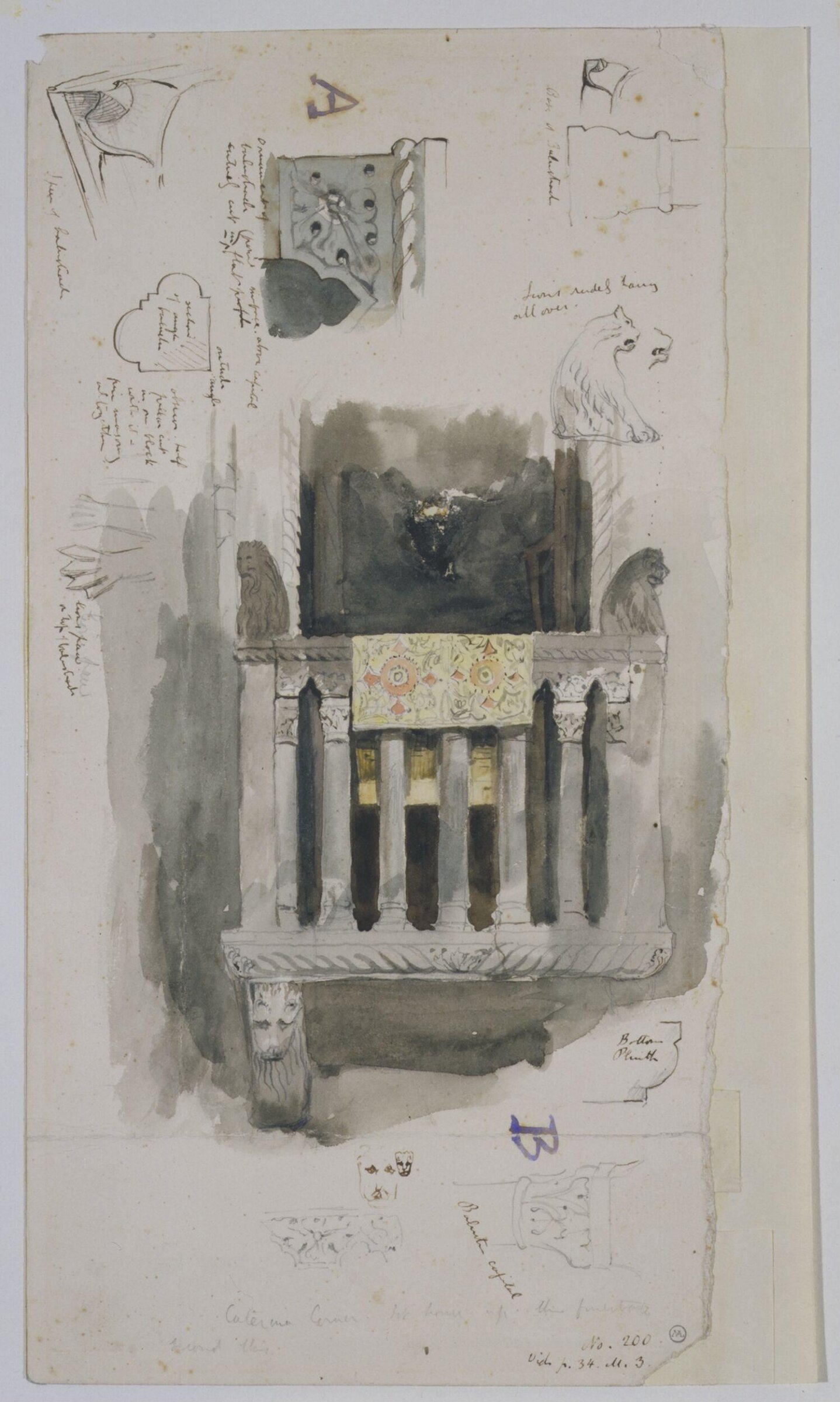
  3. Architectural Study: Palazzo Dandolo
Architectural Study: Palazzo Dandolo, John Ruskin, 1849
John Ruskin, retratoJohn RuskinInglaterra, 1819–1900

Architectural Study: Palazzo Dandolo

1849 · Drawing

¿Se puede contemplar?

Por ahora no recibe

Harvard Art Museums

Cambridge, Estados Unidos

Pertenece a la colección, pero ahora mismo no está expuesta.

Comprobado
hace 9 días
En este estado desde
27 sept 2026
Fuente
El museo
En el mapaPágina del museo

Ficha

1849 · a los 30 años
18191900
Número de inventario
1926.33.123

En el catálogo

Dibujos y acuarelasTintaRomanticismoRealismoSiglo XIXReino Unido

Fuentes

  • Harvard Art Museums
  • Imagen: Harvard Art Museums — © President and Fellows of Harvard College

Mientras tanto, en la vida de John Ruskin

La vida entera
  1. 1834–1900 · Lugar de trabajo

    Great Britain

  2. October 1847

    Engagement to Effie Gray

    During 1847 Ruskin grows closer to Euphemia “Effie” Gray, the daughter of family friends, for whom he had once written “The King of the Golden River”; they become engaged in October.

  3. 10 de abril de 1848

    Married: Effie Gray

  4. 1849

    In Venice with Effie: the sketches behind “The Stones of Venice”

    In November 1849 the couple stay at the Hotel Danieli: Effie looks for company, while Ruskin works alone and hurries to draw the Ca' d'Oro and the Doge's Palace, fearing that the occupying Austrian troops will destroy them. These sketches and notes will grow into “The Stones of Venice”.

  5. May 1851

    Letters to The Times defending the Pre-Raphaelites

    Millais and his fellow artists approach Ruskin through their mutual friend Coventry Patmore; Millais's “Christ in the House of His Parents” (1849–50), which some considered blasphemous, at first fails to impress him, but in May 1851 he writes letters to The Times defending the Pre-Raphaelite Brotherhood.

  6. 1851–1853

    The three-volume “Stones of Venice”

    Growing from a technical history of Venetian architecture, from the Byzantine to the Renaissance, into a broad cultural history, the work is a warning to contemporary England about the moral and spiritual health of society: Ruskin explains the decline of Venice by the loss of true Christian faith. The chapter “The Nature of Gothic” from the second volume — a critique of the division of labour and industrial capitalism — will be published by William Morris as a separate book.
Más obras de John Ruskin

Todas las obras
Architectural details from the Sagredo Palace, Venice, John Ruskin, 19th century

Architectural details from the Sagredo Palace, Venice

19th century · Museo de Victoria y Alberto

View of Amalfi, John Ruskin, 1844

View of Amalfi

1844 · Harvard Art Museums

Fragment of the Alps, John Ruskin, c. 1854-1856

Fragment of the Alps

c. 1854-1856 · Harvard Art Museums

Gezicht op S. Anastasia te Verona, over de Adige, John Ruskin, 1829 - 1900

Gezicht op S. Anastasia te Verona, over de Adige

1829 - 1900 · Rijksmuseum

Bergkam aan het Meer van Genève, John Ruskin, 1829 - 1900

Bergkam aan het Meer van Genève

1829 - 1900 · Rijksmuseum

The Garden of San Miniato near Florence, John Ruskin, 1845

The Garden of San Miniato near Florence

1845 · No expuesta · Galería Nacional de Arte

Tower of the Cathedral at Sens, John Ruskin, c. 1845

Tower of the Cathedral at Sens

c. 1845 · No expuesta · Galería Nacional de Arte

Ornamental Study with Acanthus Motif for "The Stones of Venice", John Ruskin, 1849

Ornamental Study with Acanthus Motif for "The Stones of Venice"

1849 · No expuesta · Galería Nacional de Arte

Bajo el mismo techo: Harvard Art Museums

Página del museo
Glück auf in Deutschland (N:4), Pınar Öğrenci, 2024

Pınar Öğrenci

Glück auf in Deutschland (N:4), 2024

Glück auf in Deutschland (N:10), Pınar Öğrenci, 2024

Pınar Öğrenci

Glück auf in Deutschland (N:10), 2024

Glück auf in Deutschland (N:7b), Pınar Öğrenci, 2024

Pınar Öğrenci

Glück auf in Deutschland (N:7b), 2024

Glück auf in Deutschland (N:6), Pınar Öğrenci, 2024

Pınar Öğrenci

Glück auf in Deutschland (N:6), 2024

Glück auf in Deutschland (N:11), Pınar Öğrenci, 2024

Pınar Öğrenci

Glück auf in Deutschland (N:11), 2024

Dwarpalika (Temple Guardian), Sneha Shrestha, 2023

Sneha Shrestha

Dwarpalika (Temple Guardian), 2023

The Eternal Pond of the Universe, Bingyi 冰逸, 2022-2024

Bingyi 冰逸

The Eternal Pond of the Universe, 2022-2024

Triangle Constellation, Carlos Amorales, 2015

Carlos Amorales

Triangle Constellation, 2015