 Hendrick GoltziusPaíses Bajos, 1558–1617
Apollo
¿Puedo verla?
No expuesta por ahora
¿Dónde está «Apollo» hoy? Colección: Museo de Arte de Cleveland, Cleveland. No expuesta por ahora. Comprobado 16 de noviembre de 2026.

Cleveland, Estados Unidos
Pertenece a la colección, pero ahora mismo no está expuesta.
- Comprobado
- En este estado desde
- Fuente
- El museo
Sobre la obra
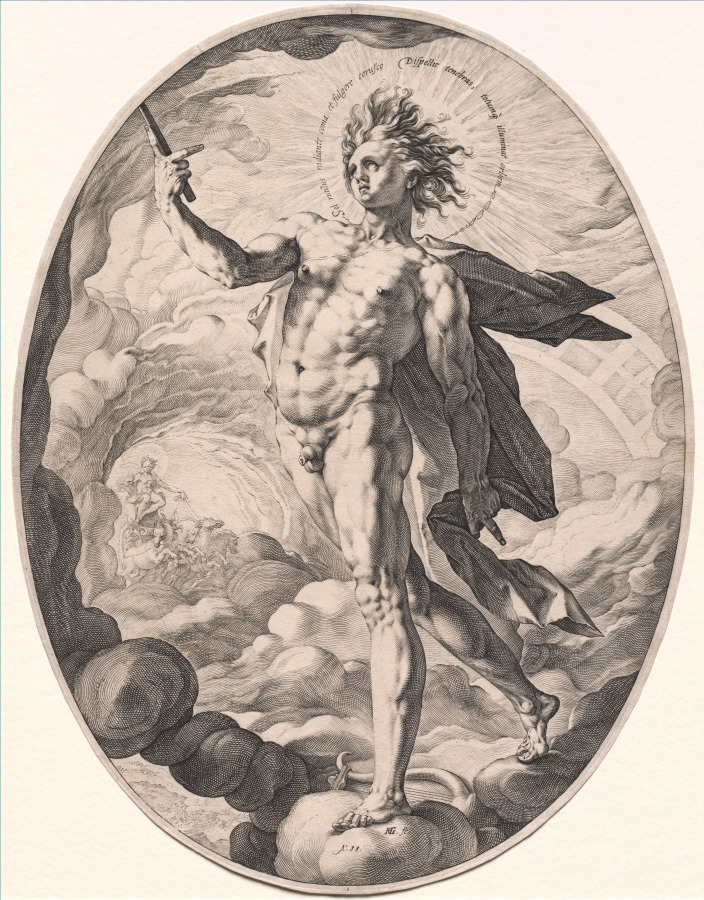
Hendrick Goltzius’s Apollo, engraved in 1588, is displayed in gallery 101A of the Cleveland Museum of Art, Cleveland. Flame-like hair crowns the sun god as he strides over billowing clouds. His chariot travels across the sky behind him. Latin words form a halo, describing sunlight driving darkness away and illuminating the earth. The body’s swollen muscles belong to the exaggerated forms of late-sixteenth-century Mannerism. By pushing an athletic physique beyond natural proportions, Goltzius gives the figure the anatomy of a supernatural being.
En palabras del museo
This engraving depicts Apollo as the radiant sun god. With fire-like hair, he strides through rolling waves of clouds, while in the background his chariot makes its daily trip across the sky. The Latin text that forms his halo translates: “With its aureole and shining ray, the bright Sun drives away the darkness and lights the whole earth.” Apollo’s excessively muscled body reflects an aspect of Mannerism, a stylistic trend in the mid- to late 1500s that exaggerated natural qualities. By over embellishing Apollo’s musculature, Goltzius transformed an athletic male body into a supernatural one.
Museo de Arte de Cleveland
Ficha
- Número de inventario
- 1969.48
En el catálogo
Exposiciones
Ahora no está expuesta
Museo de Arte de Cleveland · 9 nov 2026 — hoy · Verificado
Estaba expuesta · 101A Prints & Drawings
Museo de Arte de Cleveland · 19 ago 2026 — 9 nov 2026 · Verificado
Fuentes
- Museo de Arte de Cleveland
- Imagen: Museo de Arte de Cleveland — Museum open access
En la vida de Hendrick Goltzius
La vida entera1579–1587
Pupil: Jan Saenredam
late 1580s
Depression and consumption
From the late 1580s he suffered from depression and consumption; his family life was unhappy.
1585–1587
Pupil: Jacob de Gheyn II
1587
Founding of the Haarlem Academy
Together with Cornelis van Haarlem and Karel van Mander he founded an academy of art in Haarlem, later known as the Haarlem Mannerist Academy (some sources give 1583 or 1600). There, for the first time in the Netherlands, systematic study of anatomy and drawing from the nude model were introduced.
1590
Departure for Italy
He fled from his wife and, despite his illnesses, set out for Italy — via Hamburg and Munich to Venice, Bologna and Florence. Part of the way he traveled on foot, passing himself off as a commoner, "partly out of a love of mystification."