Joaquín SorollaEspaña, 1863–1923
Aparejando el caballo
¿Se puede contemplar?
Se desconoce

Madrid, España
Se conoce el propietario; no se sabe si hoy está expuesta.
- En este estado desde
- Fuente
- El museo
Sobre la obra
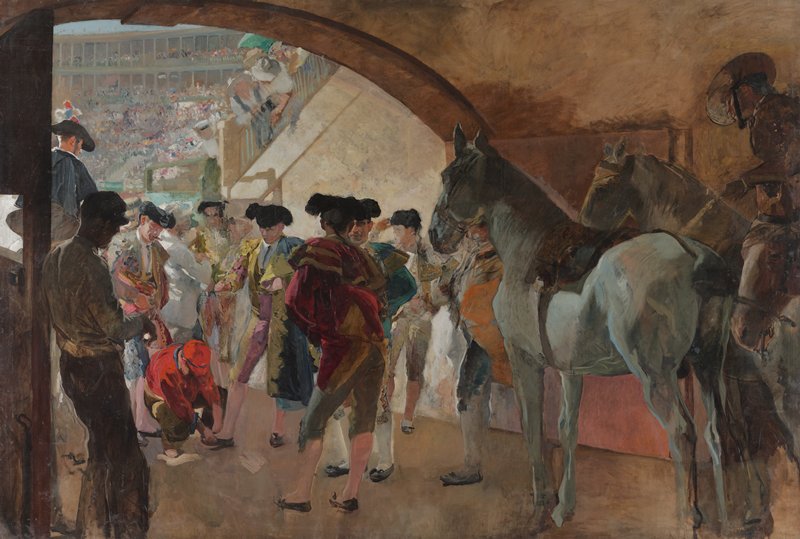
Anverso: Aparejando el caballo A la izquierda, una figura masculina de perfil a la derecha extiende las manos hacia la cabeza de un caballo que tiene en frente, ajustándole las riendas. El caballo está visto de perfil a la izquierda y sólo la cabeza, ya que el resto de su cuerpo está tapado por otro caballo que tampoco se ve completo, cortándose por una línea vertical. Este segundo caballo está montado por un jinete del que solo vemos la pierna, en la que se distingue el pantalón de un torero (taleguilla) con los machos para ajustarlo bajo la rodilla. En la parte derecha, esbozo de un caballo mucho menos detallado que los anteriores. Reverso: Estudios de toreros y caballos Un caballo visto desde los cuartos traseros, montado por jinete, pero cortado en el lado derecho por líneas verticales. A la derecha, tres estudios superpuestos. En el primero, un personaje agachado, puede que ajustando algún arreo del caballo. El segundo se inscribe en un rectángulo y sólo se distinguen dos figuras. El tercero son otras dos figuras, muy esquemáticas.
Museo Sorolla
Ficha
Lo que muestra
En el catálogo
Fuentes
- Museo Sorolla
- Imagen: Museo Sorolla — In Copyright
Mientras tanto, en la vida de Joaquín Sorolla
La vida entera12 de junio de 1895
Daughter born: Elena Sorolla García
1897
“A Research”: the Prize of Honour in Madrid
Two paintings linking art and science, “Portrait of Dr. Simarro at the Microscope” and “A Research”, won Sorolla the Prize of Honour at the National Exhibition of Fine Arts. He showed his friend Simarro in the laboratory, catching the contrast between the reddish-yellow light of a gas burner and the weak mauvish light from the window.
1900
Grand Prix at the Paris Universal Exposition
“Sad Inheritance”, a huge canvas of crippled children bathing in the sea at Valencia under a monk’s supervision, brought Sorolla his greatest official recognition, the Grand Prix and a medal of honour, and his exhibit as a whole earned him nomination as a Knight of the Legion of Honour. After this picture he never returned to so overtly social a theme.
1901
A medal of honour in Madrid for “Sad Inheritance”
The painting won the medal of honour at the National Exhibition in Madrid. Two of its luminous preparatory oil sketches Sorolla gave as gifts to the American artists John Singer Sargent and William Merritt Chase.
1901 · Distinción
Knight of the Legion of Honour
1902 · Distinción
Grand cross of the Civil Order of Alfonso XII