 Pierre-Joseph RedoutéFrancia, 1759–1840
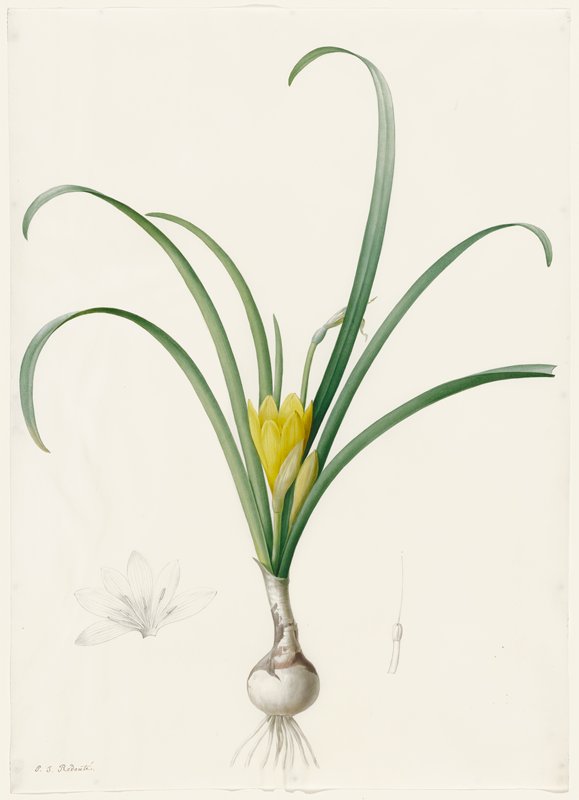
Amaryllis lutea
¿Puedo verla?
No expuesta por ahora
¿Dónde está «Amaryllis lutea» hoy? Colección: Instituto de Artes de Mineápolis, Minneapolis. No expuesta por ahora. Comprobado 29 de septiembre de 2026.

Minneapolis, Estados Unidos
Pertenece a la colección, pero ahora mismo no está expuesta.
- Comprobado
- En este estado desde
- Fuente
- El museo
Sobre la obra
Pierre-Joseph Redouté was the foremost flower painter of the golden age of botanical illustration that spanned the century from 1750 to 1850. This drawing of the hardy bulbous perennial Amaryllis lutea exemplifies his extraordinary observational and artistic skills. Stark and graceful, it shows the general characteristics of the flowers, leaves, stem, bulb, and roots of the mature plant. Also portrayed in this single image are three stages of flowering, from bud to spent bloom. Two meticulous pencil renderings of the plant’s reproductive system are included, one describing the anatomy of the flower’s corolla and stamens, the other its single pistil.
Leer más
This work was originally part of a collection of flower portraits commissioned by Empress Joséphine de Beauharnais, the first wife of Napoleon Bonaparte. Redouté studied many of the specimens for the series at Malmaison, Joséphine’s grand estate near Paris. The composition was engraved for Redouté’s eight volume magnum opus Les Liliacées (1802–16).
Instituto de Artes de Mineápolis
Ficha
- Número de inventario
- 91.32
En el catálogo
Fuentes
- Instituto de Artes de Mineápolis
- Imagen: Instituto de Artes de Mineápolis — public domain
![Elément décoratif [Fleurs], Pierre Joseph Redoute, 4e quart 18e siècle, 1er quart 19e siècle](https://pop-perf-assets.s3.gra.io.cloud.ovh.net/joconde/50190041716/0113312.jpg)
![Elément décoratif [Fruits], Pierre Joseph Redoute, 4e quart 18e siècle, 1er quart 19e siècle](https://pop-perf-assets.s3.gra.io.cloud.ovh.net/joconde/50190041696/0113350.jpg)
![Elément décoratif [Oiseau], Pierre Joseph Redoute, 4e quart 18e siècle, 1er quart 19e siècle](https://pop-perf-assets.s3.gra.io.cloud.ovh.net/joconde/50190041711/0113243.jpg)
![Elément décoratif [Fruits], Pierre Joseph Redoute, 4e quart 18e siècle, 1er quart 19e siècle](https://pop-perf-assets.s3.gra.io.cloud.ovh.net/joconde/50190041694/0113240.jpg)
![Elément décoratif [Fruits], Pierre Joseph Redoute, 4e quart 18e siècle, 1er quart 19e siècle](https://pop-perf-assets.s3.gra.io.cloud.ovh.net/joconde/50190041693/0113223.jpg)