Jasper JohnsEstados Unidos, 1930
Alphabet
¿Puedo verla?
Sí, expuesta ahora
¿Dónde está «Alphabet» hoy? Instituto de Arte de Chicago, Sala 292, Chicago. Sí, expuesta ahora. Comprobado 16 de noviembre de 2026.

Chicago, Estados Unidos
Abierto· hasta las 20:00
Expuesta al público.
- Comprobado
- En este estado desde
- Fuente
- El museo
Sobre el cuadro
Jasper Johns arranged one complete A-to-Z sequence in Alphabet (1959), in the Art Institute of Chicago, Chicago, the only painting in which he used that single progression. Stencilled letters form a grid, but brushmarks and pasted fragments of painted paper disrupt orderly reading. Primary colours join other hues across the surface, introduced into his practice that year. Following the letters from the upper left becomes difficult as the scattered marks pull attention elsewhere. The measured letterforms and freely applied paint set two methods against each other. On view in Gallery 292.
En palabras del museo
Jasper Johns has worked with stencils of alphabet letters since the 1950s, yet this is his only painting that shows a single sequence from A to Z. The artist made Alphabet the same year in which he introduced riots of primary color-augmented by touches of green, pink, orange, pale blue, gray, brown, black, and white into his work. We might try to read this painting in order, letter by letter, from top left to bottom right. But the jumble of strokes, daubs, smudges, and collaged fragments of painted paper scatters our eyes across the animated surface, challenging any sense of sequential progress. In this way, two different stylistic approaches orderly grids of stenciled forms versus brushy gestures are set against one another.
Instituto de Arte de ChicagoCC BY 4.0
Ficha
- Número de inventario
- 2015.121
En el catálogo
Fuentes
- Instituto de Arte de Chicago
- Imagen: Instituto de Arte de Chicago — © the artist or rights holder
En la vida de Jasper Johns
La vida entera1957
Un estudio en Coenties Slip entre otros artistas
En 1957 Johns vivió en antiguos desvanes navieros del puerto del Bajo Manhattan, en torno a Coenties Slip, que habían sido ocupados por artistas, junto a Rauschenberg, Robert Indiana y Ellsworth Kelly; la comunidad albergó también durante un tiempo a Agnes Martin.
1957
Leo Castelli descubre a Johns
En marzo de 1957, durante una visita al estudio de Rauschenberg, el marchante Leo Castelli pidió ver el arte de Johns: en el piso de abajo encontró «una fantástica exhibición de banderas y dianas» y ofreció de inmediato una exposición a Johns. Según otras fuentes, Castelli descubrió a Johns en 1958.
early 1958
Primera exposición individual en la Leo Castelli Gallery
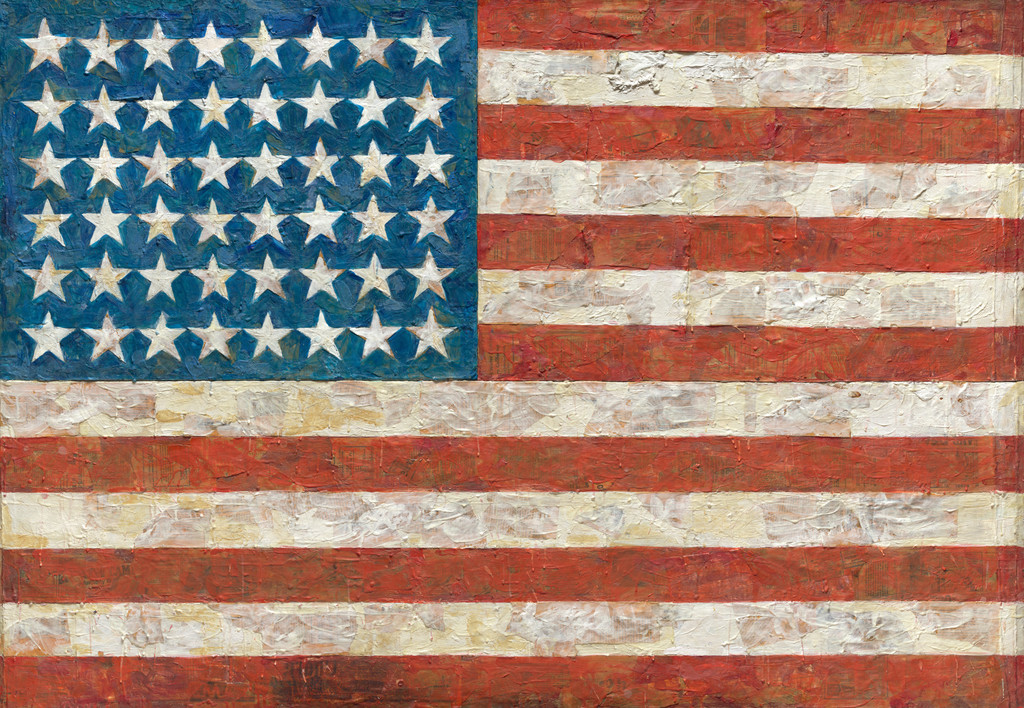
La primera exposición individual de Johns en la Leo Castelli Gallery, a principios de 1958, fue bien recibida: se vendieron todas las obras salvo dos de las dieciocho expuestas. Alfred H. Barr Jr., director fundador del Museum of Modern Art, compró tres pinturas, las primeras obras de Johns en entrar en una colección de museo; los patronos temían ataques de grupos patrióticos por «Flag», así que Barr dispuso que el arquitecto Philip Johnson la comprara y la donara al museo en 1973.
1960
Se inicia en la litografía en la ULAE de Tatyana Grosman
En 1960 Tatyana Grosman, fundadora de Universal Limited Art Editions, invitó a Johns a su taller de grabado en Long Island. Empezando por litografías de sus motivos familiares, como «Target» (1960), llegó a publicar más de 180 ediciones con ULAE en diversas técnicas.
1961
Se separa de Rauschenberg
En 1961 terminaron la relación sentimental y la estrecha colaboración de Johns con Robert Rauschenberg, iniciadas en 1953; Rauschenberg había sido una profunda influencia artística para él.