 Johannes VermeerDutch, 1632–1675
Woman with a Lute
Young Woman with a Lute
May one see it?
Yes, receiving visitors

The Metropolitan Museum of Art
Room614New York, United States
On public display.
- Checked
- 4 hours ago
- In this state since
- Aug 16, 2026
- Source
- The museum's own collection data
About the painting
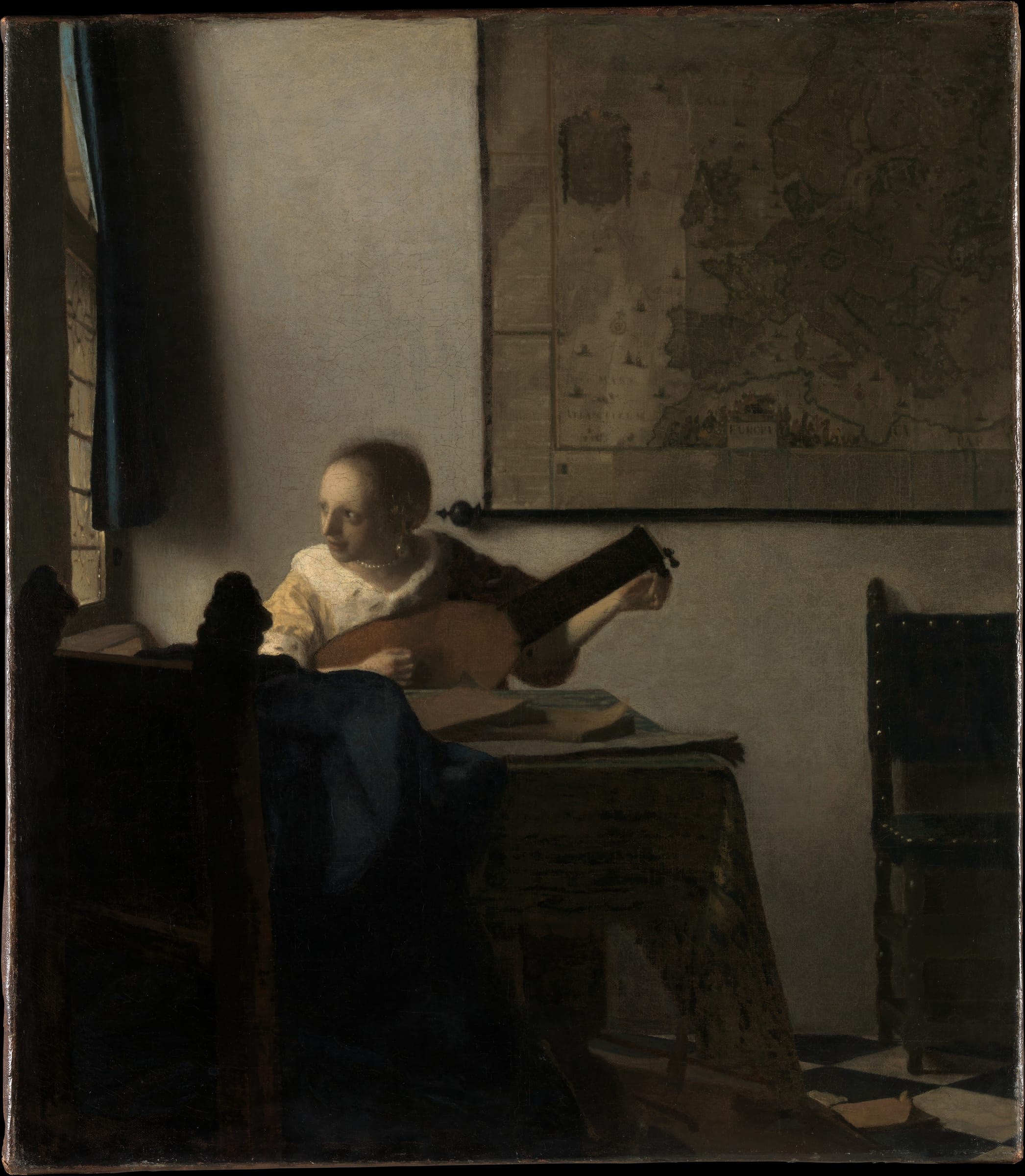
Woman with a Lute, also known as Woman with a Lute Near a Window, is a painting created about 1662–1663 by Dutch painter Johannes Vermeer and now at the Metropolitan Museum of Art in New York.
The painting depicts a young woman wearing an ermine-trimmed jacket and enormous pearl earrings as she eagerly looks out a window, presumably expecting a male visitor. "A musical courtship is suggested by the viola da gamba on the floor in the foreground and by the flow of songbooks across the tabletop and onto the floor," according to a web page about the work at the Metropolitan Museum of Art website. The tuning of a lute was recognized by contemporary viewers as a symbol of the virtue of temperance. The oil on canvas work is 20¼ inches high and 18 inches wide (51.4 × 45.7 cm). The painting's canvas was almost certainly cut from the same bolt as that used for Lady Writing a Letter with her Maid.
Read on
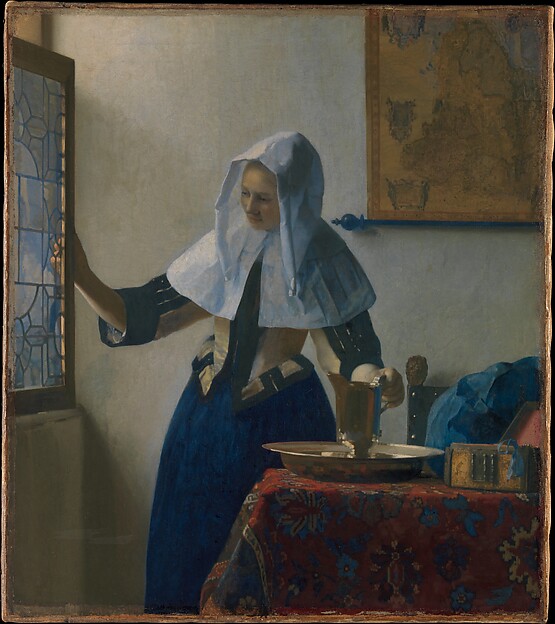
The work likely was painted shortly after Young Woman with a Water Pitcher, and it shares with that painting its framing of the figure within rectangular motifs. But the painting has more muted tones, reflecting a shift in that direction by Vermeer in the mid- to late 1660s. At this time, Vermeer began using shadows and soft contours to further evoke an atmosphere of intimacy. "The impression of spatial recession and atmosphere is somewhat diminished by darkening with age of the objects in the foreground and by abrasion of the paint surface, mostly in the same area," according to the Metropolitan Museum of Art web page.
The painting was given to the museum in 1900 by a bequest of railroad industrialist Collis P. Huntington.
Particulars
- Accession number
- 25.110.24
- Credit line
- Bequest of Collis P. Huntington, 1900
What it shows
Sources
- The Metropolitan Museum of Art: the museum's own open data · fetched 4 days ago
- Image: The Metropolitan Museum of Art — CC0 (The Met Open Access)
Meanwhile, in the life of Johannes Vermeer
The whole life1652–1661
The influence of Pieter de Hooch in Delft
The genre painter Pieter de Hooch, who lived in Delft from 1652 to 1661, had an enormous influence on Vermeer, reflected in, among other works, Diana and Her Companions. De Hooch's individual style was developed further in Vermeer's paintings.
1653–1675
Patrons: van Ruijven and van Buyten
Pieter van Ruijven and his wife Maria de Knuijt were Vermeer's patrons for the better part of his career: van Ruijven bought much of his output, which kept Vermeer afloat financially but reduced the chances of his fame spreading beyond Delft. The baker Hendrick van Buyten held a couple of his paintings as collateral.
1653–1675 · Workplace
Delft
1660
Moving into his mother-in-law's house on the Oude Langendijk
In 1660 Vermeer and his wife moved into the eleven-room house of his mother-in-law Maria Thins on the Oude Langendijk. Here he worked in his own studio.
1662
Elected head of the Guild of Saint Luke
In 1662 Vermeer was elected head of the guild and was re-elected in 1663, 1670 and 1671, evidence that his peers considered him an established craftsman.
1663
A visit from Balthasar de Monconys
In 1663 the diplomat Balthasar de Monconys came to see Vermeer's work, but Vermeer had no paintings to show him. Monconys and the two French clergymen with him were sent to the baker Hendrick van Buyten, who held a couple of the artist's paintings as collateral.