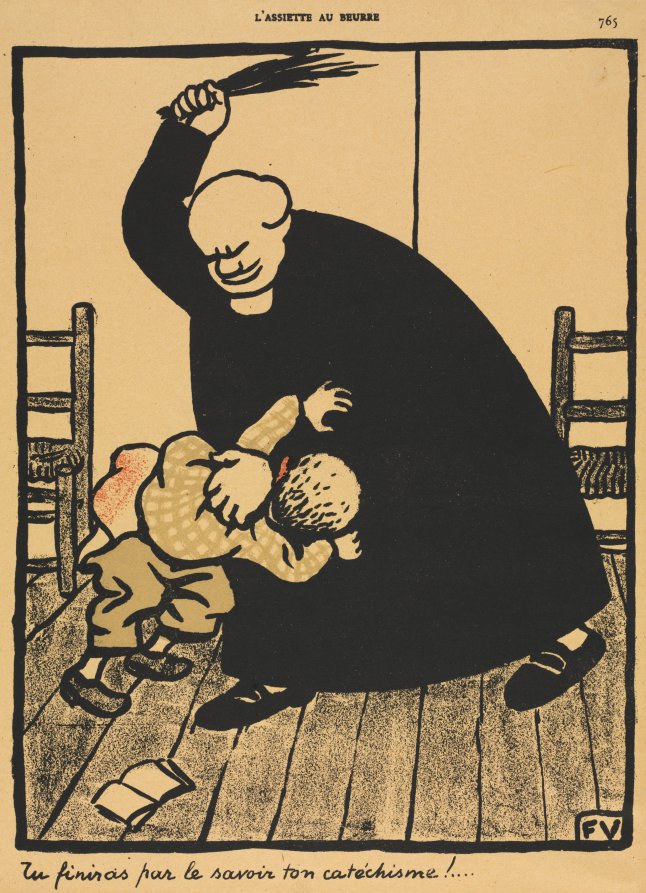
 Félix Edouard VallottonFrench, 1865–1925
You'll learn...
Can I see it?
Not on view at present
Where is “You'll learn...” now? Collection: The Cleveland Museum of Art, Cleveland. Not on view at present. Checked September 29, 2026.

Cleveland, United States
It belongs to the collection, but is not on display at present.
- Checked
- In this state since
- Source
- The museum
About the work
This print was published in the magazine L’Assiette au Beurre (March 1, 1902 ) as plate 8 from the series Crimes and Punishments.
The Cleveland Museum of Art
Details
- Accession number
- 2011.479
In the catalog
Sources
- The Cleveland Museum of Art
- Image: The Cleveland Museum of Art — Museum open access
In the life of Félix Edouard Vallotton
The whole life1899
Married: Gabrielle Bernheim
1899
After the wedding, a flat by the Gare Saint-Lazare
His wife, Gabrielle Rodrigues-Henriques — a widow and the daughter of the dealer Alexandre Bernheim, founder of the Galerie Bernheim-Jeune — brought three children from her first marriage into the household. After a brief honeymoon in Switzerland the couple moved into a large flat near the Gare Saint-Lazare; the marriage brought Vallotton financial security.
1900
Becomes a French citizen
The Swiss-born Vallotton was naturalised as a French citizen.
1900s
Exhibitions across Europe and in Russia
In the 1900s Vallotton's exhibitions met with triumph in Vienna, Munich, Zurich, Prague, London and Stockholm; his works were also shown in Moscow, St Petersburg, Kiev, Odessa and Amsterdam.
after 1901
Gives up the woodcut for painting
After 1901 Vallotton made few prints and devoted himself to painting (he had been turning to it increasingly since 1899): after his marriage the woodcut ceased to be his main income, and the Galerie Bernheim-Jeune, with which he formed a solid relationship, mounted a Nabis exhibition including ten of his works.
May 1903
A one-man show and the first state purchase
The Galerie Bernheim-Jeune gave Vallotton a one-man show, which drew good reviews, and at the end of the year the French government made its first purchase of one of his paintings, for the Musée du Luxembourg, then Paris's leading museum of modern art. His finances nonetheless remained precarious.