Washington Sea Eagle
About the painting
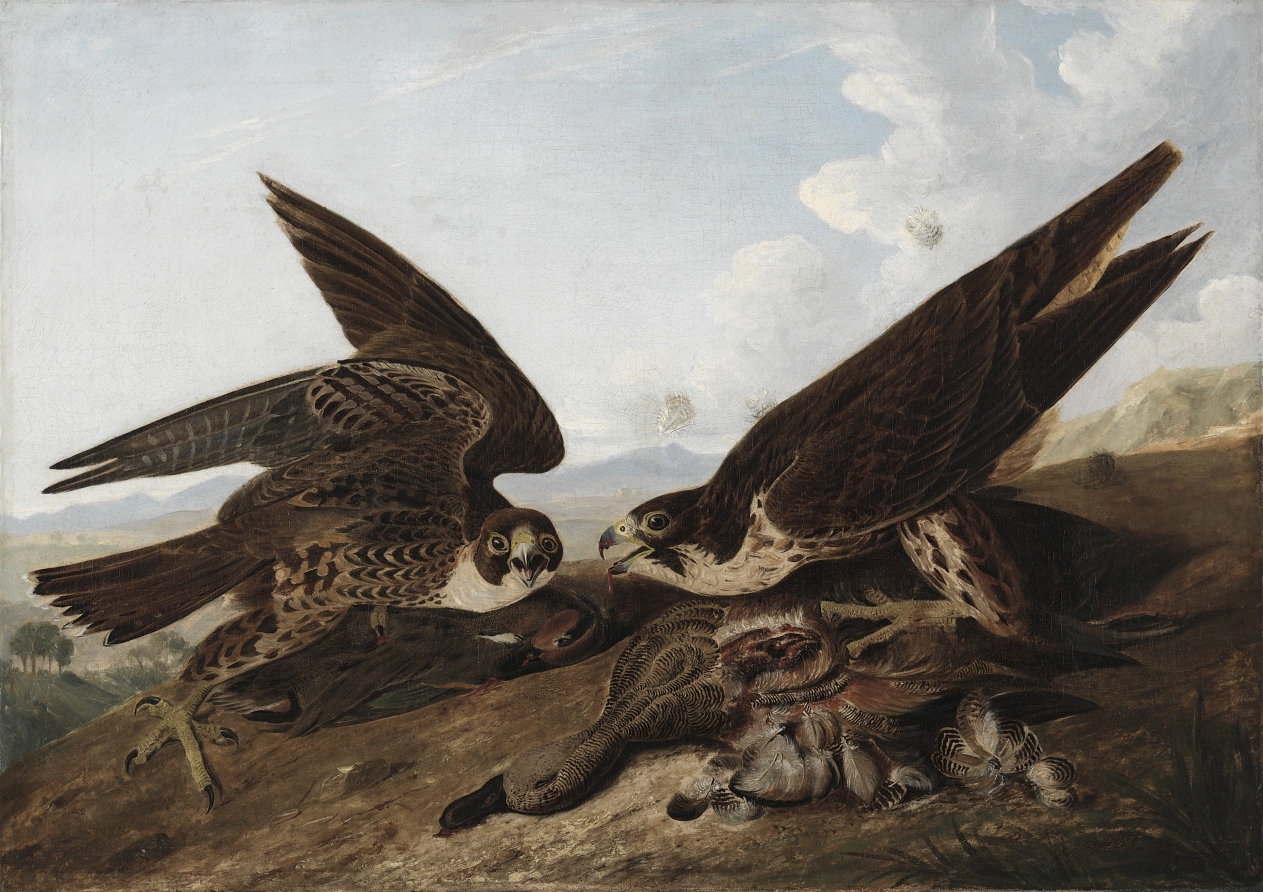
In 1814 artist and ornithologist John James Audubon first saw the elusive gigantic eagle he called "The Bird of Washington" flying along the bluffs of the upper Mississippi river, near the Great Lakes. Audubon documented four more sightings of this bird before finally acquiring a specimen. Larger than any known species of eagle found anywhere in the world, the eagle Audubon shot measured almost four feet tall, with a wingspan over ten feet wide. Due to its impressive size, Audubon immediately named it falco Washingtonii, or Washington's Eagle, and declared it to be a new species native to North America. Specimens of the "Bird of Washington" graced museum collections in Philadelphia, Boston, and London during the 19th century.
Smithsonian American Art Museum

Particulars
- Accession number
- 1994.121
Meanwhile, in the life of John James Audubon
The whole life1835
The critic John Neal questions his honesty
Audubon failed to credit the work of Joseph Mason, which prompted a series of articles in 1835 by the critic John Neal questioning Audubon's honesty and trustworthiness.
summer 1836 – spring 1837
The South and Texas: meeting Sam Houston
In the summer of 1836 Audubon set off for America with his son John; the trip took in South Carolina, Florida, Louisiana and Texas. In October he was at last able to study Townsend's Columbia River collection, which in his opinion held about 40 new species, and to buy some of the skins; in the spring of 1837 he travelled by water to Galveston Bay, visited Houston and met Sam Houston, president of the Republic of Texas. By then he had lost almost all his teeth, and on the trip he lost 12 pounds.
August 1837
His last visit to England: the “Synopsis” of American birds
In August 1837 Audubon returned to England for the last time and oversaw the publication of the final volumes of both works. He then issued for subscribers a one-volume index, the “Synopsis of the Birds of America”, his attempt at a classification of birds of his own.
1839
Moves to New York and a cheaper edition of the “Birds”
In 1839 Audubon moved with his family to New York, where several hundred of his works were exhibited that year, and began a new edition of “The Birds of America” with reduced-size illustrations and the ornithological text. Demand was huge: on 3 December 1839, 300 copies of the first number were ready, and on 9 January 1841, 1,475, with the total number of subscribers reaching 1,198.