ART WIKI33,040 on view
MapCollectionArtistsMuseumsExhibitionsJournal
Sign in

ART WIKI

Where the masterpiece hangs, and when they let you in.

Collections: Art Institute of Chicago, Getty Villa, Harvard Art Museums, Hirshhorn Museum and Sculpture Garden, J. Paul Getty Museum, Minneapolis Institute of Art, Musée du Louvre, National Gallery of Art, National Museum of Asian Art, National Portrait Gallery (Smithsonian), Pushkin State Museum of Fine Arts, Rijksmuseum, Smithsonian American Art Museum, SMK — National Gallery of Denmark, State Hermitage Museum, State Russian Museum, The Cleveland Museum of Art, The Metropolitan Museum of Art, The Museum of Modern Art, Tretyakov Gallery, Victoria and Albert Museum, Whitney Museum of American Art, State Catalogue of the Museum Fund of Russia (274 museums), Europeana (19 museums), Wikidata (6 museums), Paris Musées (12 museums), and Joconde, the French Ministry of Culture's museum database (495 museums). Images belong to their rights holders.

Sections

  • Map
  • Search
  • Collection
  • Masterpieces
  • On view now
  • Artists

More

  • Museums & galleries
  • Exhibitions
  • Journal
  • Where the data comes from
  • Privacy & cookies
HomeMapBrowse
  1. Collection/
  2. Rijksmuseum/
  3. Wapen van Michael Behaim
Wapen van Michael Behaim, Albrecht Dürer, 1518 - 1520
Albrecht Dürer, portraitAlbrecht DürerGerman, 1471–1528

Wapen van Michael Behaim

1518 - 1520 · Print

May one see it?

Unknown

Rijksmuseum

Amsterdam, Netherlands

The owner is known; whether it is on view today is not.

Source
The museum
On the mapMuseum page

About the work

In the museum's own words — in Dutch

Het wapenschild van de Neurenbergse familie Behaim von Schwarzbach, bekroond door een helm, waarop een adelaar staat. Het geheel omgeven door bladmotieven. Onder de voorstelling een rechthoekig leeg vlak.

Rijksmuseum

Particulars

1518 - 1520
14711528
Accession number
RP-P-OB-1501

What it shows

Armorial bearing, heraldry

In the catalog

PrintsRenaissance16th century

Sources

  • Rijksmuseum
  • Image: Rijksmuseum — public domain

Meanwhile, in the life of Albrecht Dürer

The whole life
  1. 1507–1528 · Workplace

    Nuremberg

  2. 1517

    Joins Nuremberg's circle of reformers

    Dürer joined the circle of Nuremberg reformers led by the Augustinian vicar Johann Staupitz and Wenceslaus Linck. Around 1518 he came to know the writings of Martin Luther, which, he said, had “greatly helped” him.

  3. 1519

    Death of Emperor Maximilian

    Maximilian, Dürer's chief patron, died just as the artist feared he was losing “my sight and freedom of hand” (perhaps from arthritis) and was increasingly drawn to Luther's writings. Shortly before the emperor's death Dürer had made his portrait.

  4. July 1520

    Journey to the Netherlands with his wife

    To renew his imperial pension and win the patronage of the new emperor, Charles V, Dürer travelled with his wife and her maid down the Rhine via Cologne to Antwerp, where he was warmly received. He attended the coronation at Aachen and saw van Eyck's Ghent Altarpiece and Michelangelo's Madonna of Bruges.

  5. 4 October 1520

    Charles V confirms his pension

    The new emperor, Charles V, confirmed Dürer's right to his pension of 100 guilders a year; the main aim of the journey had been achieved.

  6. 1520–1521

    An illness caught in the Netherlands

    In the Netherlands Dürer caught an unknown illness, possibly malaria, whose attacks plagued him for the rest of his life. He drew himself pointing to his spleen, with the note: “Where the yellow spot is, and where I point with my finger, that is where it hurts.”
More by Albrecht Dürer

All works
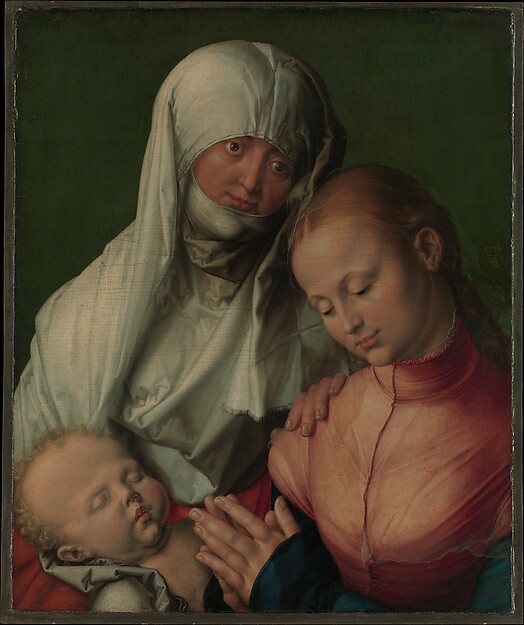
Virgin and Child with Saint Anne, Albrecht Dürer, probably 1519

Virgin and Child with Saint Anne

probably 1519 · The Metropolitan Museum of Art

Madonna and Child [obverse], Albrecht Dürer, c. 1496/1499

Haller Madonna

c. 1496/1499 · National Gallery of Art

Lot and His Daughters [reverse], Albrecht Dürer, c. 1496/1499

Lot and His Daughters [reverse]

c. 1496/1499 · National Gallery of Art

The Martyrdom of Saint Catherine, Albrecht Dürer, ca. 1498

The Martyrdom of Saint Catherine

ca. 1498 · The Metropolitan Museum of Art

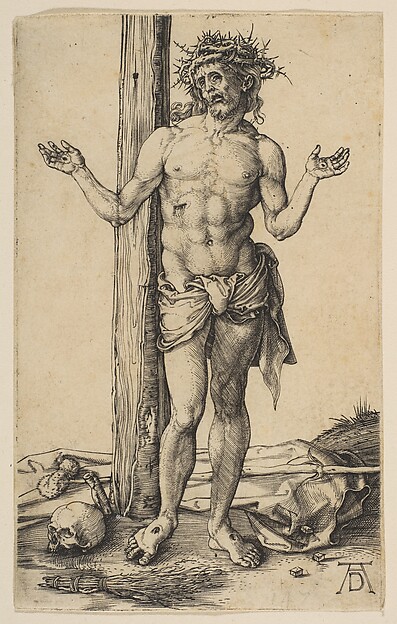
Man of Sorrows with Arms Outstretched, Albrecht Dürer, ca. 1500

Man of Sorrows with Arms Outstretched

ca. 1500 · The Metropolitan Museum of Art

Nemesis (The Great Fortune), Albrecht Dürer, c. 1501/1502

Nemesis (The Great Fortune)

c. 1501/1502 · National Gallery of Art

Large Horse, Albrecht Dürer, 1505

Large Horse

1505 · National Gallery of Art

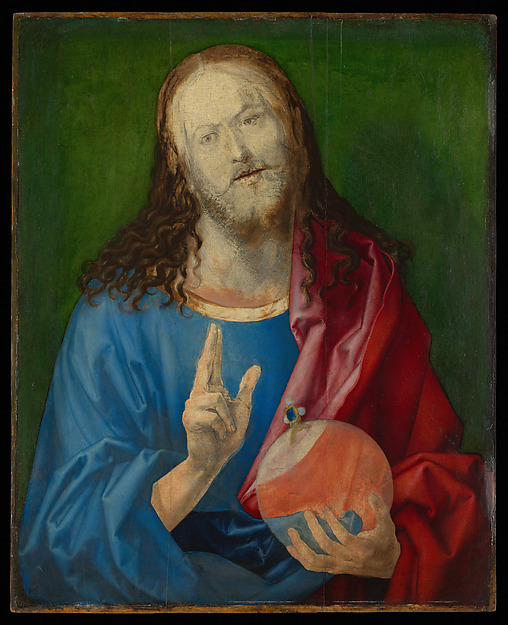
Salvator Mundi, Albrecht Dürer, ca. 1505

Salvator Mundi

ca. 1505 · The Metropolitan Museum of Art

Neighbors at Rijksmuseum

Museum page
Self-portrait, Vincent van Gogh, 1887

Vincent van Gogh

Self-portrait, 1887

La Corniche near Monaco, Claude Monet, 1884

Claude Monet

La Corniche bij Monaco, 1884

De Nachtwacht, Rembrandt van Rijn, 1642

Rembrandt van Rijn

The Night Watch, 1642

Portrait of a Woman, Probably Maria Trip (1619-1683), Rembrandt van Rijn, 1639

Rembrandt van Rijn

Portrait of Maria Trip, 1639

Landscape with a Stone Bridge, Rembrandt van Rijn, c. 1638

Rembrandt van Rijn

The Stone Bridge, c. 1638

Man in Oriental Dress, Rembrandt van Rijn, 1635

Rembrandt van Rijn

Man in Oriental Dress, 1635

Portrait of Haesje Jacobsdr van Cleyburg, Rembrandt van Rijn, 1634

Rembrandt van Rijn

Portrait of Haesje Jacobsdr van Cleyburg, 1634

Jonge vrouw in gefantaseerde kleding, Rembrandt van Rijn, 1633

Rembrandt van Rijn

Jonge vrouw in gefantaseerde kleding, 1633