Karl Bryullov1799–1852
Horsewoman
May one see it?
Unknown: the museum keeps its counsel

Tretyakov Gallery
Moscow, Russia
The owner is known. Whether it is on view today, the museum does not say, and we were not trained to guess.
- Source
- The museum's own collection data
About the painting
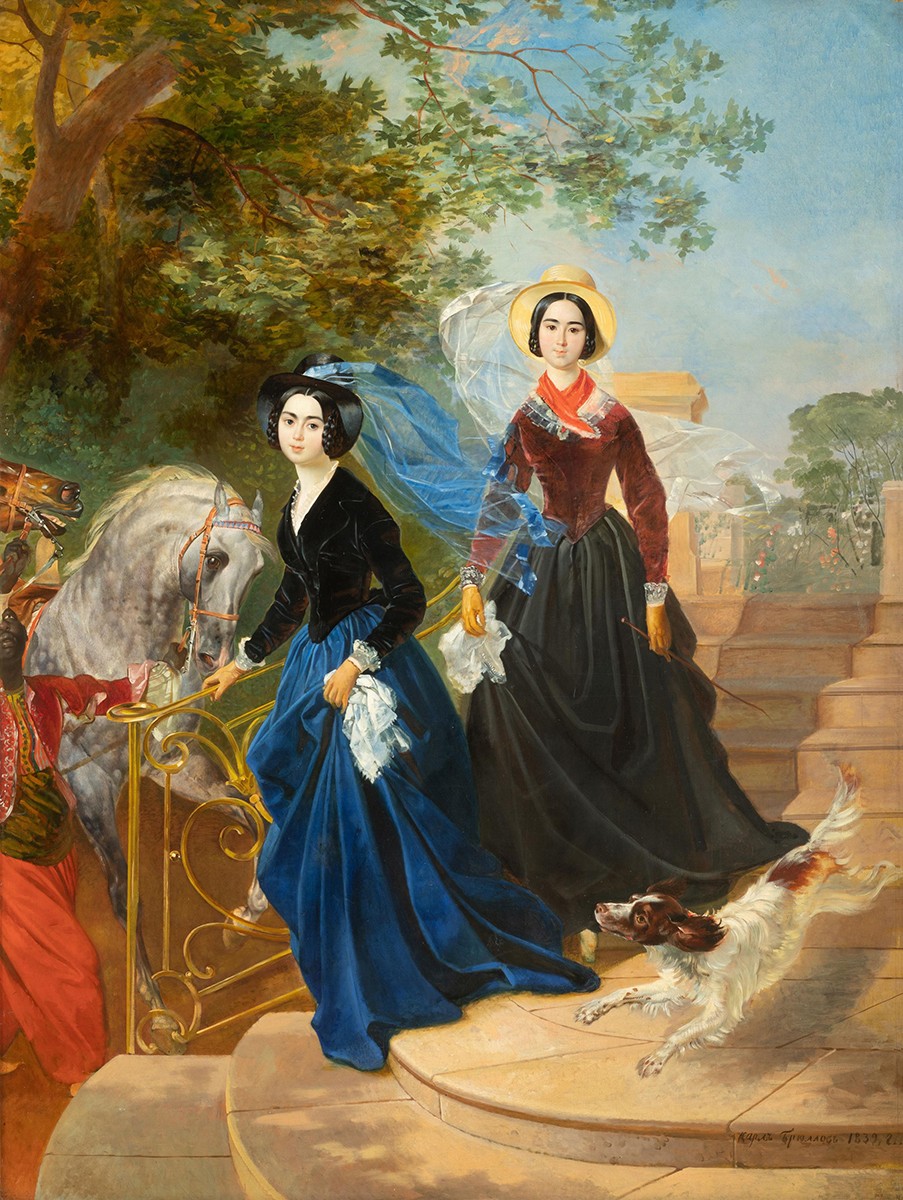
Horsewoman is a painting by the Russian artist Karl Bryullov (1799–1852), produced in 1832 and preserved in the State Tretyakov Gallery in Moscow (inventory no. 212). The size of the canvas is 291.5 × 206 cm (according to other sources 293 × 209.8 cm).
The painting was commissioned by Countess Yuliya Samoylova in Milan. In the same year, 1832, it was exhibited at the Brera Academy of Fine Arts in Milan, where it was highly praised by the public and critics. In their reviews, the Italians compared Bryullov to Peter Paul Rubens and Antonis van Dyck and wrote that they had not yet seen "an equestrian portrait conceived and executed with such excellence".
Read on
For almost forty years, almost nothing was known about the painting, which was part of the collection of Yuliya Samoylova. In 1872 or 1874, shortly before the death of the bankrupt Samoylova, her property was sold in Paris. At the auction "Horsewoman" was bought by one of the commissioners. Then it went to the St. Petersburg Society for the Pledge of Movable Property, where it was bought by Pavel Tretyakov in 1893.
For a long time it was believed that the painting was of Julia Samoilova herself. Later art historians came to the conclusion that Samoilova's pupil Giovannina was represented as a horsewoman, and the model for the little girl was Amacilia, the daughter of composer Giovanni Pacini and Samoilova's adopted daughter.
Art historian Olga Lyaskovskaya wrote that the creation of "Horsewoman" was "a significant step forward in achieving the new goals set by the artist". According to the art historian Magdalina Rakova, "Horsewoman" is "a typical example of a portrait painting" in which "everything is conceived as an apotheosis of beauty and cheerful youth, as an apotheosis of the serenity of the feeling of life", and all this is contained in two actors: a young horsewoman and a little girl.
In the museum's own words — in Russian
«Всадница» является одной из самых впечатляющих живописных работ Карла Брюллова. Картина была написана в 1832 году в Милане по заказу графини Ю.П. Самойловой, которая покровительствовала юному художнику и была его музой. Брюллов с воодушевлением запечатлел на холсте ее юных воспитанниц, родственниц итальянского композитора Дж. Пачини – старшую, верхом на лошади, Джованнину и младшую Амацилию. Художник органично объединил их хрупкие детские фигурки в сложном по композиции парадном портрете, создав новый тип портрета-картины. Юные модели позируют на фоне дворца в тени живописного пейзажного парка и изображены в момент стремительного движения и эмоционального подъема.
Read on
При разработке сюжета художник отдал предпочтение мотивам прогулки и верховой езды. Таким образом, он отразил в портрете яркие стороны жизни и времяпрепровождения представителей аристократического круга, к которому принадлежали девочки, и сделал полотно более эффектным. В картине «Всадница» Брюллов продолжил традиции репрезентативного конного портрета, который был популярен у придворных мастеров россики, но освободился от нарочито застывших и условных форм, присущих аналогичным изображениям коронованных особ прежних эпох. Предвосхищая искания романтического направления в искусстве, художник акцентировал внимание зрителя на декоративной стороне живописи и сумел придать образу малолетней, но убежденной в своем успехе наездницы, правдоподобие и жизненную энергию.
Верхом очаровательная амазонка подъезжает к открытой террасе богатой итальянской виллы. Уверенно потянув за узду, с кажущейся легкостью Джованнина останавливает строптивого коня, который, резко прерывая бег, вздымается на дыбы. Обворожительный облик и ловкость кокетливой всадницы вызывает искреннее восхищение миловидной Амацилии. Она выбежала на крыльцо, поднялась на ограждение и с восторгом смотрит на сестру. Комплекс эмоциональных зрительских впечатлений дополняет насыщенный цветовыми контрастами звучный колорит портрета. Эстетическое наслаждение доставляют и живописные приемы мастера. Он противопоставляет гладкую, переливающуюся поверхность дорогого шелка на платьях девочек мягкой густой шерсти их породистых собак. Упругий и мускулистый корпус разгоряченной лошади контрастирует с бликами на холодном металле перил.
Картина стала первой зрелой успешной работой начинающего художника. Сразу после завершения она была выставлена в зале Миланской Академии изящных искусств Брера и стала настоящим открытием для публики. Многочисленные хвалебные отзывы в европейской прессе предвосхитили славу Брюллова в России.
Tretyakov Gallery
Particulars
- Accession number
- 212
Sources
- Tretyakov Gallery: the museum's own open data · fetched 6 days ago
- Image: Tretyakov Gallery — Museum open access
Meanwhile, in the life of Karl Bryullov
The whole lifec. 1830
Meets Countess Yulia Samoilova
The time of his work on “Pompeii” is when Bryullov met Yu. P. Samoilova, an aristocrat of the Skavronsky family; for many years she was his muse and model.
c. 1830
Studies the excavations at Pompeii and Herculaneum
To convey the tragedy more accurately, Bryullov studied many literary sources, visited the excavations at Pompeii and Herculaneum and made sketches on the spot of the landscape, the ruins and the petrified figures; the canvas shows part of the Street of Tombs.
1833
“The Last Day of Pompeii” causes a sensation in Europe and Russia
Completed in 1833, the painting caused a real sensation. What was new for Russian painting was the subject itself: not an outstanding individual but a whole people in the hours of tragedy.
1834
“Pompeii” in Paris: first prize at the Salon
In 1834 the painting was shown in Paris (the Louvre) and won first prize at the Salon, although the Paris critics received it coolly: it was already the age of Delacroix and French Romanticism.
1834
Honorary free associate of the Academy of Arts
From 1834 Bryullov was an honorary free associate of the Imperial Academy of Arts.