John RuskinEnglish, 1819–1900
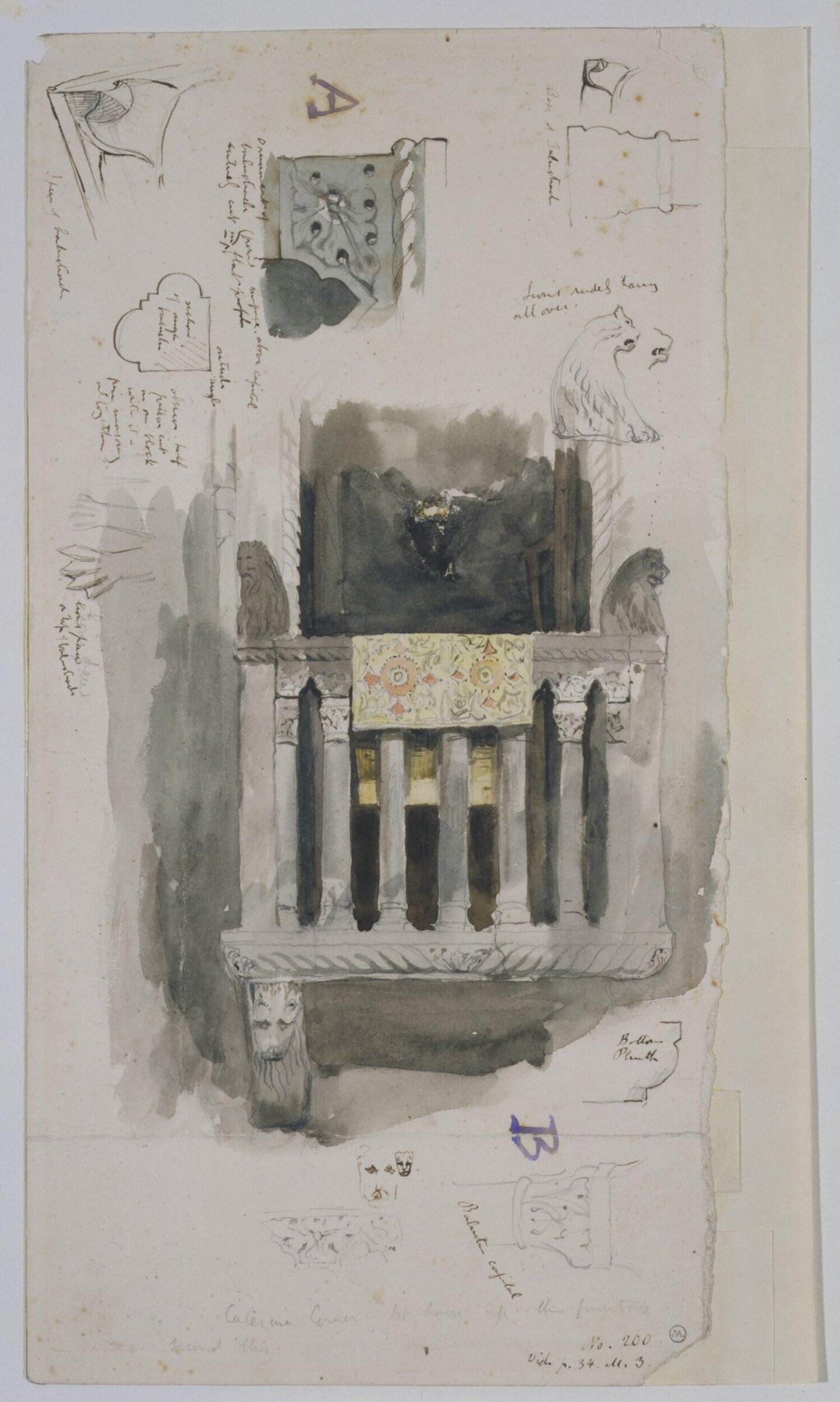
Viterbo
Can I see it?
Not on view at present
Where is “Viterbo” now? Collection: Art Institute of Chicago, Chicago. Not on view at present. Checked November 23, 2026.

Chicago, United States
It belongs to the collection, but is not on display at present.
- Checked
- In this state since
- Source
- The museum
Details
- Accession number
- 1929.448
In the catalog
Sources
- Art Institute of Chicago
- Image: Art Institute of Chicago — CC0
In the life of John Ruskin
The whole life1834–1900 · Workplace
Great Britain
late 1840 – autumn 1842
Italy with his parents: guided by George Richmond
For much of the period from late 1840 to autumn 1842 Ruskin is abroad with his parents, mainly in Italy, where George Richmond — introduced to the family by Joseph Severn, a friend of Keats — guides his study of Italian art. Back at Oxford in 1842 he sits for a pass degree and is awarded an unusual honorary double fourth-class degree in recognition of his achievements.
1843
In defence of Turner: the first volume of “Modern Painters”
The first volume of “Modern Painters” — an answer to Turner's critics — is published by Smith, Elder & Co. under the name “A Graduate of Oxford”; Ruskin controversially argues that modern landscape painters, above all Turner, surpass “Old Masters” such as Gaspard Dughet, Claude and Salvator Rosa in “truth to nature”, moral as well as material. Reviews are mixed, but Charlotte Brontë and Elizabeth Gaskell are impressed, and the book cements Ruskin's relationship with Turner.
1845
“Venice is lost to me”: restoration is destruction
Alarmed by the combined effects of decay and modernisation on the city, Ruskin writes that Venice is lost to him, and becomes convinced that architectural restoration is destruction and that the only true and faithful action is preservation and conservation.
10 April 1848
Married: Effie Gray
1851–1853
The three-volume “Stones of Venice”
Growing from a technical history of Venetian architecture, from the Byzantine to the Renaissance, into a broad cultural history, the work is a warning to contemporary England about the moral and spiritual health of society: Ruskin explains the decline of Venice by the loss of true Christian faith. The chapter “The Nature of Gothic” from the second volume — a critique of the division of labour and industrial capitalism — will be published by William Morris as a separate book.