 Isaac Levitan1860–1900
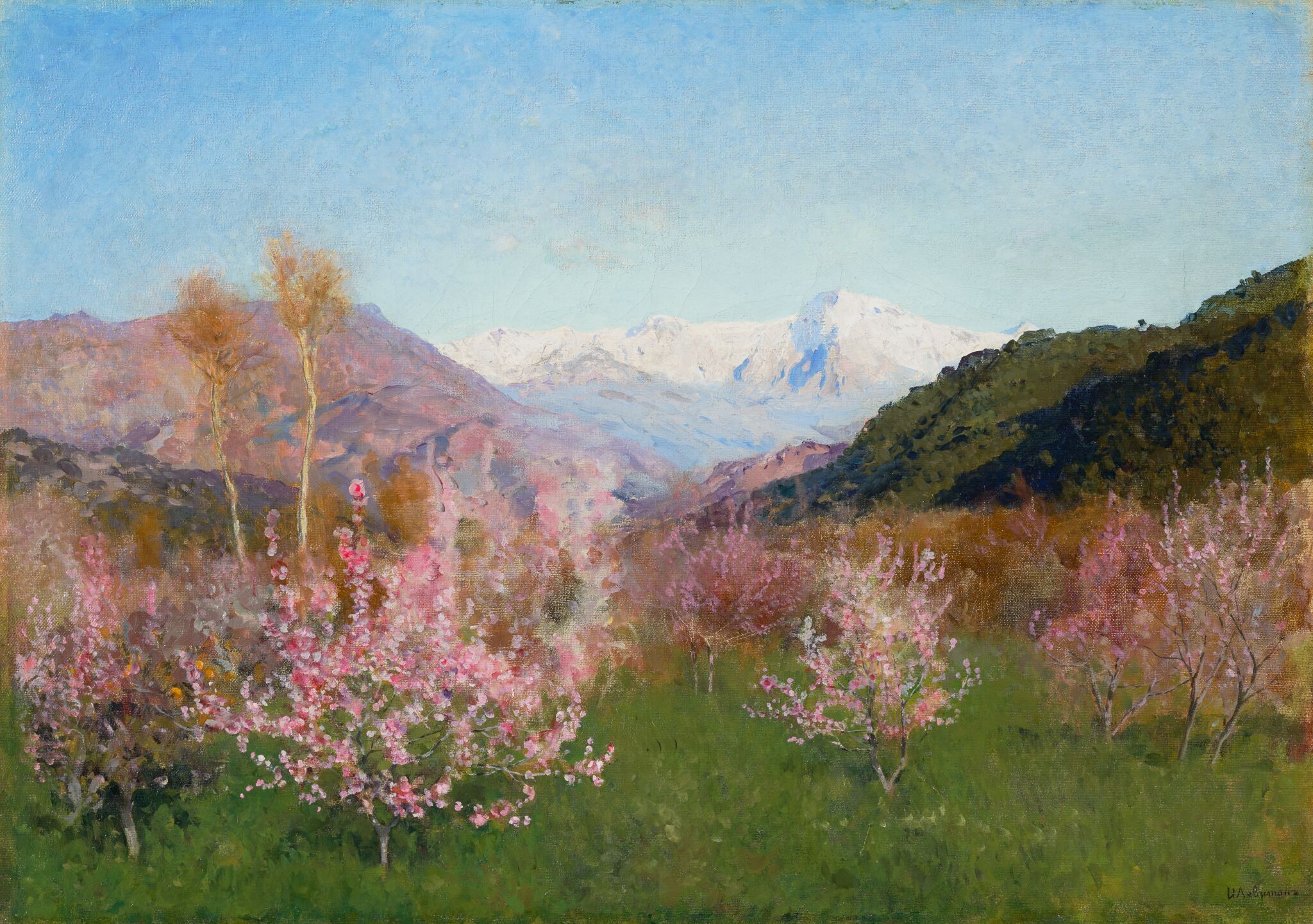
Весна в Италии
Can I see it?
Unknown
Where is “Весна в Италии” now? Collection: Tretyakov Gallery, Moscow. Unknown.

Moscow, Russia
The owner is known; whether it is on view today is not.
- Source
- The museum
About the painting
Museum text in Russian
Творчество Исаака Левитана неразрывно связано с развитием пейзажной живописи. Русское искусство обязано художнику рождением особого жанра – пейзажа настроения. Запечатлевая отечественную природу, ее скромные уголки или величественные волжские виды, мастеру всегда удавалось пробудить в зрителе восхищение лишенным ярких красок российским ландшафтом. По словам мастера, «только в России может быть настоящий пейзажист».
Первая зарубежная поездка Левитана состоялась в середине марта 1890 года и продлилась чуть больше месяца. Столицы Германии и Франции, с которых он начал свое путешествие, не заинтересовали художника – в его путевом альбоме мы не найдем зарисовок этих мест, в письмах не обнаружим восторженных откликов. Лишь добравшись до Ниццы и Ментоны, а затем проследовав в Италию – в Боргетто, Бордигеру, Флоренцию и Венецию, пейзажист исполнил ряд этюдов и набросков.
Read on
Одним из живописных свидетельств его поездки 1890 года стала небольшая работа «Весна в Италии». На фоне заснеженных гор севера Италии мастер легко, полупрозрачными мазками пишет пушистые кусты цветущего миндаля. Кисть Левитана воспевает красоту итальянской природы, столь непохожей своей яркостью на краски родины. Есть сведения, что авторское повторение этой вещи Левитан преподнес драматической актрисе М.Н. Ермоловой в знак восхищения ее талантом.
Tretyakov Gallery
Details
- Accession number
- 1483
In the catalog
Sources
- Tretyakov Gallery
- Image: Tretyakov Gallery — © State Tretyakov Gallery
In the life of Isaac Levitan
The whole lifespring 1888
He discovers Plyos on the Volga
In spring 1888 he sails by steamer along the Oka to Nizhny Novgorod and on up the Volga with the artist Alexei Stepanov and Sofia Kuvshinnikova; to their own surprise they discover the small, quiet town of Plyos and decide to stay on for a while. The three summer seasons there (1888–1890) prove extremely productive: some two hundred works bring Levitan wide fame.
late 1889 – early 1890
His first trip to Western Europe
He visits France and Italy, wanting to get to know modern painting better as shown at the World Exhibition in Paris — probably above all the Barbizon school and the Impressionists. According to Nesterov, in the West he became convinced that the path he had chosen was the right one.
March 1891
Admitted to the Peredvizhniki Association
In March 1891 he becomes a member of the Association of Travelling Art Exhibitions.
spring 1892
The 20th Peredvizhniki exhibition: “Autumn”, “At the Whirlpool”, “Summer”, “October”
By spring 1892 he finishes “Autumn”, begun in autumn 1891, and shows it at the 20th Peredvizhniki exhibition together with three more paintings: “At the Whirlpool”, “Summer” and “October”.
1892
Forced to leave Moscow again
As a “person of the Jewish faith” he is made to leave Moscow and for a time lives in the Tver and Vladimir governorates; thanks to his friends' efforts he is allowed to return “as an exception”.
1892
A quarrel with Chekhov over “The Grasshopper”
In the plot of his story “The Grasshopper” the writer used moments from the relationship of Levitan, his pupil Sofia Kuvshinnikova and her husband, the doctor Dmitry Kuvshinnikov — and the episode clouded the friendship between the two men.