Edward Burne-JonesBritish, 1833–1898
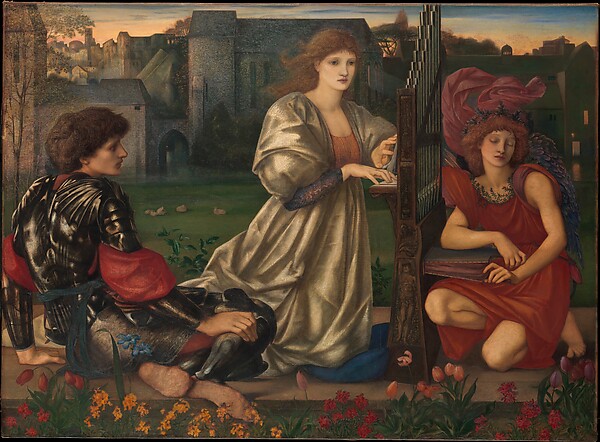
Venus Epithalamia
Can I see it?
Not on view at present
Where is “Venus Epithalamia” now? Collection: Harvard Art Museums, Cambridge. Not on view at present. Checked September 29, 2026.

Cambridge, United States
It belongs to the collection, but is not on display at present.
- Checked
- In this state since
- Source
- The museum
Details
- Accession number
- 1943.453
In the catalog
Sources
- Harvard Art Museums
- Image: Harvard Art Museums — © President and Fellows of Harvard College
In the life of Edward Burne-Jones
The whole life1870
The “Phyllis and Demophoön” scandal: he quits the Society
Maria Zambaco’s features were clearly recognisable in the barely draped Phyllis, and Demophoön’s nakedness offended Victorian sensibilities. Asked to make a slight alteration, Burne-Jones instead withdrew not only the picture from the walls but himself from the Society.
1870–1877
Seven years away from exhibitions: turning to oils
After bitterly hostile attacks in the press he exhibited only two works in these years, yet worked unremittingly: he turned from watercolour to oils and planned the first “Briar Rose” series, “Laus Veneris”, “The Golden Stairs”, the “Pygmalion” series and “The Mirror of Venus”. His partnership with the photographer Frederick Hollyer, whose reproductions brought his work to a wide audience, also began then.
1870s
Georgiana grows close to Morris
In these difficult years Georgiana developed a friendship with Morris, whose wife Jane had fallen in love with Rossetti. If he asked her to leave her husband, she refused: both couples stayed together, and Georgiana and Morris remained close for the rest of their lives.
1871
Windows at All Saints for Alfred Baldwin
Morris’s firm made the windows at All Saints, designed by Burne-Jones for Alfred Baldwin, his wife’s brother-in-law.
1873
“Love Among the Ruins” at the Dudley Gallery
Two watercolours shown at the Dudley Gallery in the Egyptian Hall, Piccadilly, were his only exhibited works of 1870–1877. One of them, “Love Among the Ruins”, was destroyed twenty years later by a cleaner who took it for an oil painting, and the artist afterwards reproduced it in oils.