 Isaac Levitan1860–1900
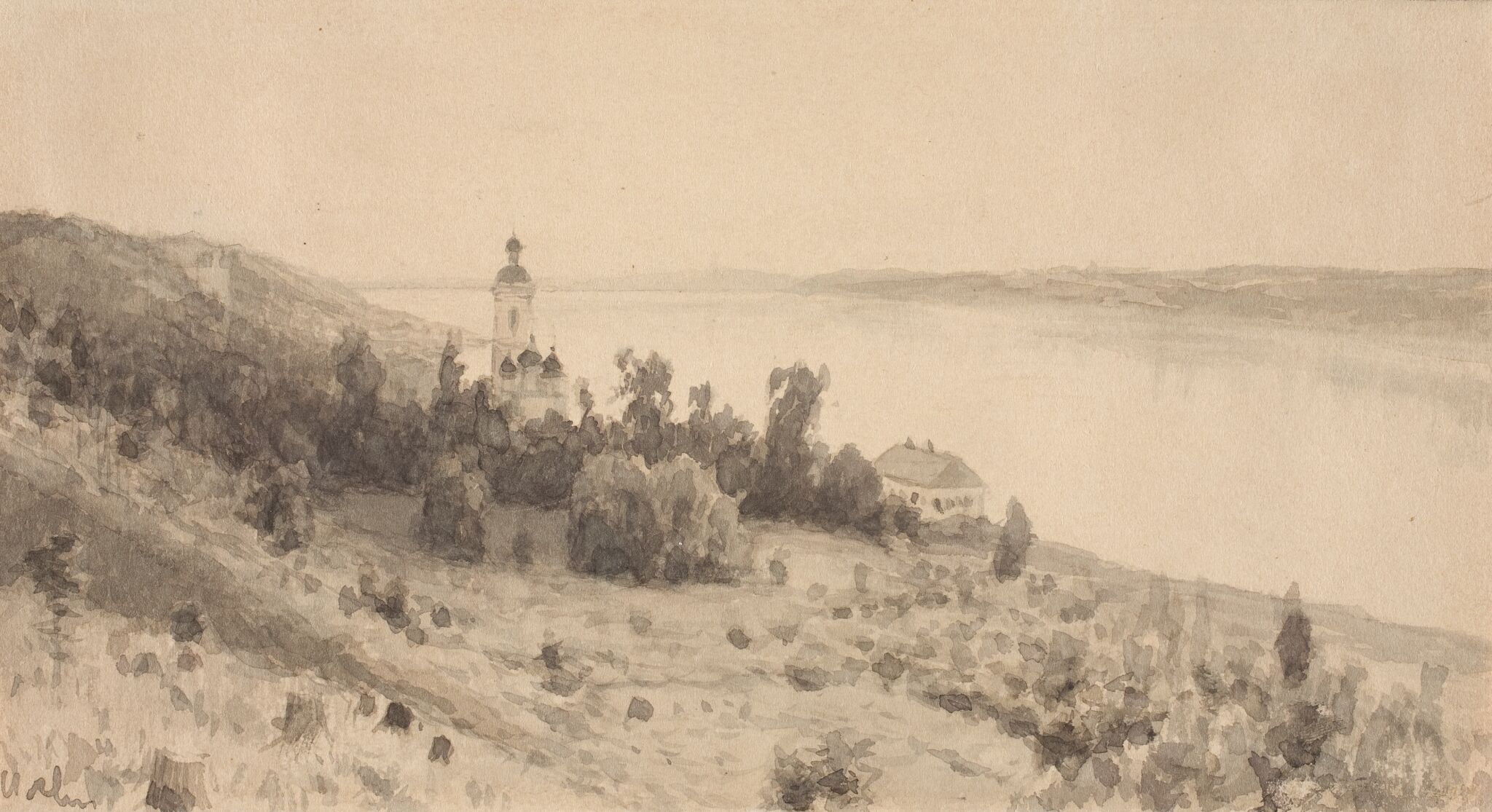
Вечер. Золотой Плёс
Can I see it?
Unknown
Where is “Вечер. Золотой Плёс” now? Collection: Tretyakov Gallery, Moscow. Unknown.

Moscow, Russia
The owner is known; whether it is on view today is not.
- In this state since
- Source
- The museum
About the work
Museum text in Russian
Исаак Левитан был крупнейшей фигурой среди пейзажистов конца XIX века. С 1887 по 1890 год художник несколько раз путешествовал по Волге. Именно в этот период появились его известные волжские картины. В 1889-м Левитан остановился в Плёсе. На основе этюдов, исполненных там, создано знаменитое живописное полотно «Вечер. Золотой Плёс» (1889, ГТГ). Экспонировавшаяся на XVIII выставке Товарищества передвижных художественных выставок (1890) картина привлекла внимание П.М. Третьякова и была приобретена им.
Read on
Монохромная акварель «Вечер. Золотой Плёс» – повторение знаменитого полотна, так называемая реплика, предназначенная для воспроизведения в иллюстрированном каталоге XVIII выставки Товарищества передвижных художественных выставок. Реплики – особый жанр, возникший именно в это время и связанный с особенностями черно-белой печати. Стремясь к наибольшей точности репродуцирования живописных работ в каталогах выставок, художники сами создавали черно-белые графические интерпретации своих картин для популярных журналов. Несмотря на сдержанную монохромную гамму, акварель Левитана передает всю гамму чувств, которые переживает художник.
Tretyakov Gallery
Details
- Accession number
- 7601
In the catalog
Sources
- Tretyakov Gallery
- Image: Tretyakov Gallery — © State Tretyakov Gallery
In the life of Isaac Levitan
The whole life1887
His first trip to the Volga: the river seems dreary
In 1887 he at last fulfils his dream and goes to the Volga, which his teacher Savrasov had painted so movingly (in the early 1880s his sister's illness had prevented the trip). In cold, overcast weather the river disappoints him: it seems to him dreary and dead.
late 1880s – early 1890s
Heads the landscape class at Gunst's school
In the late 1880s and early 1890s he heads the landscape class at the School of Fine Arts of the artist-architect A. O. Gunst.
spring 1888
He discovers Plyos on the Volga
In spring 1888 he sails by steamer along the Oka to Nizhny Novgorod and on up the Volga with the artist Alexei Stepanov and Sofia Kuvshinnikova; to their own surprise they discover the small, quiet town of Plyos and decide to stay on for a while. The three summer seasons there (1888–1890) prove extremely productive: some two hundred works bring Levitan wide fame.
late 1889 – early 1890
His first trip to Western Europe
He visits France and Italy, wanting to get to know modern painting better as shown at the World Exhibition in Paris — probably above all the Barbizon school and the Impressionists. According to Nesterov, in the West he became convinced that the path he had chosen was the right one.
summer 1890
Yuryevets: the idea of “A Quiet Monastery”
In summer 1890 he goes to Yuryevets and, among many landscapes and studies, paints “View of the Krivoozersky Monastery”; this is how the idea of “A Quiet Monastery” is born. The picture made a strong impression on Chekhov.
March 1891
Admitted to the Peredvizhniki Association
In March 1891 he becomes a member of the Association of Travelling Art Exhibitions.