 Viktor Vasnetsov1848–1926
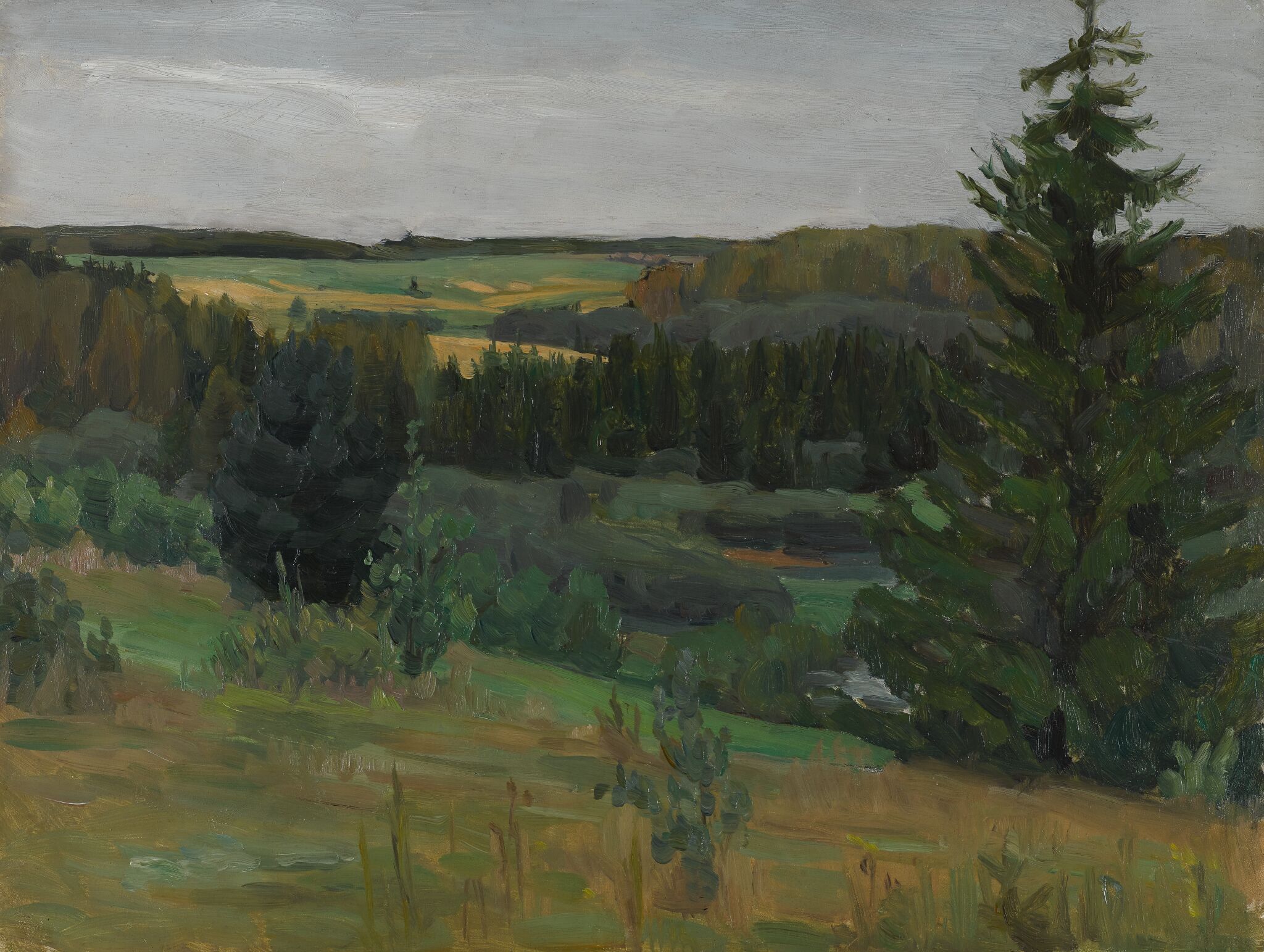
В окрестностях Абрамцева
May one see it?
Unknown

Tretyakov Gallery
Moscow, Russia
The owner is known; whether it is on view today is not.
- Source
- The museum
About the painting
In the museum's own words — in Russian
В творчестве Виктора Михайловича Васнецова пейзаж имеет важное значение и выступает в качестве героя картины наряду с изображенными персонажами. В природе, как и в душе человеческой, художника не интересовали переливы мимолетных настроений или случайных состояний; пейзаж в его работах стал инструментом, помогающим выявить внутренний смысл событий, дать им особенную вневременную окраску.
Летом 1879-1880 годов по приглашению промышленника и мецената Саввы Ивановича Мамонтова Васнецов впервые приехал в село Ахтырка, а с 1881 года каждое лето проводил в усадьбе Абрамцево. Это было значимое место для широкого круга молодых московских художников, театральных деятелей, писателей. В жизни Васнецова оно сыграло решающую роль. Здесь он впервые обратился к сюжетам народных сказок, развил фольклорно-эпическое направление своего творчества, в котором особое место занимал пейзаж.
Read on
Эпический простор абрамцевской природы сочетался с лирической нежностью, что послужило неисчерпаемым источником вдохновения для художника; недаром именно здесь появились «Алёнушка» (1881) и эпические «Богатыри» (1881–1898). Со временем интерес Васнецова к абрамцевской природе не угасал, а работа над пейзажами приобрела самостоятельную ценность и стала настоящей потребностью для художника. Недаром в 1901 году он приобрел загородное имение Ваньково в Дмитровском уезде, расположенном всего в 20 верстах от Абрамцева.
Tretyakov Gallery
Particulars
- Accession number
- ДМВ Ж-77
In the catalog
Sources
- Tretyakov Gallery
- Image: Tretyakov Gallery — © State Tretyakov Gallery
Meanwhile, in the life of Viktor Vasnetsov
The whole life1878–1890 · Career
the Peredvizhniki
From 1878 he belonged to the Society of Travelling Art Exhibitions (the Peredvizhniki): he took part in its activity in 1878–1890 and exhibited with it until 1897; he was admitted for the realism and sharp social subjects of his genre paintings.
1884–1889
Friendship with Mikhail Vrubel in Kiev
While living in Kiev he became friends with Mikhail Vrubel, who was also working on the cathedral; while they worked together Vasnetsov taught the younger artist a great deal.
1885–1895
The controversy over the Kiev frescoes: Stasov, Benois, Filosofov
Contemporaries disagreed: Dmitry Filosofov saw in the frescoes “the first bridge over the 200-year-old gulf” between classes of Russian society, Stasov a sacrilegious play with the religious feelings of the people, and Alexandre Benois a “sumptuous and frivolous féerie”; Vasnetsov himself saw the cathedral as a “Bible for the poor”.
1891–1894
He builds a terem-style house in Troitskaya Sloboda
In 1891 he bought land in Troitskaya Sloboda and himself devised a wooden mansion in the style of an ancient Russian terem; construction, carried out by peasants from Vladimir Governorate, was completed in 1894, and the second-floor studio (110 m², six-metre ceilings) became the place where the “Bogatyrs”, “The Snow Maiden” and the “Poem of Seven Fairy Tales” were painted; Governor-General Grand Duke Sergei Alexandrovich allowed the house to exceed the height limit.
1892
Professor of the Imperial Academy of Arts
From 1892 he was a professor of the Imperial Academy of Arts, and in 1893–1905 a full member of the Academy (under its new statute).