Roger FentonBritish, 1819–1869
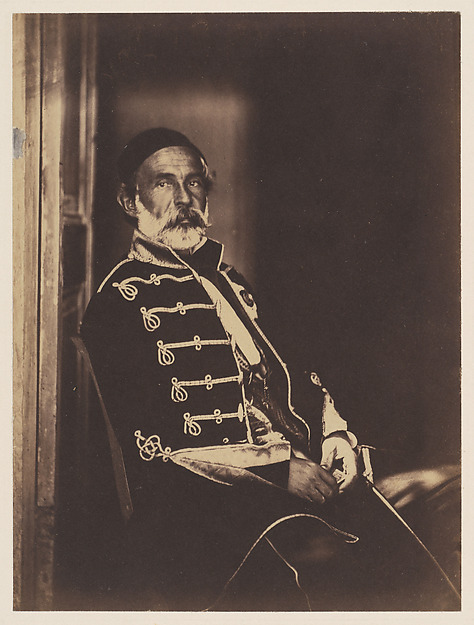
Untitled
May one see it?
Not receiving at present

Art Institute of Chicago
Chicago, United States
It belongs to the collection, but is not on display at present.
- Checked
- In this state since
- Source
- The museum's own collection data
Particulars
- Accession number
- 1969.475
What it shows
In the catalog
Sources
- Art Institute of Chicago: the museum's own open data · fetched 7 days ago
- Image: Art Institute of Chicago — CC0
Meanwhile, in the life of Roger Fenton
The whole life1853
Founding the London Photographic Society
Fenton becomes a founder and first secretary of the London Photographic Society, later the Royal Photographic Society under the patronage of Prince Albert.
1853
The British Museum commission: a studio on the roof
The British Museum commissions Fenton to record part of its collection of rare historical artefacts, and he sets up an open-air studio on the museum's roof: staff carry the items into the daylight and dust them with chalk to avoid reflections. The commissions are unpaid, but he may sell the prints on his own account, eventually opening a shop at the museum entrance.
1854
Commissioned to document the Crimean War
Probably in autumn 1854, powerful friends and patrons — among them Prince Albert and the Duke of Newcastle, Secretary of State for War — urge Fenton to go to the Crimea; the London print publisher Thomas Agnew & Sons becomes his commercial sponsor. The photographs may have been meant to offset the war's unpopularity and to counter the critical reporting of William Howard Russell of The Times: they were to be converted into woodblocks for the less critical Illustrated London News.
1855
Cholera, heat and broken ribs in the Crimea
Despite the summer heat, breaking several ribs in a fall, suffering from cholera (the effects of which will contribute to his early death) and becoming depressed at the carnage he witnesses at Sevastopol, Fenton manages to make more than 350 usable large-format negatives.
c. 1855
An exhibition of 312 prints
Soon after his return an exhibition of 312 prints goes on show in London, and in the following months at various places across the country; Fenton also shows them to Queen Victoria and Prince Albert and to Emperor Napoleon III in Paris. He is nevertheless disappointed that sales are less than he expected.
8 March – 22 June 1855
Fenton at Balaklava
Fenton sets off aboard HMS Hecla in February, lands at Balaklava on 8 March and stays until 22 June, taking Marcus Sparling as his photographic assistant, a servant known as William, and a large horse-drawn van of equipment.