Ernst Ludwig KirchnerGerman, 1880–1938
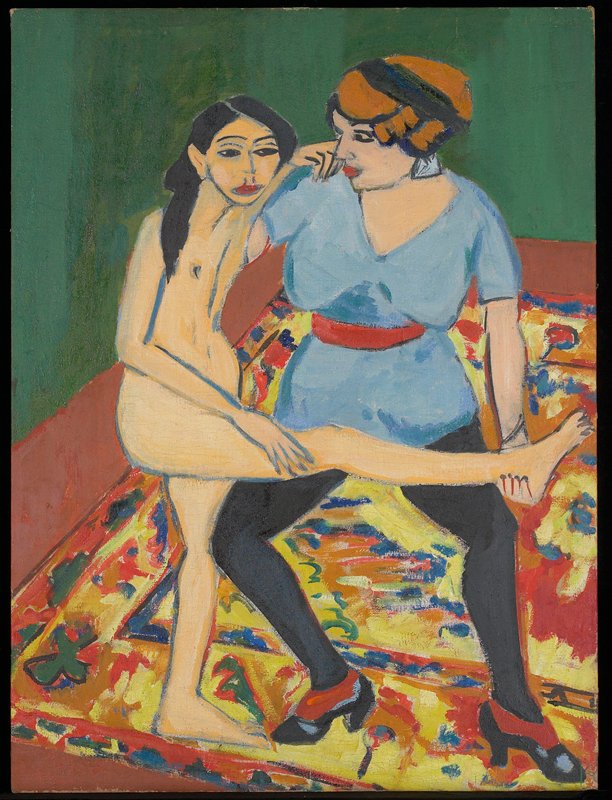
Two Nudes
May one see it?
Not receiving at present

Chicago, United States
It belongs to the collection, but is not on display at present.
- Checked
- In this state since
- Source
- The museum
About the work
The year 1905 was a crucial moment in Kirchner's artistic development. In July he received a degree in architecture from the Technisches Hochschule in Dresden; he discovered and was greatly influenced by the African sculpture in the Dresden ethnology museum; and, with fellow students Fritz Bleyl, Erich Heckel, and Karl Schmidt-Rottluff, he fotmded the group Die Brücke (the Bridge), which was active in Dresden and Berlin from 1905 to 1912. The artists of the Bridge, inspired by Edvard Munch, Vincent van Gogh, and Henri Matisse, were instrumental in promoting the growth of modern Expressionism.
Art Institute of ChicagoCC BY 4.0
Particulars
- Accession number
- 1963.557
In the catalog
Sources
- Art Institute of Chicago
- Image: Art Institute of Chicago — © the artist or rights holder
Meanwhile, in the life of Ernst Ludwig Kirchner
The whole life1903–1904
Munich: the Technical School and the Debschitz-Schule
In 1903–1904 Kirchner continued his studies at the Polytechnic School of Munich and attended the art school run by von Debschitz and Obrist.
1905
An architect’s diploma and then only painting
In 1905 Kirchner returned to Dresden, sat the final diploma examination, received his architecture degree and then turned exclusively to painting.
c. 1905
A studio in a former butcher’s shop
The group first met in Kirchner’s first studio, a former butcher’s shop; defying convention, they drew from non-professional models of their own circle, choosing quarter-hour poses to encourage spontaneity.
7 June 1905
Founding of the Brücke group
Four architecture students of the Dresden Technical College — Kirchner, Fritz Bleyl, Erich Heckel and Karl Schmidt-Rottluff — founded the group Die Brücke (“The Bridge”); 7 June is considered its founding day. Heckel proposed the name and Kirchner became the group’s ideologist: he made the rejection of the materialist worldview, realism, Impressionism and Art Nouveau the basis of its aesthetic.
1906
The Brücke manifesto
In 1906 Kirchner wrote the group’s programme: anyone who directly and without illusion reproduces what he feels the urge to create belongs to the Brücke.
September – October 1906
The first Brücke exhibition: the female nude
In September and October 1906 the group’s first exhibition, devoted to the female nude, was held in the showroom of K. F. M. Seifert and Co. in Dresden.
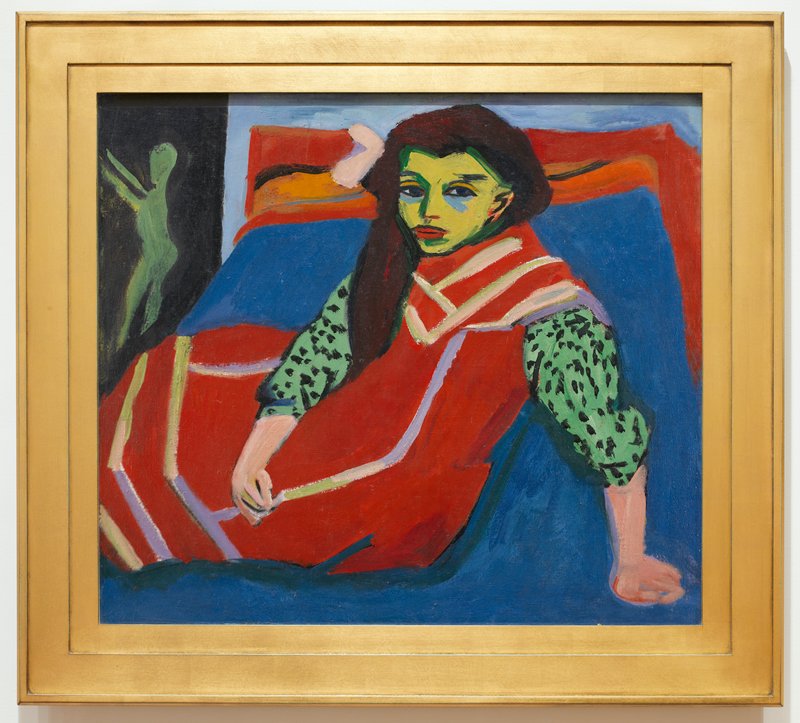
![Dance Hall Bellevue [obverse], Ernst Ludwig Kirchner, 1909/1910](https://api.nga.gov/iiif/634157b6-d0fd-4a63-b93b-0dc1eb6c03d3/full/!2400,2400/0/default.jpg)