 Isaac Levitan1860–1900
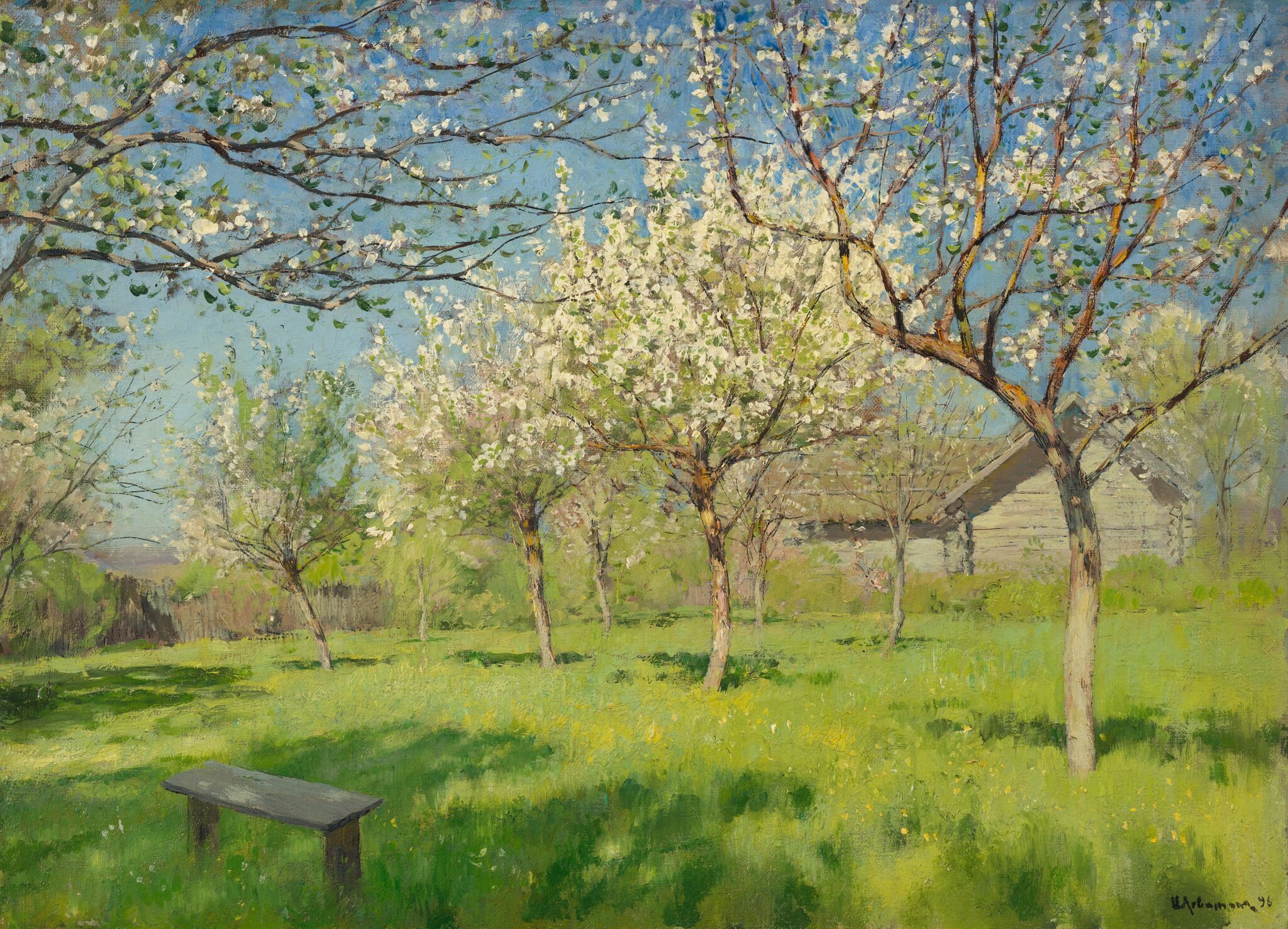
Цветущие яблони
May one see it?
Unknown

Moscow, Russia
The owner is known; whether it is on view today is not.
- Source
- The museum
About the painting
In the museum's own words — in Russian
Пейзажи Исаака Ильича Левитана, какую бы пору времени года ни изображал художник, дарят зрителю широкую гамму чувств и возможность сопереживать природе, которую боготворил живописец.
Read on
В картине «Цветущие яблони» он с радостным волнением передает белую кипень цветущих деревьев. Молодой яблоневый сад с еще тонкими стволами и причудливым переплетением ветвей, усыпанных белыми лепестками цветов и едва пробивающейся листвой, залит щедрым светом и теплом солнца. Пора весеннего цветения ассоциировалась у Левитана с темой вечного обновления природы. В его картинах и небольших натурных этюдах чутко и с неизменной любовью воспроизводятся все стадии пробуждения земли после долгого зимнего сна. С неизменным интересом и вниманием он писал бурую, еще холодную землю и последний снег – «Последний снег. Саввинская слобода»,1884; первую майскую зелень – «Первая зелень. Май», 1883; широко разлившиеся талые воды – «Весна. Большая вода», 1897 (все – Государственная Третьяковская галерея). Каждое из этих произведений выражает разнообразные оттенки чувств человека, соединенного с великой тайной жизни природы.
«Цветущие яблони» созданы художником с особой живописной деликатностью. Тени ветвей на весенней траве подвижны и трепетны. Красочный слой тонок и прозрачен, сквозь него местами просвечивает холст, структура которого тоже участвует в образном восприятии пейзажа. Левитан работает здесь не только кистью, но использует перо и тушь, подчеркивая перьевым рисунком тонкие ветви молодых деревьев, и этот прием вносит в картину ощутимую глазом весеннюю легкость и прозрачность.
Tretyakov Gallery
Particulars
- Accession number
- Ж-1480
In the catalog
Sources
- Tretyakov Gallery
- Image: Tretyakov Gallery — © State Tretyakov Gallery
Meanwhile, in the life of Isaac Levitan
The whole lifesummer 1894
A romance with Anna Turchaninova and the break with Kuvshinnikova
In summer 1894 Levitan and Sofia Kuvshinnikova are staying with the Ushakovs at the Ostrovno estate (he had met V. N. Ushakov a year earlier at Kurovo-Pokrovskoye); Anna Nikolaevna Turchaninova arrives at the neighbouring estate of Gorka with her two daughters, and Levitan begins an affair with her. The upset Kuvshinnikova returns to Moscow and never meets him again.
1894
Two paintings at the World Exhibition in London
He takes part in the World Exhibition in London with two works.
January 1895
Reconciliation with Chekhov at Melikhovo
Thanks to Tatiana Shchepkina-Kupernik, Levitan makes peace with Chekhov: on her way to Melikhovo she called at his Moscow studio to see the Udomlya studies and persuaded him to go with her; the friends met, embraced, and the friendship resumed.
21 June 1895
A suicide attempt
Overcome by severe melancholy, on 21 June 1895 Levitan makes an attempt on his life which, according to the doctor I. I. Troyanovsky, who found no trace of a wound, was rather a theatrical gesture — a “tragic comedy”.
1896
Typhus again, and a heart aneurysm
After a second bout of typhus the symptoms of an aneurysm of the heart worsen; the illness becomes grave and incurable.
1898
The title of academician and teaching at his old school
He is awarded the title of academician of landscape painting and begins teaching at the very school where he studied; he dreams of creating a “House of Landscapes” — a large studio where all Russian landscape painters could work.