
 Grant WoodAmerican, 1891–1942
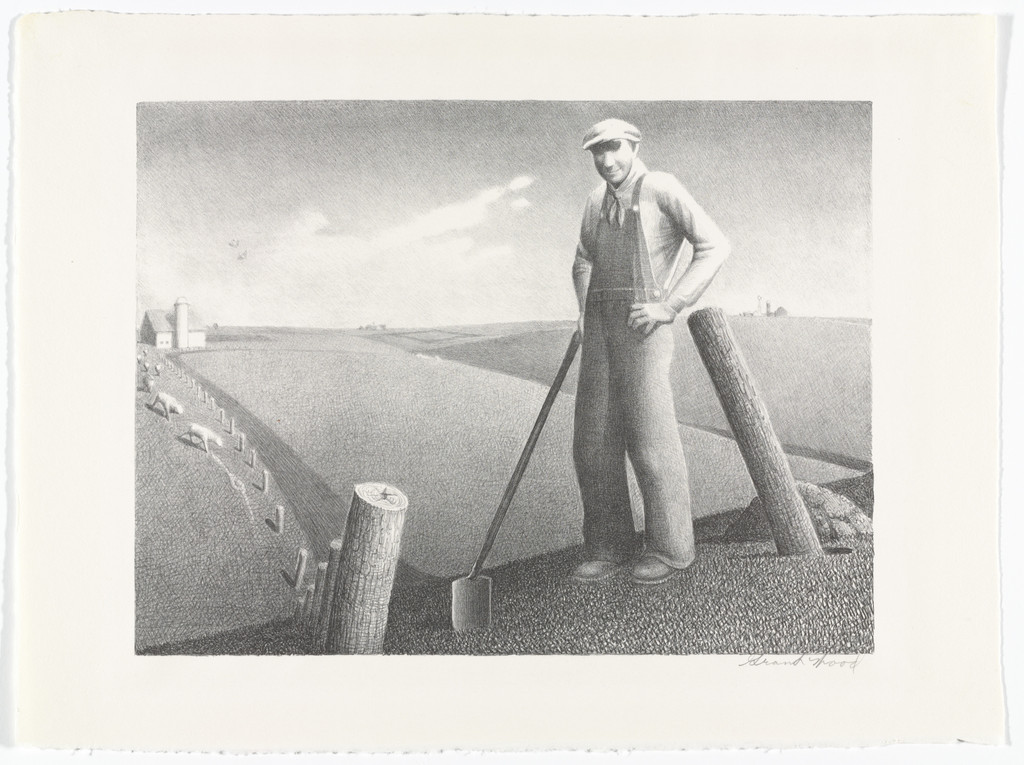
Tree Planting
May one see it?
Not receiving at present

National Gallery of Art
Washington, D.C., United States
It belongs to the collection, but is not on display at present.
- Checked
- 5 hours ago
- In this state since
- Aug 19, 2026
- Source
- The museum's own collection data
Particulars
- Accession number
- 2008.115.292
What it shows
Sources
- National Gallery of Art: the museum's own open data · fetched 4 days ago
- Image: National Gallery of Art — © the artist or rights holder
Meanwhile, in the life of Grant Wood
The whole life1924–1935
“5 Turner Alley”: a studio in a carriage-house hayloft
From 1924 to 1935 Wood lived with his mother in the hayloft of a carriage house in Cedar Rapids that he had converted into his personal studio; it had no address until Wood made one up: “5 Turner Alley”.
1930s
Helps Curry and Benton return to the Midwest
John Steuart Curry and Thomas Hart Benton, who with Wood are the artists most associated with Regionalism, returned to the Midwest thanks to his encouragement; he helped them find teaching positions at colleges, Curry in Wisconsin and Benton in Missouri.
1934–1941
A colleague, Lester Longman, tries to get Wood fired
Wood was a closeted homosexual, and a colleague at the university, Lester Longman, made an unsuccessful attempt to have him fired on explicit moral grounds and for his advocacy of regionalism. The university administration dismissed the allegations.
1934–1941
Mentor to students, among them Elizabeth Catlett
At the university Wood supervised mural-painting projects, mentored students including Elizabeth Catlett, produced works of his own and became a key part of the university’s cultural community.
1935
“Revolt Against the City” is published
In 1935 Clio Press of Iowa City published Wood’s “Revolt Against the City”.
1935–1938
Marriage to Sara Sherman Maxon
From 1935 to 1938 Wood was married to Sara Sherman Maxon; friends considered the marriage a mistake for him.

.jpg?width=1280)



![Scenes from the Passion of Christ: The Descent into Limbo [right panel], Andrea Vanni, 1380s](https://api.nga.gov/iiif/4205a539-eadd-4486-89a7-3cff9c1ba428/full/!2400,2400/0/default.jpg)


