
 Alfred StieglitzAmerican, 1864–1946
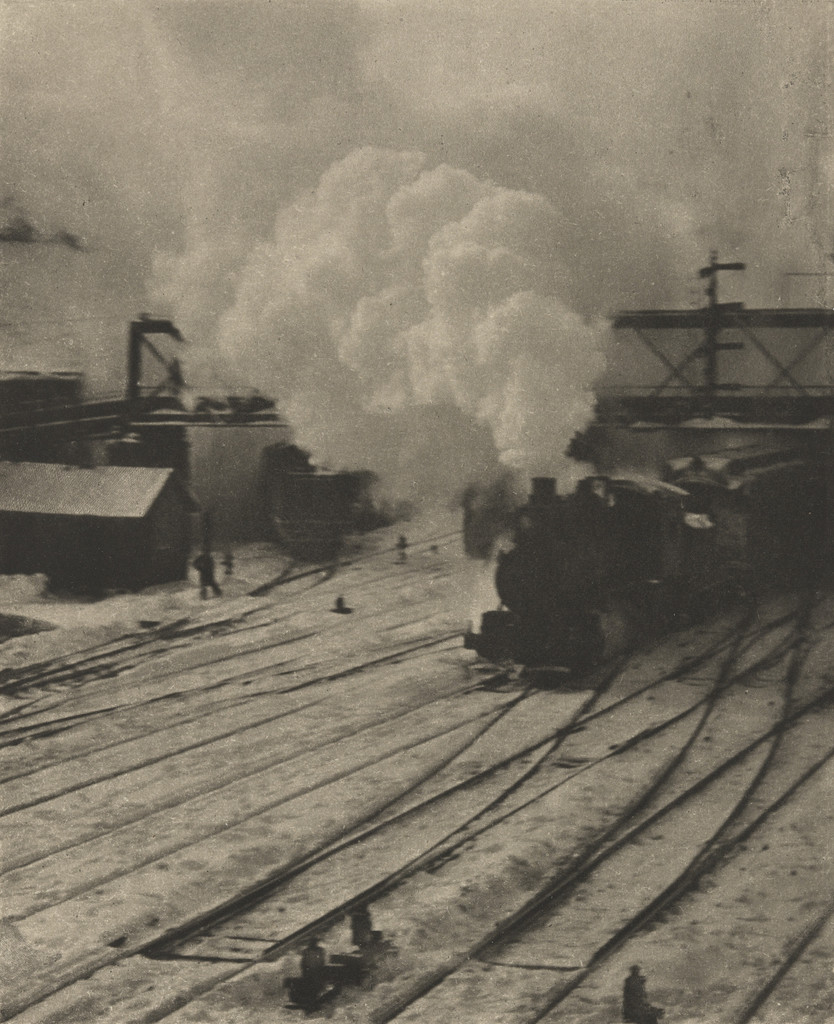
The Terminal
Can I see it?
Not on view at present
Where is “The Terminal” now? Collection: Art Institute of Chicago, Chicago. Not on view at present. Checked September 29, 2026.

Chicago, United States
It belongs to the collection, but is not on display at present.
- Checked
- In this state since
- Source
- The museum
About the work
Stieglitz took this photograph in front of the Old Post Office in New York, where the Third Avenue railway system and the Madison Avenue streetcar system had their terminals. He reflected on his creation of the work 45 years later: “Naturally there was snow on the ground. A driver in a rubber coat was watering his steaming horses. There seemed to be something related to my deepest feeling in what I saw, and I decided to photograph what was within me.” For Stieglitz, who had returned from Europe to find that everyday use of the Kodak camera had supplanted serious photography, The Terminal represented new possibilities for photography and the hope for “an America in which I could breathe as a free man.”
For more on the Alfred Stieglitz collection at the Art Institute, along with in-depth object information, please visit the website: The Alfred Stieglitz Collection.
Art Institute of ChicagoCC BY 4.0
Details
- Accession number
- 1949.706
What it shows
In the catalog
Sources
- Art Institute of Chicago
- Image: Art Institute of Chicago — CC0
In the life of Alfred Stieglitz
The whole lifeJuly 1897
First issue of Camera Notes
Stieglitz turned the Camera Club's newsletter into a magazine, Camera Notes, with full control over it; the first issue appeared in July 1897, and it was soon considered the finest photographic magazine in the world. The critic Sadakichi Hartmann wrote that artistic photography, the Camera Club and Alfred Stieglitz seemed to him three names for one and the same thing.
1902
Founds the Photo-Secession
In December 1901 Charles DeKay of the National Arts Club invited Stieglitz to put together an exhibition with “full power to follow his own inclinations”. Within two months he had assembled prints from a close circle of friends and, in homage to the Munich photographers, called the group the Photo-Secession, a secession not only from the artistic restrictions of the era but from the official oversight of the Camera Club.
25 November 1905
The 291 gallery opens on Fifth Avenue
On November 25, 1905, the Little Galleries of the Photo-Secession opened at 291 Fifth Avenue with one hundred prints by thirty-nine photographers; Edward Steichen had encouraged Stieglitz to lease the three rooms across from his own apartment. The gallery was an instant success, with almost fifteen thousand visitors in its first season and print sales of nearly $2,800, more than half of them Steichen's work.
1907
Paris: Gertrude Stein and a turn to painting
In Paris in 1907 Stieglitz met Gertrude Stein and was captivated by Rodin, Matisse, Toulouse-Lautrec, Cézanne and Rousseau. He decided to turn his photography gallery into a full art gallery to introduce the conservative American public to the newest European art.
January – May 1916
Meets Georgia O'Keeffe
In January 1916 the suffragist Anita Pollitzer showed Stieglitz a set of charcoal drawings by Georgia O'Keeffe, and he decided to exhibit them at 291 without meeting her or asking her permission. In late May O'Keeffe heard of it from a friend and came to the gallery to chastise him, which is how they met; by the summer of 1917 they were writing each other their most private thoughts.
June 1918
O'Keeffe comes to New York; he leaves his family
In early June 1918 O'Keeffe moved to New York from Texas after Stieglitz promised her a quiet studio. Within a month his wife Emmy came home during one of the first nude photography sessions in the family apartment and told him to stop seeing O'Keeffe or get out; Stieglitz left and immediately found a place in the city where he and O'Keeffe could live together.







![[Jesus mit seinen Eltern, aus dem Tempel heimkehrend; Christ Returning from the Temple with his Parents; Retour d'Egypte], Rembrandt, 1654](https://diglib.hab.de/varia/haum/rembrandt-v3-4550/max/000001.jpg)


