Camille Jacob PissarroFrench, 1830–1903
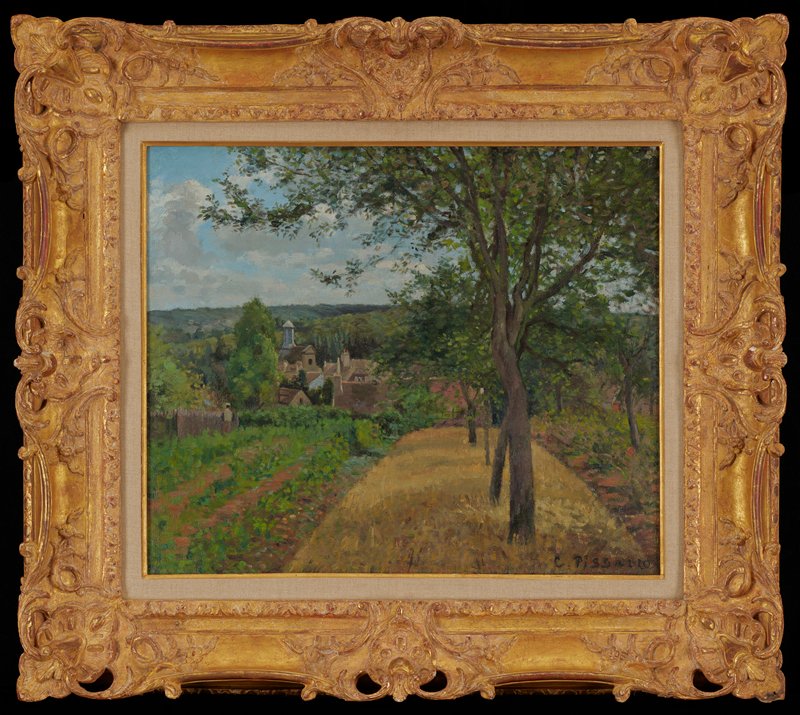
The Shepherd's Return
May one see it?
Not receiving at present

Art Institute of Chicago
Chicago, United States
It belongs to the collection, but is not on display at present.
- Checked
- In this state since
- Source
- The museum
Particulars
- Accession number
- 1921.381
In the catalog
Sources
- Art Institute of Chicago
- Image: Art Institute of Chicago — CC0
Meanwhile, in the life of Camille Jacob Pissarro
The whole life1880s
Theo van Gogh asks him to take in Vincent
The art dealer Theo van Gogh asked Pissarro whether he would take his elder brother Vincent as a lodger in his house; according to his son Lucien, Pissarro was impressed by Van Gogh's work, foresaw his fame and explained to him different ways of seeking and expressing light and colour.
1880s
A search for something new: peasant labour without idealisation
By the 1880s some Impressionists felt the movement had exhausted itself, and Pissarro returned to scenes of country life, showing people at work without idealising them; in 1882 Renoir called these works “revolutionary”.
April 1884
Settles at Éragny-sur-Epte
In April 1884 Pissarro and his family settled at Éragny-sur-Epte, a village near Gisors, where he lived for the rest of his life; he wrote to his son Lucien that the house was superb, with a garden and meadows. The house, garden, orchard, meadows and farm workers became recurring subjects for the last nineteen years of his career.
1885–1888
Pointillism: working beside Seurat and Signac
In 1885 Pissarro came into close contact with Georges Seurat and Paul Signac, whose technique juxtaposed small strokes of relatively pure colour, and until 1888 he experimented extensively with it, regarding it not as a rejection of Impressionism but as a possible continuation of it; among the older Impressionists this was unusual.
late 1880s
Abandoning Neo-Impressionism
By the end of the 1880s Pissarro found the method of divided colour too restrictive: it made it hard to respond freely to changing effects of nature, movement and personal sensation; what remained from the experiment was a heightened attention to colour relationships and a more structured handling of the surface.
1890
A trip to London: some ten views
In 1890 Pissarro visited England again and painted some ten scenes of central London.