 Henri Edmond CrossFrench, 1856–1910
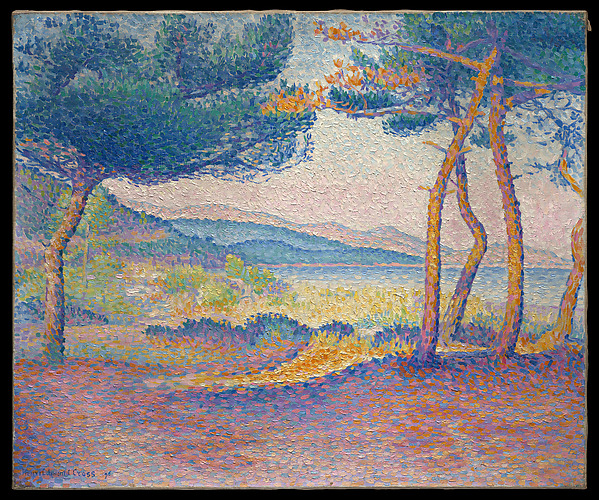
The Pink Cloud
May one see it?
Not receiving at present

Cleveland, United States
It belongs to the collection, but is not on display at present.
- Checked
- In this state since
- Source
- The museum
About the painting
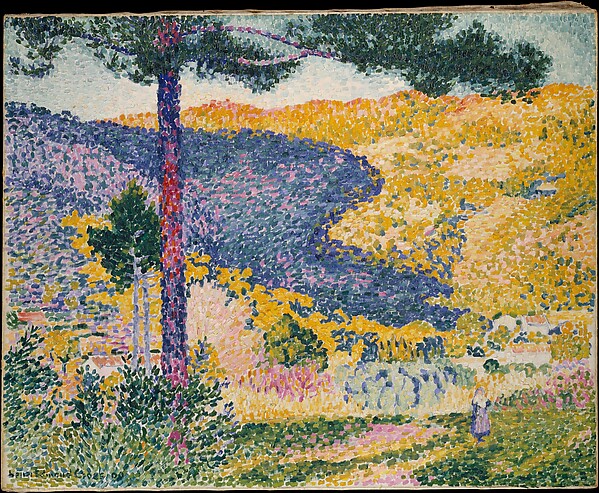
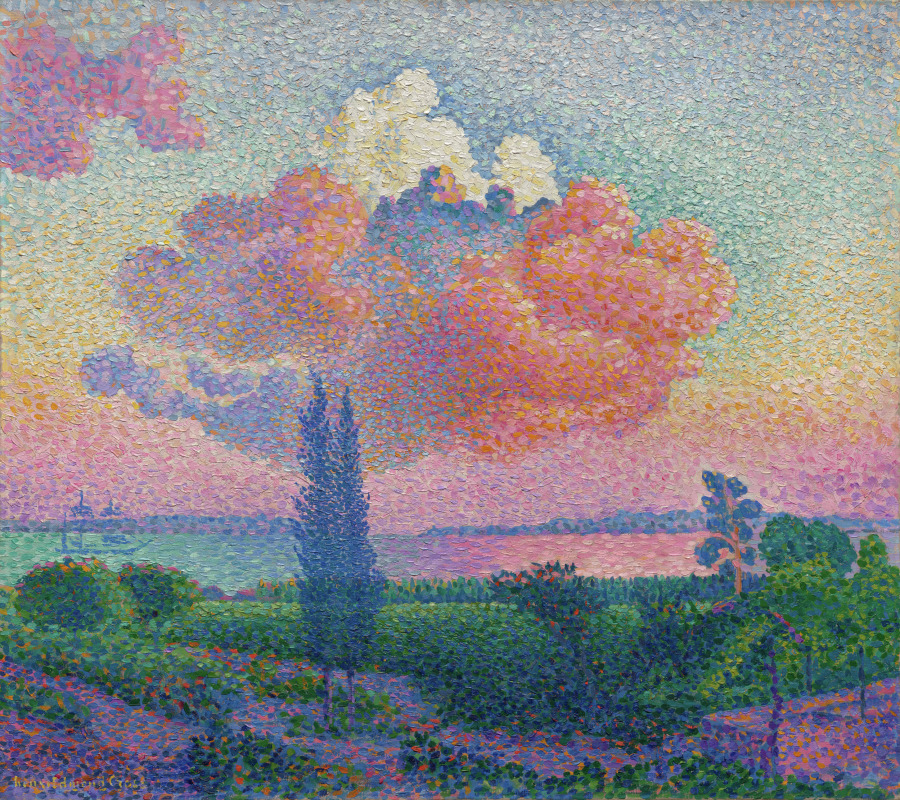
Due to his diagnosis of persistent rheumatism, Henri-Edmond Cross left Paris in 1891 and settled in the seaside village of Saint-Clair on the Mediterranean coast where the climate was more temperate. He expressed his enthusiasm for the French Riveria to his mother, “In the distance, the blue silhouette of the Maures and the Estérel—I have enough here to keep me busy all of life—I have just discovered happiness.” Once he had settled in the south, Cross adopted the Neo-Impressionist technique of Pointillism—applying paint in small dots or dashes of complementary colors that mix in the beholder’s eye to create an intense sensation of color and light. Here, a spectacular cloud is illuminated by the sunset. A pair of cypress trees link the garden landscape below to the vivid sky above.
The Cleveland Museum of Art
Particulars
- Accession number
- 2020.106
In the catalog
Sources
- The Cleveland Museum of Art
- Image: The Cleveland Museum of Art — Museum open access
Meanwhile, in the life of Henri Edmond Cross
The whole life1890s
Meets Fénéon, Gide and Verhaeren
In the 1890s he works alongside Signac and gets to know the writers and critics Félix Fénéon, André Gide and Emile Verhaeren.
c. 1895
Moves from Pointillism to a mosaic-like brushstroke
From about 1895 he gradually changes his technique: instead of tiny dots, broad blocky brushstrokes with small areas of bare canvas left between them. The surfaces resemble mosaics, and such paintings are seen as precursors of Fauvism and Cubism.
1895
Shows at La Libre Esthétique at Maus’s invitation
Octave Maus, who had earlier invited him to the annual exhibitions of Les XX, invites him to the Libre Esthétique show; Cross takes part again in 1897, 1901, 1904, 1908 and 1909.
1896
Lithograph “The Wanderer” for an anarchist journal
The lithograph “L’Errant” (“The Wanderer”), his first work with a publisher, appeared anonymously in Jean Grave’s anarchist journal Les Temps Nouveaux. Like Signac and Pissarro, Cross held anarchist principles, and they shaped his choice of subjects — scenes of a utopian world.
1898
The first Neo-Impressionist exhibition in Germany
In 1898, together with Signac, Maximilien Luce and Théo van Rysselberghe, he takes part in the first Neo-Impressionist exhibition in Germany, organized by Harry Kessler at the Keller und Reiner Gallery.