Gustave CourbetFrench, 1819–1877
The Painter's Studio
Can I see it?
Unknown
Where is “The Painter's Studio” now? Collection: Musée d'Orsay, Paris. Unknown.

Paris, France
The owner is known; whether it is on view today is not.
- In this state since
- Source
- The museum
About the painting
The Painter's Studio (French: L'Atelier du peintre; in full, The Painter's Studio: A real allegory summing up seven years of my artistic and moral life) is an 1855 oil-on-canvas painting by Gustave Courbet. It is located in the Musée d'Orsay in Paris, France.
Courbet painted The Painter's Studio in Ornans, France in 1855. "The world comes to be painted at my studio," said Courbet of the Realist work. The figures in the painting are allegorical representations of various influences on Courbet's artistic life. On the left are human figures from all levels of society. In the center, Courbet works on a landscape, while turned away from a nude model who is a symbol of Academic art. On the right are friends and associates of Courbet, mainly elite Parisian society figures, including Charles Baudelaire, Champfleury, Pierre-Joseph Proudhon, and Courbet's most prominent patron, Alfred Bruyas.
Read on
The 1855 Paris World Fair's jury accepted eleven of Courbet's works for the Exposition Universelle, but The Painter's Studio was not among them. In an act of self promotion and defiance, Courbet, with the help of Alfred Bruyas, opened his own exhibition (The Pavilion of Realism) close to the official exposition; this was a forerunner of the various Salon des Refusés. Very little praise was forthcoming, and Eugène Delacroix was one of the few painters who supported the work. Of the painting, Courbet stated that The Painter's Studio "represents society at its best, its worst, and its average."
Details
- Accession number
- RF 2257
In the catalog
Sources
- Wikidata
- Image: Musée d'Orsay — Gustave Courbet · Public domain · Wikimedia Commons
In the life of Gustave Courbet
The whole life1855
Stages the “Pavilion of Realism”
Refusing to accept the jury's decision, Courbet asked museums and private owners to lend his paintings, had a separate building erected and showed about forty canvases there, without state permission, under the Second Empire. The public was baffled and laughed at the “crude art”, and the critics mocked him; the paintings were appreciated by Delacroix and Baudelaire.
1855
The “Realist Manifesto” in the exhibition catalogue
The catalogue of the Pavilion of Realism opened with a manifesto in which Courbet claimed the right to artistic freedom and the right to show his works to the public on his own. He defined his aim as conveying the customs, ideas and appearance of his time, to be not only a painter but a man as well: to “create living art”.
1855
The Exposition Universelle jury turns down three paintings
Courbet submitted fourteen paintings to the Salon of 1855, part of the Exposition Universelle; three were rejected “for lack of space”, among them the monumental “A Burial at Ornans” and “The Artist's Studio”.
1855
Empress Eugénie before “The Bathers”
According to Proudhon's recollection, Empress Eugénie, visiting the Pavilion of Realism, stopped before Courbet's “Bathers”, with its robustly peasant-like nude body shown without the usual idealization, and exclaimed, “Is this a Percheron too?” She had just been looking at Rosa Bonheur's “Horse Fair”.
1857
Salon of 1857: “Young Ladies on the Banks of the Seine”
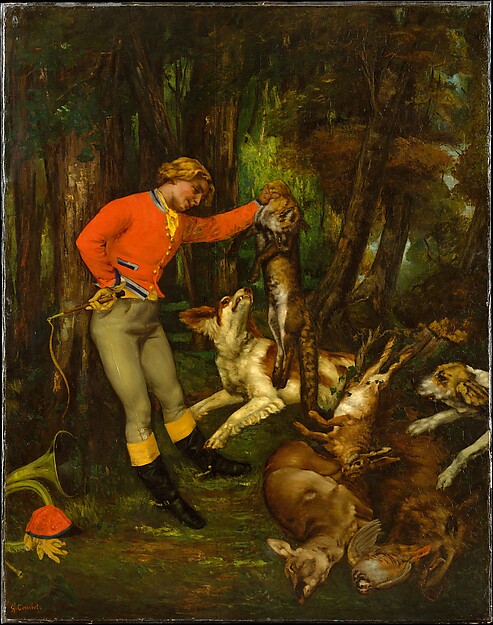
At the Salon of 1857 Courbet showed six paintings, among them “Young Ladies on the Banks of the Seine (Summer)”, painted the year before, and the first of his many hunting scenes. Modern women casually displaying their undergarments caused a scandal; pairing sensational works with hunting scenes secured Courbet both notoriety and sales.