John TennielBritish, 1820–1914
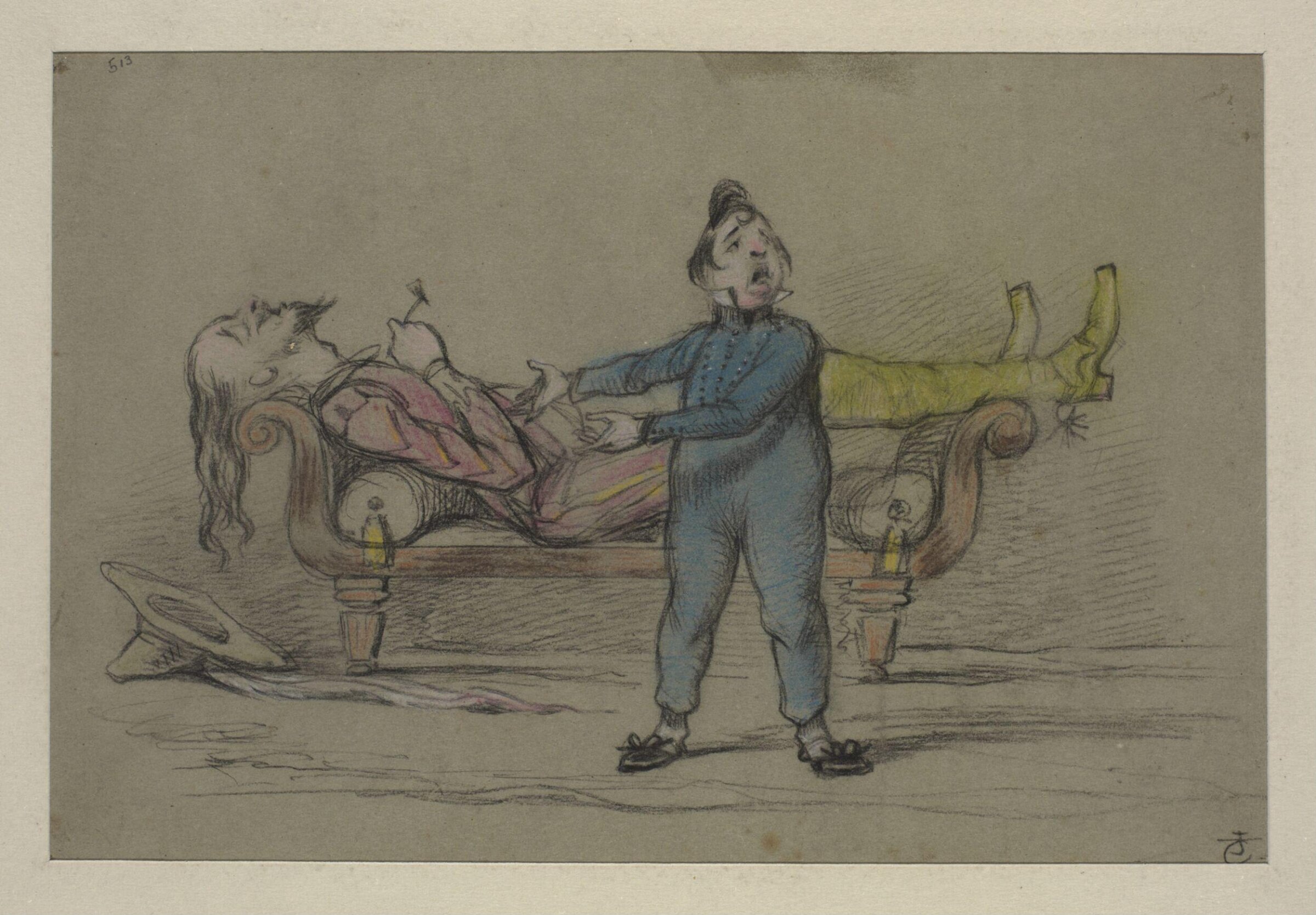
The Modern Sphynx
Can I see it?
Not on view at present
Where is “The Modern Sphynx” now? Collection: Harvard Art Museums, Cambridge. Not on view at present. Checked September 29, 2026.

Cambridge, United States
It belongs to the collection, but is not on display at present.
- Checked
- In this state since
- Source
- The museum
Details
- Accession number
- M9555
In the catalog
Sources
- Harvard Art Museums
- Image: Harvard Art Museums — © President and Fellows of Harvard College
In the life of John Tenniel
The whole life28 February 1820
Born in London
The youngest of the three sons of John Baptist Tenniel, a fencing master of French Huguenot descent, and Eliza Maria Tenniel; his father wanted him to take up a military career. He was born in Kensington — by other accounts, in Bayswater.
1840
Loses the sight of one eye
During fencing practice his father’s foil, which had accidentally lost its protective tip, badly wounded Tenniel’s eye; in time he lost its sight — the left eye, by other accounts the right — but never told his father how serious the wound was. After the accident he gave up painting, with rare exceptions, and concentrated on graphic art.
1845
The Palace of Westminster mural competition
Despite missing the deadline, he submitted a 16-foot (4.9 m) cartoon, “An Allegory of Justice”, to the competition for the murals of the new Palace of Westminster. It was not accepted, but Tenniel won a £200 premium and a commission for a fresco in the Hall of Poets of the House of Lords — Saint Cecilia, after John Dryden.
December 1850
Becomes a cartoonist for “Punch”
At Christmas 1850 Mark Lemon invited him to join John Leech as cartoonist of “Punch”, on the strength of his recent illustrations to Aesop’s Fables. His first drawing for the magazine was an initial letter, “Lord Jack the Giant Killer”, showing Lord John Russell assailing Cardinal Wiseman.
1864
Meets Lewis Carroll
Carroll had wanted to illustrate “Alice’s Adventures in Wonderland”, already set in type, himself, but his drawing was amateurish, and the publisher Alexander Macmillan advised him to approach Tenniel (by other accounts it was the engraver Orlando Jewitt who suggested hiring a professional). Having read the text, Tenniel agreed to make forty-two illustrations — the number Carroll insisted on.
1864
Chief cartoonist of “Punch” after Leech’s death
When John Leech died, Tenniel became chief cartoonist of “Punch” and carried on their work alone, rarely missing a single week. His drawings followed the wishes of the magazine’s editors and could be scathing.