Rogier van der WeydenFlemish, 1399–1464
The Magdalen Reading
May one see it?
Unknown

London, United Kingdom
The owner is known; whether it is on view today is not.
- In this state since
- Source
- The museum
About the painting
The Magdalen Reading is one of three surviving fragments of a large mid-15th-century oil-on-panel altarpiece by the Early Netherlandish painter Rogier van der Weyden. The panel, originally oak, was completed some time between 1435 and 1438 and has been in the National Gallery, London since 1860.
Read on
It shows a woman with the pale skin, high cheek bones and oval eyelids typical of the idealised portraits of noble women of the period. She is identifiable as the Magdalen from the jar of ointment placed in the foreground, which is her traditional attribute in Christian art. She is presented as completely absorbed in her reading, a model of the contemplative life, repentant and absolved of past sins. In Catholic tradition the Magdalen was conflated with both Mary of Bethany who anointed the feet of Jesus with oil and the unnamed "sinner" of Luke 7:36–50. Iconography of the Magdalen commonly shows her with a book, in a moment of reflection, in tears, or with eyes averted.
The background of the painting had been overpainted with a thick layer of brown paint. A cleaning between 1955 and 1956 revealed the figure standing behind the Magdalene and the kneeling figure with its bare foot protruding in front of her, with a landscape visible through a window. The two partially seen figures are both cut off at the edges of the London panel. The figure above her has been identified as belonging to a fragment in the Museu Calouste Gulbenkian, Lisbon, which shows the head of Saint Joseph, while another Lisbon fragment, showing what is believed to be Saint Catherine of Alexandria, is thought to be from the same larger work. The original altarpiece was a sacra conversazione, known only through a drawing, Virgin and Child with Saints, in Stockholm's Nationalmuseum, which followed a partial copy of the painting that probably dated from the late 16th century. The drawing shows that The Magdalen occupied the lower right-hand corner of the altarpiece. The Lisbon fragments are each a third of the size of The Magdalen, which measures 62.2 cm × 54.4 cm (24.5 in × 21.4 in).
Although internationally successful in his lifetime, van der Weyden fell from view during the 17th century, and was not rediscovered until the early 19th century. The Magdalen Reading can first be traced to an 1811 sale. After passing through the hands of a number of dealers in the Netherlands, the panel was purchased by the National Gallery, London, in 1860 from a collector in Paris. It is described by art historian Lorne Campbell as "one of the great masterpieces of 15th-century art and among van der Weyden's most important early works."
Particulars
- Accession number
- NG654
In the catalog
Sources
- Wikidata
- Image: The National Gallery — Rogier van der Weyden · Public domain · Wikimedia Commons
Meanwhile, in the life of Rogier van der Weyden
The whole life1427–1438
Four children: Cornelius, Margaretha, Pieter and Jan
Cornelius was born in 1427 (he later became a Carthusian monk), Margaretha in 1432, and Pieter and Jan in 1437 and 1438 in Brussels; Pieter became a painter and inherited his father’s workshop, Jan a goldsmith.
1432–1435 · Workplace
Tournai
by 21 October 1435
He moves to Brussels and takes a new name
By 21 October 1435 he and his family were living in Brussels — one of Europe’s largest cities and the chief residence of the Dukes of Burgundy; Dutch was spoken there, and Roger de la Pasture became Rogier van der Weyden.
1435–1464 · Workplace
Brussels
1435–1464
Portraitist of the Burgundian court
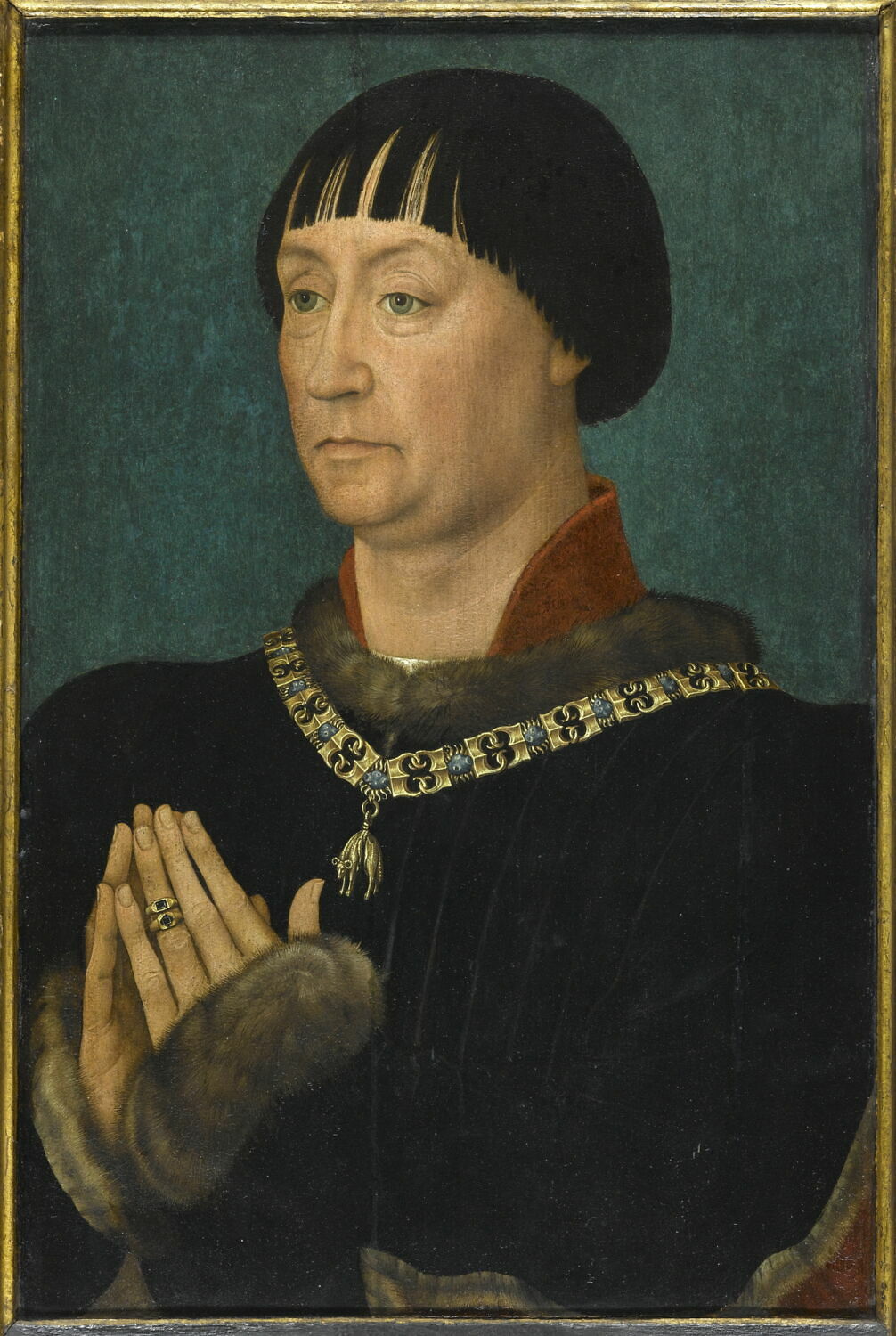
In Brussels he painted portraits of Duke Philip the Good, his son Charles the Bold and his illegitimate son Anthony of Burgundy, Philip I de Croÿ (1460) and Laurent Froimont; there is ample evidence of his prosperity and of the special patronage of the Burgundian court at the height of its power.
2 March 1436
Painter to the town of Brussels
From 2 March 1436 he held the prestigious title of “painter to the town of Brussels” (stadsschilder): the post was created especially for him, was meant to lapse on his death and was tied to a huge commission — four justice scenes for the “Golden Chamber” of the town hall.