 Henri RousseauFrench, 1844–1910
The Dream
May one see it?
Not receiving at present

New York, United States
It belongs to the collection, but is not on display at present.
- Checked
- Source
- The museum
About the painting
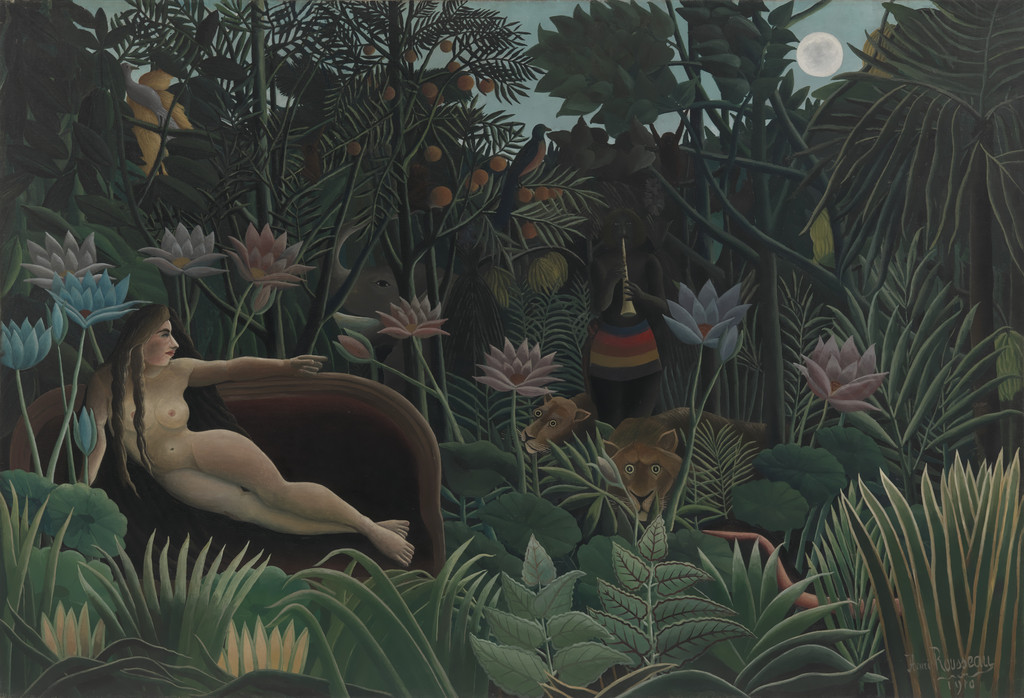
The Dream (French: Le Rêve; occasionally also known as Le Songe or Rêve exotique) is a large oil-on-canvas painting created by Henri Rousseau in 1910, one of more than 25 Rousseau paintings with a jungle theme. His last completed work, it was first exhibited at the Salon des Indépendants from 18 March to 1 May 1910, a few months before his death on 2 September 1910. Rousseau's earlier works had received a negative reception, but poet and critic Guillaume Apollinaire remarked on its debut: "The picture radiates beauty, that is indisputable. I believe nobody will laugh this year."
Read on
The Dream is the largest of the jungle paintings, measuring 6' 8½" × 9' 9½" (204.5 × 298.5 cm). It features an almost surreal portrait of Yadwigha (Jadwiga), Rousseau's Polish mistress from his youth, lying naked on a divan to the left of the painting, gazing over a landscape of lush jungle foliage, including lotus flowers, and animals including birds, monkeys, an elephant, a lion and lioness, and a snake. The stylised forms of the jungle plants are based on Rousseau's observations at the Paris Museum of Natural History and its Jardin des Plantes. The nude's left arm reaches towards the lions and a black snake charmer who faces the viewer playing his flute, barely visible in the gloom of the jungle under the dim light of the full moon. A pink-bellied snake slithers through the undergrowth, its sinuous form reflecting the curves of the woman's hips and leg.
Suspecting that some viewers did not understand the painting, Rousseau wrote a poem to accompany it, Inscription pour Le Rêve:
One possible interpretation of the painting, offered by Rousseau in a letter to art critic André Dupont, is that it depicts a woman reclining on a couch in Paris, dreaming she is listening to a flute player in the jungle.
The subject of a reclining nude draws from a classical tradition, from Titian’s 1538 painting Venus of Urbino to Manet's 1863 painting Olympia. Rousseau may have taken some inspiration from Émile Zola's novel Le Rêve, which deals with the love between a painter and an embroideress. While he was painting The Dream, Rousseau was romantically involved with a shop assistant, Leonie.
French art dealer Ambroise Vollard bought the painting from Rousseau in February 1910. It was sold through Knoedler Galleries in New York to clothing manufacturer and art collector Sidney Janis in January 1934. Janis sold the painting to Nelson A. Rockefeller in 1954, who donated it to the Museum of Modern Art, New York to celebrate the Museum's 25th anniversary. It remains on display at MoMA.
Particulars
- Accession number
- 252.1954
In the catalog
Sources
- The Museum of Modern Art
- Image: The Museum of Modern Art — © the artist or rights holder
Meanwhile, in the life of Henri Rousseau
The whole life1893–1910
A studio in Montparnasse
In 1893 Rousseau moved to a studio in Montparnasse, where he lived and worked until his death in 1910.
1908
Picasso’s banquet in Rousseau’s honour
Picasso came across a Rousseau painting being sold on the street as a canvas to be painted over, instantly recognised his genius and went to meet him; in 1908 he gave a half-serious, half-burlesque banquet for Rousseau in his Bateau-Lavoir studio, attended by Apollinaire, Gertrude Stein, Max Jacob, Marie Laurencin, Juan Gris and others.
March 1910
“The Dream,” his last painting, at the Salon
In March 1910 Rousseau exhibited “The Dream,” his last painting, at the Salon des Indépendants.
March 1910
Phlegmon in the leg
In March 1910, the month “The Dream” was shown, Rousseau developed a phlegmon in his leg.
August 1910
Necker Hospital: gangrene and surgery
In August 1910 Rousseau was admitted to the Necker Hospital in Paris, where his son had died; gangrene was found in his leg. After an operation he died of a blood clot on 2 September.
2 September 1910
Died