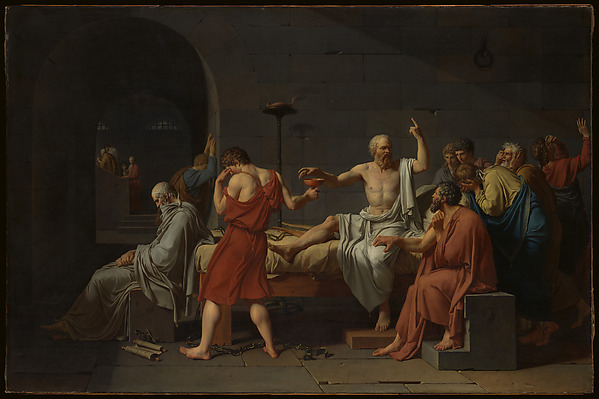
 Jacques-Louis DavidFrench, 1748–1825
The Death of Socrates
May one see it?
Yes, receiving visitors

The Metropolitan Museum of Art
Room634New York, United States
On public display.
- Checked
- 4 hours ago
- In this state since
- Sep 26, 2026
- Source
- The museum's own collection data
About the painting
The Death of Socrates (French: La Mort de Socrate) is an oil on canvas painted by French painter Jacques-Louis David in 1787. The painting was part of the neoclassical style, popular in the 1780s, that depicted subjects from the Classical age, in this case the story of the execution of Socrates as told by Plato in his Phaedo. In this story, Socrates has been convicted of corrupting the youth of Athens and introducing strange gods, and has been sentenced to die by drinking poison hemlock. Socrates uses his death as a final lesson for his pupils rather than fleeing when the opportunity arises, and faces it calmly. The Phaedo depicts the death of Socrates and is also Plato's fourth and last dialogue to detail the philosopher's final days, which is also detailed in Euthyphro, Apology, and Crito.
Particulars
- Accession number
- 31.45
What it shows
Sources
- The Metropolitan Museum of Art: the museum's own open data · fetched 4 days ago
- Image: The Metropolitan Museum of Art — Open Access (CC0)
Meanwhile, in the life of Jacques-Louis David
The whole lifefrom 1786
The Trudaine circle: liberal aristocrats
From 1786 he moved in liberal aristocratic circles; in the Society of the Trudaines he met Chénier, Bailly and Condorcet, and the future leaders of the Revolution Barère, Barnave and Alexandre de Lameth.
26 October 1786
Daughter born: Pauline Jeanne David
1787
The Salon of 1787: “The Death of Socrates”
Critics compared the painting with Michelangelo’s Sistine Ceiling and Raphael’s Stanze, and one, after ten visits to the Salon, called it perfect in every sense. David received no royal “work of encouragement” for it.
1789
The Salon of 1789: the scandal over “Brutus”
An attempt by the Royal Buildings administration to keep the picture out of the Salon caused an outcry, and the royal family had to give way; during the exhibition students guarded the canvas.
September 1789
Heads the “commune of the arts”
With Jean-Bernard Restout he headed the “commune of the arts,” which grew out of the “dissident academicians” movement to reform the Royal Academy; it called for an end to the Academy’s privileges and for unlicensed artists to be allowed to exhibit.
5 May 1789 – 9 November 1799
Took part in: French Revolution