Francisco de ZurbaránSpanish, 1598–1664
Crucifixion of Christ
The Crucifixion
May one see it?
Not receiving at present

Art Institute of Chicago
Chicago, United States
It belongs to the collection, but is not on display at present.
- Checked
- 4 hours ago
- In this state since
- Sep 28, 2026
- Source
- The museum's own collection data
About the painting
Christ on the Cross is a 1627 oil painting on canvas by the Spanish painter Francisco de Zurbarán, now in the Art Institute of Chicago.
In 1626 Zurbarán signed a new contract with the Dominicans of San Pablo de Real Monastery in Seville to produce 21 paintings in 8 months. One of these was Christ on the Cross, which was so admired by the artist's contemporaries that Seville's city council suggested he moved there permanently in 1629.
As in Diego Velázquez's 1632 Christ Crucified, the artist shows Christ's two feet nailed separately – the number of nails used to crucify Christ was then a matter of controversy, with Bridget of Sweden writing of four nails. Both works also draw on a Counter Reformation trend after the Council of Trent to depictions focusing solely on Christ rather than those gathered around the cross.
Particulars
- Accession number
- 1954.15
What it shows
In the catalog
Sources
- Art Institute of Chicago: the museum's own open data · fetched 4 days ago
- Image: Art Institute of Chicago — CC0
Meanwhile, in the life of Francisco de Zurbarán
The whole life1614–1658 · Workplace
Seville
1625
A second marriage: the wealthy widow Beatriz de Morales
In 1625 Zurbarán marries again, to the wealthy widow Beatriz de Morales.
17 January 1626
The Dominican contract: 21 paintings in eight months
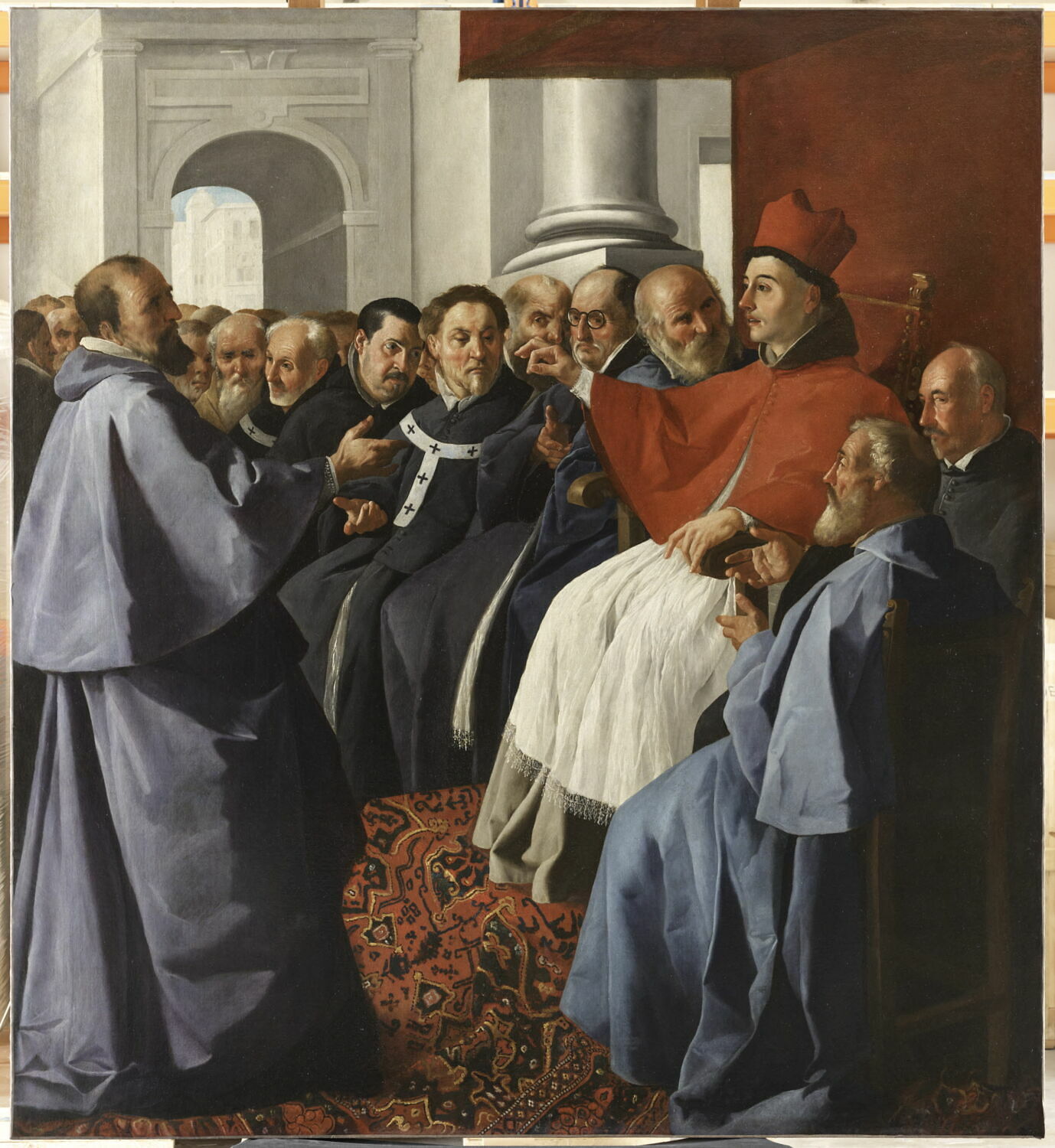
On 17 January 1626 Zurbarán signs a contract with the prior of the Dominican monastery of San Pablo el Real in Seville, agreeing to produce 21 paintings within eight months: fourteen depict the life of Saint Dominic, the others Saint Bonaventura, Saint Thomas Aquinas and the four Doctors of the Church. The commission establishes him as a painter.
29 August 1628
The Mercedarians commission 22 paintings for their monastery
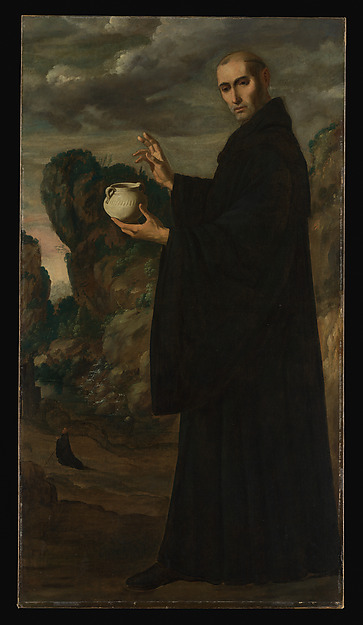
On 29 August 1628 the Mercedarians of Seville commission Zurbarán to produce 22 paintings for their monastery. Between 1628 and 1630 he paints a cycle on Saint Peter Nolasco and a cycle on the life of Saint Bonaventura.
1629
Invited to move to Seville
In 1629 the Elders of Seville, whose city stands to gain from his growing reputation, invite Zurbarán to relocate there permanently. He accepts and moves with his wife Beatriz de Morales, the three children of his first marriage, a relative called Isabel de Zurbarán and eight servants.