 André DerainFrench, 1880–1954
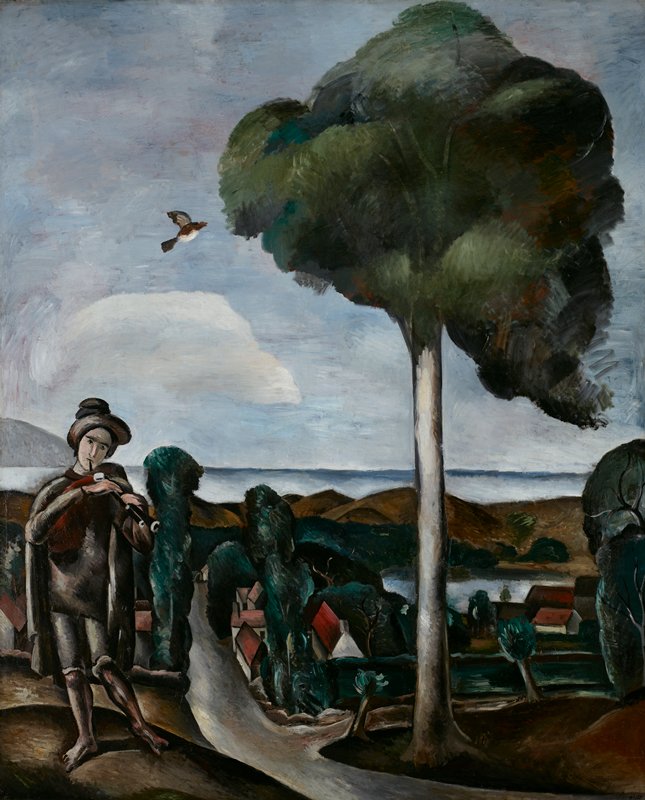
The Bagpiper
Can I see it?
Yes, on view now
Where is “The Bagpiper” now? Minneapolis Institute of Art, G371, Minneapolis. Yes, on view now. Checked November 23, 2026.

Minneapolis, United States
Open now· until 5:00 PM
On public display.
- Checked
- In this state since
- Source
- The museum
About the painting
André Derain painted The Bagpiper in 1910–11; it is in the Minneapolis Institute of Art, Minneapolis. Colour, handling and composition owe much to Cézanne, while the pastoral subject recalls Titian and Claude Lorrain's scenes with shepherds and musicians. Derain had grown dissatisfied with Fauvism and Cubism, feeling that technical concerns displaced subject matter. His turn towards older painting helped shape this lyrical, romantic work, which became widely known before the war. Its large format continues that older tradition. The painting is exhibited in gallery G371.
In the museum's words
Although Derain had helped found Fauvism and had been an early adherent of Cubism, he increasingly fell away from both aesthetics, feeling their obsession with technique had supplanted the content of their work. Derain, instead, began to turn toward the Old Masters, even as he kept pace with the spirit of his own time. Thus, while The Bagpiper at Camiers owes much to Cézanne in color, brushwork and composition, a great debt to the Old Masters is also evident, especially the arcadian scenes peopled with shepherds and musicians by Titian, and Derain's countryman, Claude Lorrain. The Bagpiper at Camiers became one of Derain's best known pre-war pictures and its lyrical and romantic feeling established him as an artist in the grand tradition of large formats and timeless subjects.
Minneapolis Institute of Art
Details
- Accession number
- 61.36.10
In the catalog
Sources
- Minneapolis Institute of Art
- Image: Minneapolis Institute of Art — public domain
In the life of André Derain
The whole life1909
Woodcuts for Apollinaire's First Book
He made woodcuts in a primitivist style for the edition of Guillaume Apollinaire's first prose book, The Rotting Magician (L'enchanteur pourrissant).
1910
Exhibition of the Neue Künstlervereinigung in Munich
He showed works at the exhibition of the Neue Künstlervereinigung in Munich.
1912
Participation in the Blaue Reiter Exhibition
He exhibited at the show of the secessionist group Der Blaue Reiter; in the same year he illustrated a collection of poems by Max Jacob.
1913
Participation in the Armory Show in New York
He took part in the epoch-making Armory Show in New York.