 Nicolas PoussinFrench, 1594–1665
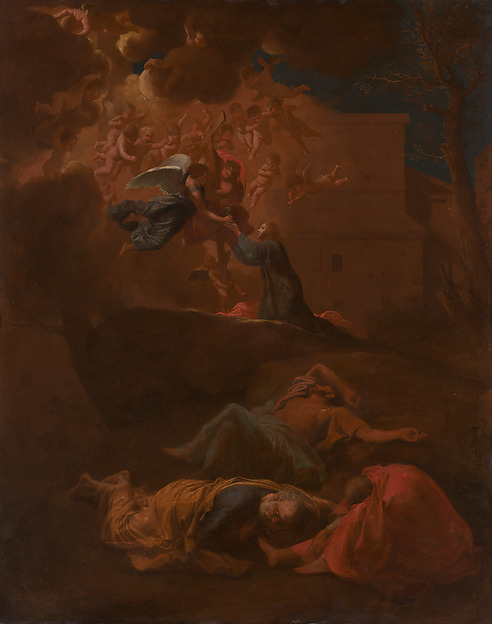
The Agony in the Garden
May one see it?
Yes, receiving visitors

The Metropolitan Museum of Art
Room623New York, United States
On public display.
- Checked
- 5 hours ago
- In this state since
- Sep 26, 2026
- Source
- The museum's own collection data
Particulars
- Accession number
- 2021.378
What it shows
Sources
- The Metropolitan Museum of Art: the museum's own open data · fetched 4 days ago
- Image: The Metropolitan Museum of Art — Open Access (CC0)
Meanwhile, in the life of Nicolas Poussin
The whole life1620s
The Cavaliere Marino takes the painter under his wing
Poussin’s work caught the attention of the Italian poet Cavaliere Marino, then living in France; his patronage let the thirty-year-old painter work in peace. According to Bellori the poet took him into his house and helped him with the invention of subjects and the rendering of emotion, and in Marino’s house Poussin gained access to a library with treatises by Alberti and Dürer and manuscripts and drawings by Leonardo.
spring 1624
Spring 1624: Poussin arrives in Rome
According to Bellori Poussin settled in Rome in the spring of 1624 (other accounts say he first visited Venice); the lists of the church of San Lorenzo in Lucina name him from March 1624 among twenty-two people, mostly French artists, living in the house of Simon Vouet. He studied Raphael, while Caravaggio, whose literal materiality repelled him, he held to have come “to destroy painting”.
1624–1626
First years in Rome: no patrons, in want
Marino, who had recommended him to Cardinal Francesco Barberini, left for Naples and died there, and the cardinal himself was sent as legate to Spain in 1625 with Cassiano dal Pozzo; the Marquis Sacchetti showed no interest. Poussin was badly wounded in a street brawl, possibly caught syphilis and refused to enter a hospital, and, according to Félibien, had to sell two battle canvases for seven écus each and a figure of a prophet for eight.
1624–1640
Domenichino’s academy, anatomy, measuring ancient statues
He resumed his study of anatomy with the surgeon Larchet, drew models at Domenichino’s academy, worked in the open air and measured ancient statues — on the back of the drawing “The Victory of Joshua” survive his measurements of the Apollo Belvedere; unlike many, he did not “restore” the lost fragments of antiques. In his Roman years he began to learn modelling, made wax models, arranged them in the order he wanted on a board, and copied Titian’s “Bacchanal” — in oil and as a bas-relief together with one of the Duquesnoy brothers.
1626
Friends in Rome: Claude Lorrain, Stella, the Duquesnoy brothers
In 1626 Pierre Mellin and the brothers François and Jérôme Duquesnoy lodged in his studio; he was close to Claude Lorrain and kept company with Jacques Stella and Jean Lemaire. The circle was united by a pull towards classical antiquity; despite all his disagreements with French painters, it was this milieu that helped Poussin keep his national roots.
1626
Poussin’s name first appears in Cardinal Barberini’s books
In 1626 Cardinal Francesco Barberini’s account books for the first time record a fee paid to Poussin — for the painting “The Destruction of Jerusalem”; it has not survived, but in 1638 the artist repeated the canvas, now in Vienna.