 Edward SteichenAmerican, 1879–1973
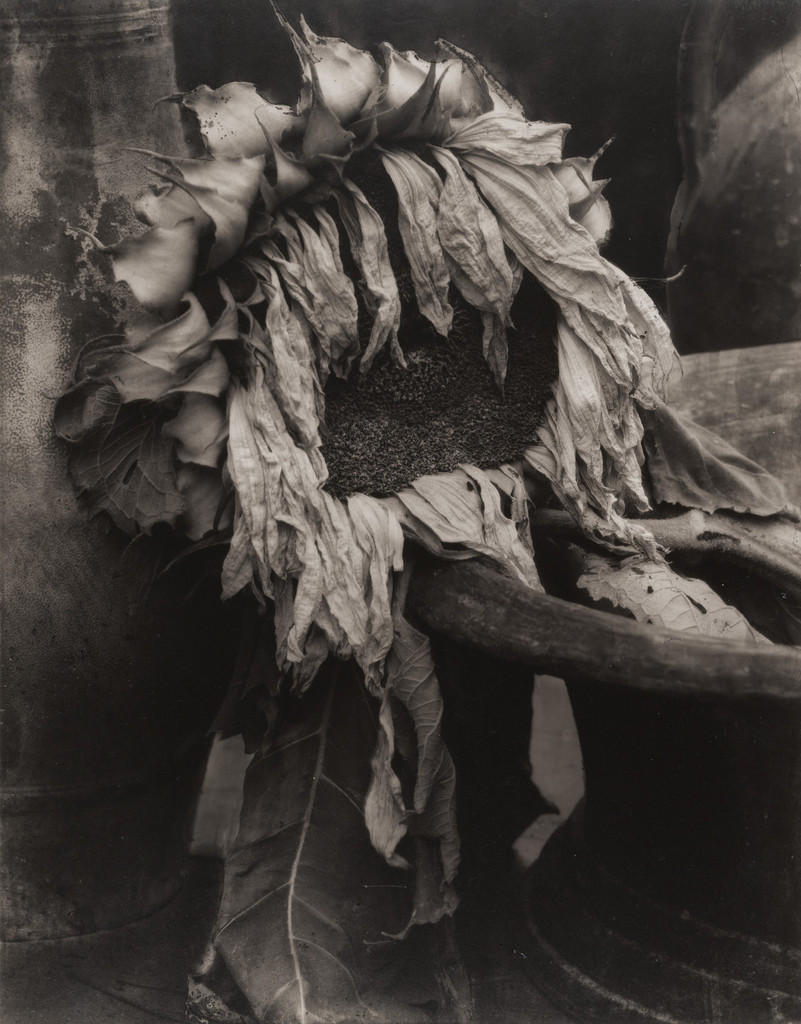
Sunflowers from Seed to Seed
May one see it?
Not receiving at present

New York, United States
It belongs to the collection, but is not on display at present.
- Checked
- Source
- The museum
Particulars
- Accession number
- 238.1961
In the catalog
Sources
- The Museum of Modern Art
- Image: The Museum of Modern Art — © the artist or rights holder
Meanwhile, in the life of Edward Steichen
The whole lifeduring the First World War
Aerial photography in the US Army in the First World War
Serving in the US Army, he commands the photographic division of the American Expeditionary Forces and teaches recruits the basics of aerial photography, emerging from the war an Army Colonel. The war pushes him towards uncompromising realism, and afterwards he gradually reverts to straight photography.
1923
Chief photographer of Condé Nast
Condé Nast hires him at an extraordinary salary of $35,000; until 1938 he is chief photographer of Vogue and Vanity Fair, and is called the “greatest living portrait photographer.” He also works for advertising agencies, including J. Walter Thompson, and in these years is regarded as the most popular and highest-paid photographer in the world.
January 1942
Head of the Naval Aviation Photographic Unit
Refused for active service because of his age, he is invited by the Navy to direct the Naval Aviation Photographic Unit and is commissioned a Lieutenant-Commander. For the unit he picks six officer-photographers, among them Wayne Miller and Charles Fenno Jacobs, irreverently known as “Steichen’s chickens.”
1947
Director of Photography at MoMA
On the strength of the attendance at his propaganda exhibitions Road to Victory and Power in the Pacific, he is appointed Director of Photography at the Museum of Modern Art, a post he holds until 1962; Beaumont Newhall resigns along with most of his staff. The appointment is protested by those who see him as anti-art photography: his own style seemed too commercial and popular.
28 March – 30 May 1961
The retrospective “Steichen the Photographer”
Steichen’s only solo show during his years at the museum, the retrospective Steichen the Photographer, takes place only after he has announced his retirement; it is organised by Grace M. Mayer.
1 July 1962
His successor: John Szarkowski
He hires John Szarkowski as his successor as director of photography (other accounts have Steichen leaving as early as 1961); Szarkowski promotes Grace M. Mayer to Curator. The culmination of his tenure is The Family of Man (1955): more than 500 photographs of life, love and death in 68 countries, with a prologue to the catalogue by Steichen’s brother-in-law Carl Sandburg; nine million people saw it, still a record for a photography exhibition, and at Steichen’s wish it was donated to Luxembourg, his country of birth.