Edward RuschaAmerican, 1937
Standard—Figueroa St.
May one see it?
Not receiving at present

Chicago, United States
It belongs to the collection, but is not on display at present.
- Checked
- In this state since
- Source
- The museum
About the work
Ed Ruscha radically changed the basis for art with his photobooks, the earliest of which appeared in 1963 with the matter-of-fact title Twentysix Gasoline Stations. Photographed on Route 66 between Los Angeles, where Ruscha still lives and works, and his hometown of Oklahoma City, the book heralded fundamentally influential turns in contemporary art: to vernacular corporate architecture and the branding of public space; to critical and creative possibilities found on the interstate highway; and to the impersonal, banal, and random as sources of inspiration. Ruscha interspersed pictures of industry giants such as Standard, Shell, or Texaco with others of mom-and-pop stations.
Read on
He never showed the photographs but instead presented the coolly designed books (eighteen in all, recently acquired by the Art Institute along with a selection of the original photographs) in galleries, where the asking price of a few dollars apiece confounded purchasers of his paintings and drawings; and at bookstores, where they failed equally to attract buyers for many years. Yet, by equating an artist’s book with a dime novel, Ruscha achieved his desire to “be the Henry Ford of book making.”
Art Institute of ChicagoCC BY 4.0
Particulars
- Accession number
- 2012.118
In the catalog
Sources
- Art Institute of Chicago
- Image: Art Institute of Chicago — © the artist or rights holder
Meanwhile, in the life of Edward Ruscha
The whole life1956–1960
Chouinard: Irwin, Woelffer and the journal Orb
At the Chouinard Art Institute (now the California Institute of the Arts) he studies under Robert Irwin and Emerson Woelffer; in 1959–1960, together with Joe Goode, Woelffer, Stephan von Huene, Jerry McMillan and others, he edits and produces the journal Orb, one of the first recorded alternative newspapers in the US.
1961
Seven months in Europe with his mother and brother
He travels through Europe for seven months with his mother and brother, coming upon more works by Johns and Rauschenberg, R. A. Bertelli's “Head of Mussolini” and “Ophelia” by Sir John Everett Millais. The photographs from this trip mark the start of his photography.
1962
“New Painting of Common Objects” in Pasadena
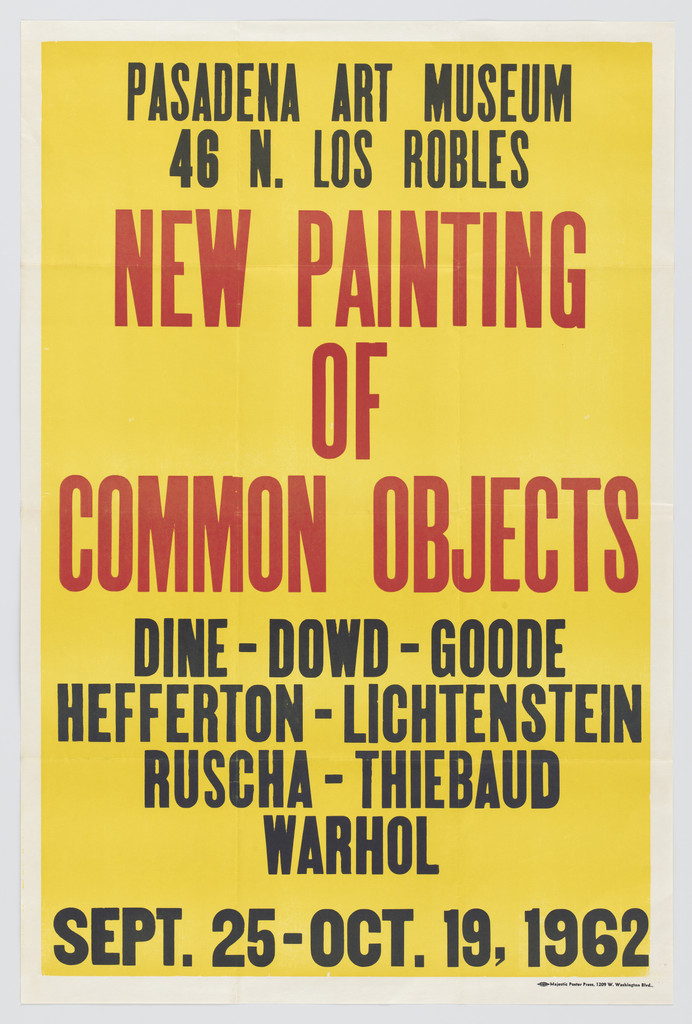
Ruscha takes part, with Roy Lichtenstein, Andy Warhol, Robert Dowd, Phillip Hefferton, Joe Goode, Jim Dine and Wayne Thiebaud, in “New Painting of Common Objects” at the Pasadena Art Museum, curated by Walter Hopps. It is regarded as one of the first Pop Art exhibitions in America.
1963
“Twentysix Gasoline Stations” is published
The first of sixteen small artist's books produced between 1962 and 1978; the photographic books present precisely what their titles describe.
1963
First solo exhibition at Ferus Gallery
His first solo exhibition takes place at the Ferus Gallery in Los Angeles, around which a group of artists has gathered, among them Robert Irwin, John Altoon, John McCracken, Larry Bell, Ken Price and Edward Kienholz.